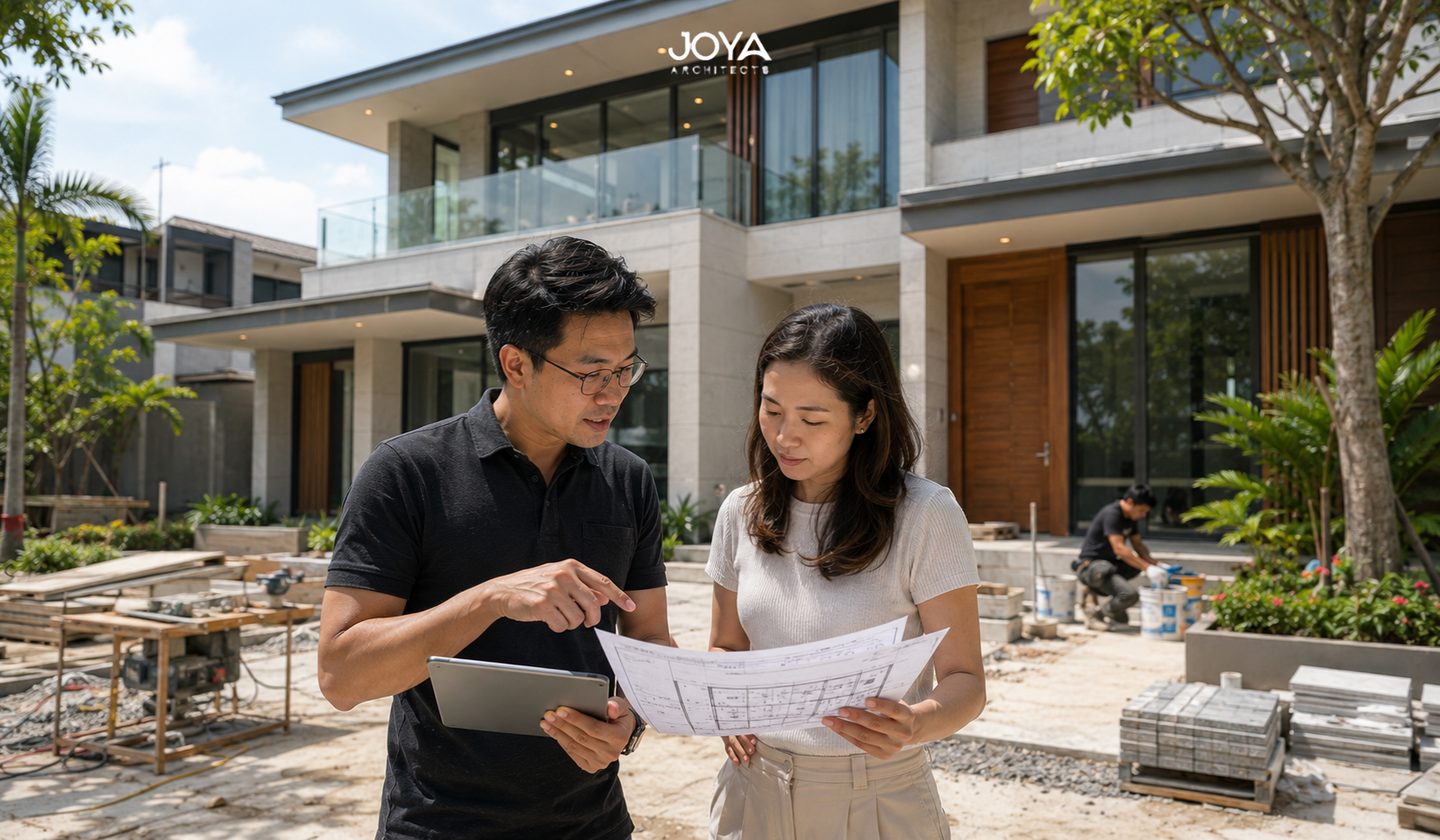
A couple in Siglap spent eleven months watching their landed house go up. By the end, they rarely visited the site. Not because they didn’t care about the home. They’d spent two years imagining it. Going back felt pointless because every visit ended with something they hadn’t expected: a material they didn’t recognise, a contractor question they weren’t sure how to answer, a budget figure that left them less certain than before. The home at handover was good. But the process had worn them down completely.
A different couple in Holland Village described their build as one of the most engaging projects of their lives. Same duration. Similar budget. Completely different experience. When asked what made the difference, neither pointed to a specific moment or decision. Both pointed to how the project was structured from the very beginning.
Stress in a Singapore landed house built isn’t random. It has specific causes. And most of them can be addressed long before construction starts.
Why the Process Feels Overwhelming, and What Actually Causes It
The reputation is real. Ask homeowners who have been through a Singapore landed house project, and the word “stress” comes up fast. But stress isn’t one thing. It usually comes from a few specific dynamics, and understanding them is the first step toward avoiding them.
Decision overload is the most common. A new erection involves thousands of decisions. From the spatial layout down to door handle specifications. Without a process that stages those decisions in the right order, homeowners get confronted with everything at once: approving tile samples while the structural drawings are still incomplete, choosing hardware before the room layout is confirmed. Decisions made under that kind of pressure are almost always the ones homeowners later regret.
Expectation gaps compound the problem. Homeowners who start a project without a clear picture of how the process works are repeatedly surprised by its demands. Design development takes four to six months, minimum. BCA submission and approval add several more. Variations accumulate even on well-managed projects. Each of these surprises, predictable as they are to an experienced architect, erodes the homeowner’s confidence and trust.
Communication friction does the rest. When the architect and homeowner aren’t communicating clearly, when concerns aren’t raised until they’ve been sitting for weeks, unresolved tension accumulates. Over a twelve-to-eighteen-month build, that tension becomes exhausting. None of these dynamics is inevitable. They’re all the result of a process that wasn’t structured to prevent them.
Plan Your Home with Experienced Architects
Why Resolving the Design First Is the Most Powerful Thing a Homeowner Can Do
The single most reliable way to reduce construction-phase stress is to finish the design before the contractor arrives on site.
This sounds obvious. It isn’t universally practised. Many Singapore landed house projects begin construction while the design is still being worked out, materials are unselected, and details are unspecified. The contractor starts while the architect finishes. That sequence produces exactly the rushed, pressure-driven decisions that make builds feel overwhelming.
Resolving those decisions before they reach the site isn’t just good practice. It’s the single biggest contributor to a calm construction experience.
A fully resolved design means every material selection is made before the first slab is poured. Every junction is worked out on paper. The contract sum reflects the complete scope of what will be built. Not an estimate to be refined later on site.
Two extra months in design development cost relatively little. Resolving design questions during active construction costs much more, in money, in time, and in the quality of the decisions themselves. Patience in the early phases pays dividends in the build. Homeowners who understand
what each architectural design stage actually involves tend to make that investment more willingly.
Why a Single Trusted Architect Changes the Whole Experience
Projects that feel manageable almost always share one feature: a single architect who is personally accountable from the first brief to handover.
This matters more than it might appear. When construction supervision is handled by a different team from the one that designed the home, continuity of understanding breaks down. The person on site making judgment calls is working from documents rather than from the design itself. Their answers to field questions are less accurate, whereas the original designer holds that understanding without needing to be briefed. And the homeowner has to rebuild trust with a new professional relationship mid-project, at the most demanding point of the build.
A principal architect who stays present throughout changes both the quality of the outcome and the quality of the experience.
What that kind of practice looks like in Singapore is worth understanding before you appoint anyone. The question of who specifically will be on site, and how often, is one of the most important questions a homeowner can ask.
There’s a subtler benefit, too. A homeowner with a genuine relationship with a single accountable architect can let go of the anxiety that comes from monitoring a complex project. That letting go, though it sounds simple, is part of what makes the whole experience feel different.

How Decision Staging Prevents Overload
One of the most underrated skills in residential architecture is sequencing. Getting decisions in the right order. Giving homeowners the right information at the right moment.
Done well, this is almost invisible. Material selection happens room by room, over structured sessions, with curated options that fit the design direction already established. Hardware and joinery decisions come after the spatial layout is confirmed. External works and landscape staging happen after the building envelope is locked. Each decision builds naturally on the last.
Done badly, the breadth feels like urgency. Homeowners are asked to select everything simultaneously. Finishes for rooms that haven’t been fully designed. Specifications for systems they don’t yet understand. That kind of overload isn’t an accident. It’s what happens when the architect doesn’t have a clear structure for the process.
A well-structured landed house design process stages these decisions deliberately. Homeowners who go through that experience usually describe it as one of the more satisfying parts of the whole project.
Worth asking upfront: how does your architect stage client decisions through the design process? The answer tells you whether they have a structure or not.
Budget Transparency as a Condition for Calm
Budget anxiety is one of the most persistent sources of stress in Singapore landed home builds. Not because budgets always blow out. Yet many homeowners don’t have a clear picture of where their budget stands at any given point in the project.
The first question most homeowners ask when they arrive on site is whether they’re on budget. If the answer requires a lengthy conversation or shifts significantly from one visit to the next, the budget isn’t being managed transparently enough.
Transparent management means the homeowner always knows the approved contract sum, the value of all variations to date, the remaining contingency, and a likely final account estimate. Updated monthly. That information turns budget management from a source of anxiety into a monitoring exercise.
Avoiding budget overruns through architectural planning comes down largely to keeping that picture clear throughout the build, not just at the beginning and end.
The contingency is the deciding factor. A homeowner who has ring-fenced genuine contingency and kept it untouched through the first six months manages variations as routine. One who spent it on finishing upgrades in month three manages the same variations as emergencies. Same project. Completely different experience.
Speak with Our Architects Today
Frequently Asked Questions
Is a stress-free Singapore home build actually realistic?
Completely stress-free is probably not the right expectation. The project is long and complex, and there will be moments of challenge. But the difference between a stressful build and a manageable one is real and well understood. Homeowners in projects with a resolved design, a trusted single architect, and transparent communication consistently describe the experience as manageable. Often rewarding.
How early should I engage an architect for a Singapore landed house project?
Twelve to eighteen months before your intended construction start is the right range. That allows adequate time for brief development, schematic design, design development, and construction documentation without the time pressure that forces shortcuts.
When to engage an architect for a landed house project is one of the most consequential timing decisions a homeowner makes. Compressed design timelines are one of the most reliable predictors of construction-phase stress.
What is the single most important thing a homeowner can do to reduce building stress?
Commit fully to the design before construction begins. Homeowners who carry design uncertainty into the construction phase carry it through every site visit. The investment in a thorough, unhurried design process is the most effective stress prevention available.
What does “principal-led” mean in practical terms during a build?
It means the architect who designed your home is also the person visiting the site, reviewing quality milestones, approving material samples, and signing off on Architect’s Instructions. Not a project architect working from documents. The person who holds the full design intent, from the first sketch to the final inspection.
Where can I find practical guidance on managing the build process day to day?
The specific protocols for communication, site visits, contractor management, and budget tracking are covered in detail in
how to reduce building stress in a complex Singapore landed house project. This article covers the conditions. That one covers the practices.
Building a landed home in Singapore is one of the most demanding things a family will take on. It doesn’t have to be defined by stress. With the right structure, the right professional, and enough time given to the design, it can be what it should be: a process of watching something you imagined become real.