Joya Architects » Blogs » Principal-Led Architect in Singapore: What It Means and Whether It’s Right for Your Landed Home
Architectural Process Guides
Principal-Led Architect in Singapore: What It Means and Whether It’s Right for Your Landed Home
By achmad
2026-07-03 10:03:31
The term “principal-led” is used by a growing number of architectural practices in Singapore as a quality signal, a way of distinguishing themselves from larger firms where projects are managed by teams rather than founders. But what does principal-led architecture actually mean in practice? And for a homeowner planning a landed house project, why should the distinction matter?This article explains the principal-led practice model in the context of Singapore architectural services, describes its specific advantages for private landed residential projects, and provides a framework for evaluating whether a practice is genuinely principal-led or using the term aspirationally.
What “Principal-Led” Means in Architectural Practice
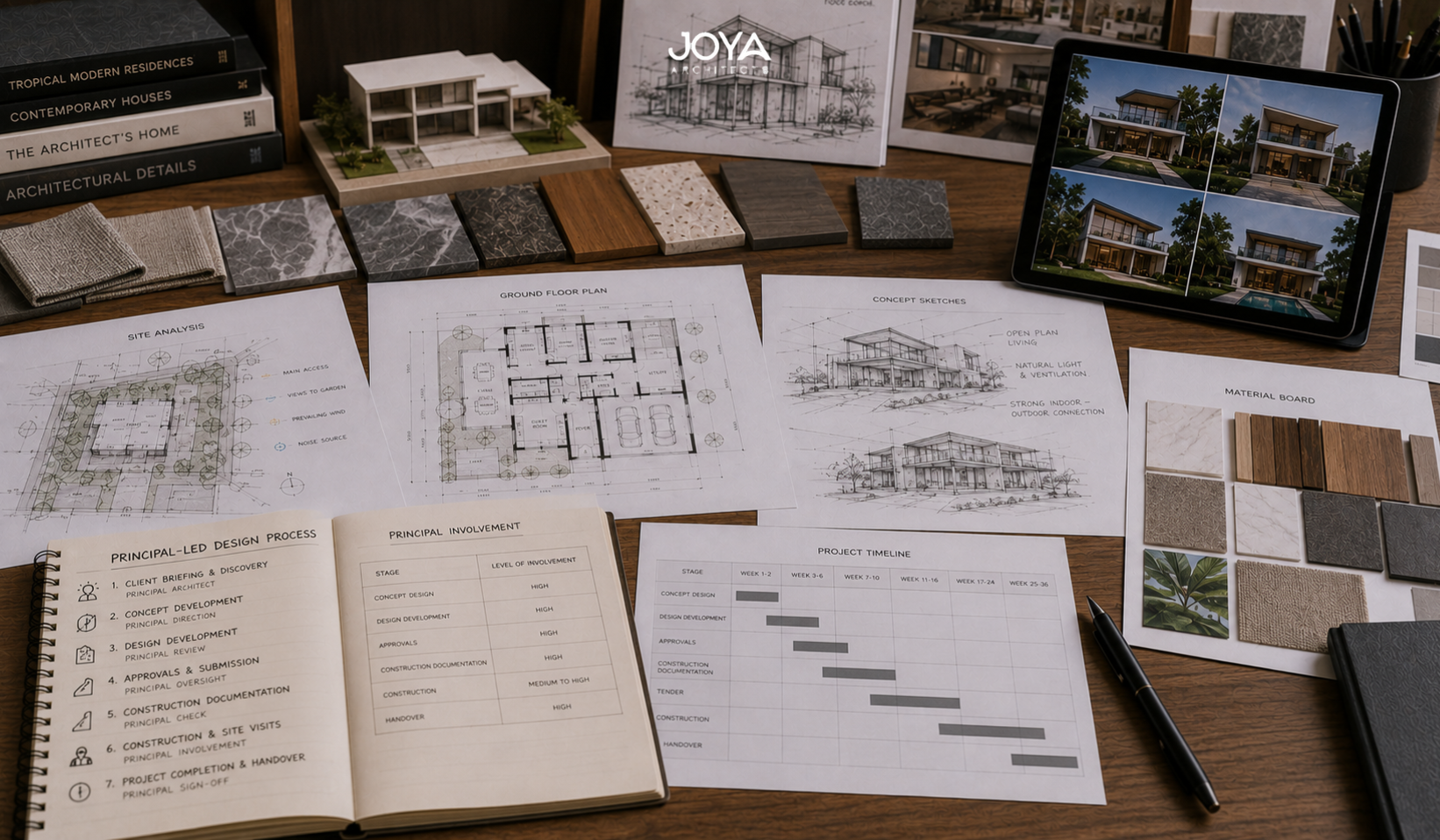
In an architectural practice, the principal is the founding architect, the person whose registration, reputation, and design philosophy define the firm’s identity. In a principal-led practice, this architect is personally involved in every project at every significant stage: initial client consultation, brief development, schematic design, design development, construction documentation, authority submissions, and construction supervision.This is the operational model that characterised most architectural practice before the profession scaled into large commercial entities. A client who engaged a principal-led architect knew they were engaging the most qualified person in the room, someone whose professional reputation depended directly on the quality of the outcome.In a principal-led practice, there is no layer of project management or delegation between the homeowner’s brief and the design intelligence applied to it.
How Principal-Led Differs from Team-Led Practice
In a team-led architectural firm, the principal (or partner, or director) sets a design direction in the early stages and attends key milestones, while a project architect manages the day-to-day process: leading consultant meetings, developing the detailed design, producing construction documents, and coordinating construction administration.This model allows a firm to manage multiple large and complex projects simultaneously, a necessary condition for commercial architectural practice at scale. But it has a structural consequence for private landed residential work: the person who understood the homeowner’s brief most deeply, who developed the initial design concept with the client in mind, is not the person resolving the technical and design issues that arise through construction.The project architect who manages construction administration is working from drawings and notes, not from the embedded understanding of design rationale that the principal architect developed through the briefing and concept design process. When a field decision is required, a construction deviation, a material substitution, an unforeseen structural condition, the quality of that decision depends on how well the project architect understands what the design was trying to achieve. In a principal-led practice, the person making that decision is the person who made the original design decision.
Why Principal-Led Matters Specifically for Singapore Landed Homes
Landed house projects in Singapore are characterised by a specific set of conditions that make principal-led involvement particularly valuable:
Long project duration, a new erection or reconstruction in Singapore typically spans 18 to 36 months from first brief to construction completion. Maintaining design coherence over this period requires a single authoritative design intelligence to remain engaged throughout.
Complex regulatory environment, URA’s landed housing planning parameters, BCA’s technical requirements, SCDF’s fire safety standards, and the various approvals required for specific works are best navigated by an architect with extensive personal experience of Singapore’s regulatory landscape, not by a junior team member working from guidelines.
High stakes decisions, a landed home represents, for most Singapore families, their largest single lifetime investment. The design decisions made during this project are irreversible and will be lived with for decades. These decisions deserve the most experienced professional judgment available.
Design intent preservation, the spatial and material qualities that distinguish an exceptional landed home from a merely functional one are precisely the qualities most vulnerable to erosion during construction. A principal architect who attends site regularly and understands the design intent from its inception is the most reliable guardian of those qualities.
How to Verify Whether a Practice Is Genuinely Principal-Led
Not every firm that describes itself as principal-led is operating this model in the way the term implies. These questions help verify:
Will the principal architect personally attend my first consultation and all subsequent design review meetings?
Who will produce the schematic design? Will it be the principal, or will a design team produce concepts for the principal to review?
Who will attend construction site meetings? Will the principal architect be present at key construction milestones?
How many projects is the practice currently managing? A practice with more projects than the principal can personally supervise is not fully principal-led in operational terms, regardless of the description.
Genuine principal-led practices answer these questions with specificity and consistency. The principal is not a figurehead, they are the architect.
Joya Architects: A Principal-Led Practice for Singapore Landed Homes
Joya Architects operates as a principal-led practice with a specific focus on Singapore’s private landed residential market. Every project, from the initial briefing conversation to construction handover, involves the principal architect’s direct participation. This continuity of design intelligence is the foundation of the firm’s ability to deliver homes where the design intent survives the full journey from concept to built reality.The firm’s name reflects its founding philosophy: that the experience of building a home should be a process of joy, achieved through clarity of design, quality of craft, and a client-architect relationship built on genuine trust and sustained engagement.Explore Joya Architects’ principal-led approach to Singapore landed house design at joyaarchitects.com/architectural-design-services.
Frequently Asked Questions
Does a principal-led practice charge more than a team-led firm?
Principal-led practices vary widely in their fee structures. Some command a premium reflecting the principal’s seniority and the quality of their portfolio. Others, particularly smaller boutique practices with lower overhead, price competitively with larger team-led firms. Compare scope and outcomes, not just fee levels.
Can a principal-led architect manage a large or complex landed house project?
Yes. Principal-led practices manage complex new erections, GCB reconstructions, and large-scale A&A works regularly. The key is that the practice’s project volume is calibrated to allow genuine principal involvement on every project, not that the principal works alone without consultant support.
How do I find a principal-led architect in Singapore?
BOA Singapore’s register includes all registered architects in Singapore. The most reliable method is to review portfolios and conduct consultations, asking directly about the principal’s involvement in project management and construction supervision. Homeowner references from recently completed projects are the most reliable evidence of how the practice actually operates.
Conclusion
For Singapore homeowners undertaking a landed house project, the principal-led model is not a marketing preference, it is a meaningful quality differentiator. The continuity of design intelligence from brief to building that a genuinely principal-led practice provides is the most reliable protection against the design compromises, construction deviations, and post-completion regrets that characterise projects where design intent is managed at arm’s length.