




Choosing an architect for a landed house in Singapore is not a stylistic decision. It is a structural, regulatory, and long-term asset decision.
For many homeowners at the bottom-of-funnel stage, the question is no longer whether to engage an architect. It becomes more precise: how to choose an architect for landed house projects that align with your property type, site conditions, and long-term vision?
A terrace reconstruction differs fundamentally from a corner semi-detached home. A good class bungalow carries planning sensitivities that a narrow inter-terrace plot does not. Elevation articulation, envelope control, and structural spans vary significantly between typologies.
The architect you select becomes the translator between land constraints, URA envelope controls, structural feasibility, spatial aspiration, and generational value.
This guide explores how to select the right architect based on landed house type, through experience & specialization, regulatory knowledge, design alignment, service scope, budget clarity, and communication strategy.
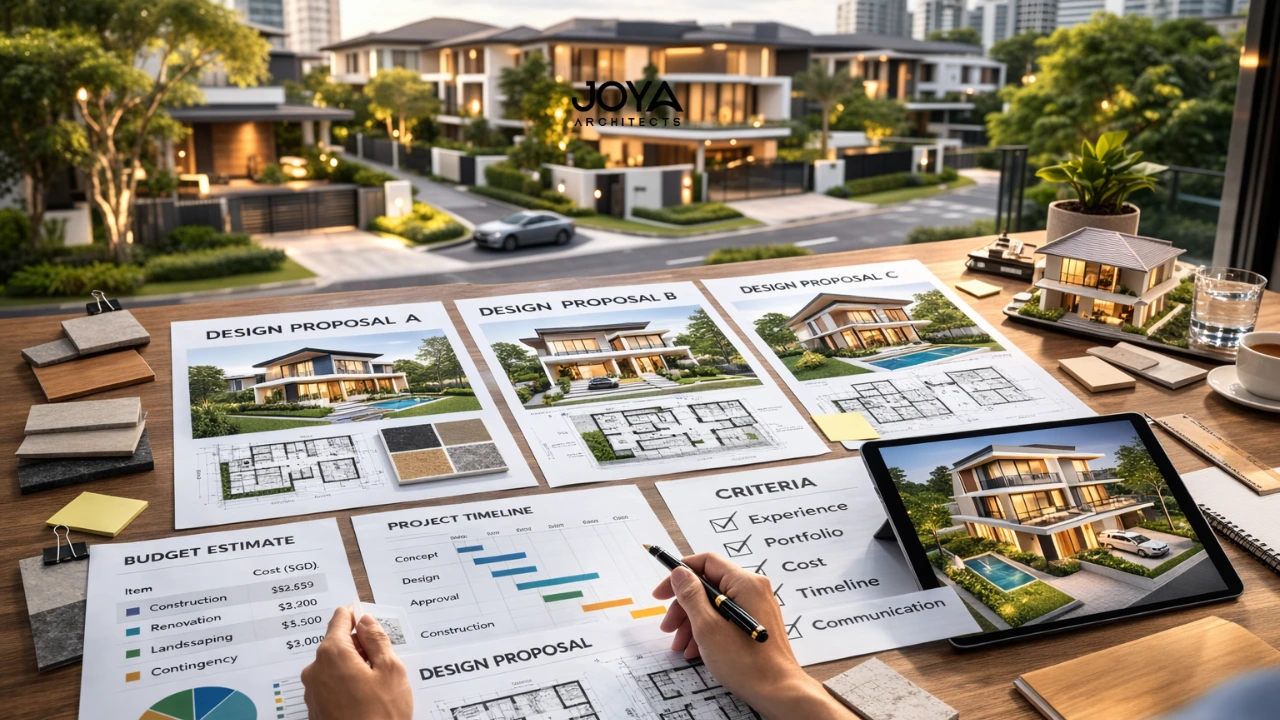
Not all residential architects are equally positioned for every landed house type.
A semi-detached reconstruction on a corner lot demands different massing sensitivity compared to a mid-terrace rebuild where privacy, light wells, and vertical stacking dominate design strategy.
When assessing experience & specialization, examine whether the architect has:
For example, a homeowner rebuilding a 6-metre frontage terrace often prioritizes spatial expansion through vertical layering and daylight penetration. This requires refined understanding of architectural planning room layouts, particularly in narrow plots where circulation efficiency and structural cores become decisive.
By contrast, a detached house client may be evaluating façade articulation and landscape integration, similar to broader modern home exterior design ideas, where the architect must coordinate setback articulation and massing modulation.
From a structural standpoint, landed houses frequently involve:
A homeowner may initially focus on aesthetics, but the deeper question is whether the architect understands structural sequencing and long-term building performance.
Selecting based on portfolio appearance alone overlooks this architectural depth.
Design alignment is not about whether you like an architect’s Instagram feed.
It concerns whether the architect’s spatial philosophy aligns with how you intend to live.
Some architects specialise in highly minimalist architecture features, where restraint, proportion, and natural light dominate. Others work with layered material palettes or hybrid contemporary forms.
A homeowner considering a knockdown rebuild often arrives with reference images, perhaps drawn from minimalist living concepts or refined modernist influences. But images do not reflect:
A well-aligned architect will discuss how those stylistic directions influence:
For example, a family seeking open-plan living may not initially consider how column placement affects flexibility. An architect grounded in the architectural design process stages will guide the conversation from aesthetic preference toward structural coordination.
Similarly, clients often ask whether architecture and interior should be integrated. When the architect understands custom home interior design holistically, spatial continuity improves. Ceiling heights, window alignments, and stair positioning become architectural, not decorative, decisions.
Alignment means the architect listens for long-term lifestyle evolution.
Will elderly parents reside on the ground floor in 10 years?
Will children require study zones with acoustic separation?
Will resale positioning matter within the landed housing market?
Design alignment addresses future adaptability, not just present desire.
In Singapore, regulatory literacy is not optional.
Landed housing falls under layered control from URA, BCA, SCDF, and potentially NEA and PUB. Each landed type has:
An architect must understand how interior design codes and regulations intersect with architectural planning, especially when staircases, fire escapes, and ventilation shafts are configured.
Consider a homeowner planning to add an attic. Without precise envelope interpretation, ridge height miscalculation can trigger redesign.
Similarly, basement construction requires waterproofing strategy, structural engineering coordination, and authority submission sequencing. Regulatory knowledge becomes embedded in design from day one, not addressed as a later hurdle.
Importantly, regulatory navigation should not be framed as fear-based complexity. Instead, it is a structured framework that guides proportion and massing.
A capable architect will:
For a homeowner at the feasibility planning stage, clarity on this front reduces uncertainty.
Regulatory competence is part of how to select the right architect, not an afterthought.
The question of cost & key insight architect for landed house in Singapore often arises early.
Architectural fees vary depending on:
Homeowners sometimes compare percentage fees without understanding service inclusions.
Does the architect provide:
For example, engaging an architect only for concept design while leaving technical detailing to others may fragment accountability.
Budget transparency also involves construction cost estimation strategy. An experienced architect will align spatial ambition with realistic cost frameworks during schematic design, not after detailed drawings are completed.
In landed housing, cost shifts commonly arise from:
A strategic architect does not promise lowest cost. Instead, they clarify cost implications early, so homeowners can make informed decisions.
This measured discussion distinguishes professional architectural advisory from transactional drafting services.
Building a landed house typically spans 18–30 months from concept to completion.
Communication discipline becomes structural.
An architect who explains the architectural design process stages transparently helps homeowners understand when key decisions occur:
For example, delaying window configuration decisions can cascade into façade redesign, affecting structural lintel positions.
Clear documentation protocols reduce misunderstanding between architect, structural engineer, and builder.
Homeowners frequently ask: How to choose architects for landed houses when multiple firms present similar portfolios?
The differentiator often lies in communication method:
Architectural collaboration is a strategic partnership. The process demands measured dialogue, not reactive messaging.
Ultimately, choosing the right architect is less about brand visibility and more about typological relevance.
For a terrace rebuild, prioritise architects with proven narrow-plot optimisation experience.
For a semi-detached home, examine façade articulation sensitivity and side setback negotiation skill.
For detached houses, assess spatial layering and environmental performance thinking.
Ask how they approach:
These are architectural questions, not marketing ones.
An architect becomes the long-term custodian of your land’s built expression.
Selecting with typology awareness ensures your landed house is not merely constructed, but architecturally resolved.
To choose an architect for landed house projects in Singapore is to select a strategic interpreter of land, regulation, structure, and lifestyle.
Experience & specialization provide confidence in typology.
Regulatory knowledge ensures compliant elegance.
Design alignment translates aspiration into spatial order.
Service scope clarity protects project integrity.
Communication discipline sustains long-term coordination.
The right architect does not simply design a façade.
They structure the future of your land asset.
If you are evaluating how to select the right architect for your landed property and would like structured clarity on typology alignment, regulatory pathway, and long-term spatial strategy, our experienced landed house architects in Singapore can guide you through a cohesive architectural framework.
Begin the conversation through our contact page and explore how strategic architectural planning can shape your landed home with foresight and precision.