



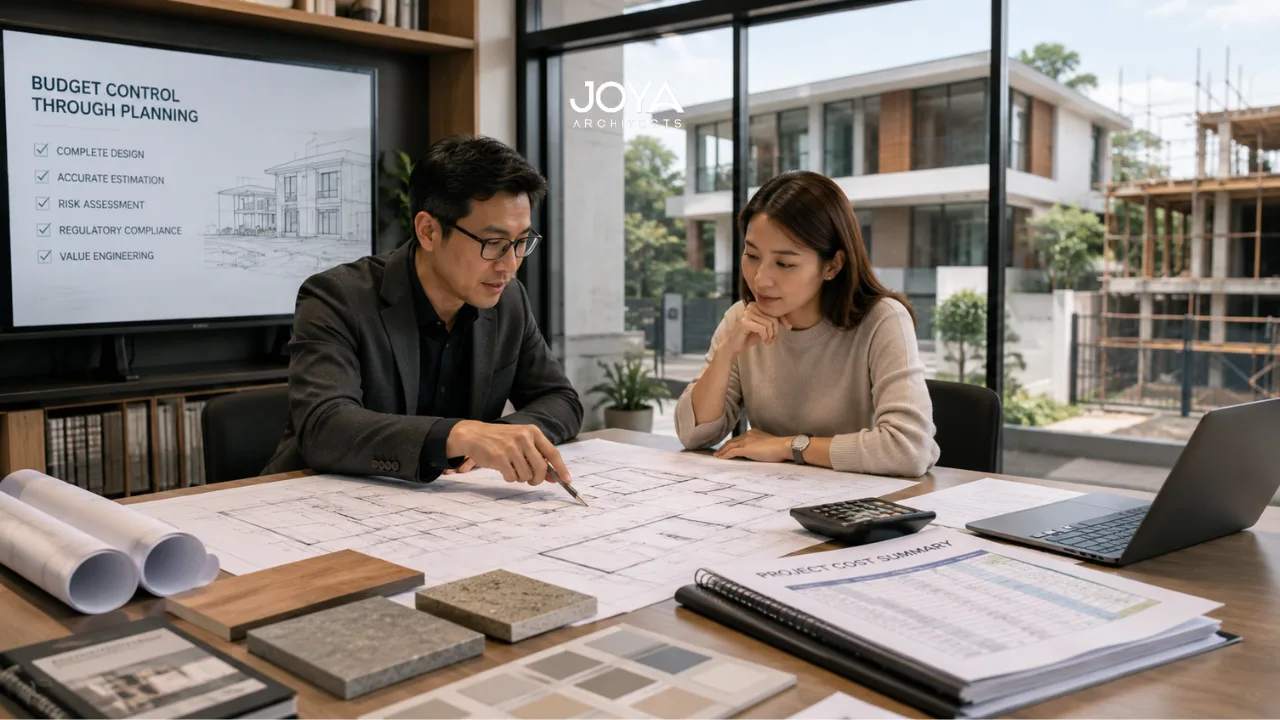
Budget overruns are the norm in construction, not the exception. Studies consistently find that a majority of construction projects exceed their initial budget, in some sectors by substantial margins. Landed house projects in Singapore are not immune. But the causes of budget overruns are, in most cases, predictable, and therefore preventable.
The most effective tool for preventing budget overruns on a landed project is not the contingency fund (though that matters). It is the quality of the architectural planning process that precedes construction. This guide explains why, and what good architectural planning looks like in practice.
Understanding the root causes of budget overruns is the first step in preventing them. On Singapore landed home projects, the most common causes are:
Incomplete scope definition before contracting. When the scope of works is not fully defined at the point of signing the construction contract, contractors have legitimate grounds for variation orders every time a design gap is filled. A project with a well-defined scope produces fewer variations; a project with a loose scope produces many.
Design changes initiated during construction. Post-contract scope changes, “while we’re at it” additions, second thoughts on materials, last-minute spatial changes, are consistently the most avoidable source of cost overruns. Contractors price variations at their discretion once a contract is signed; rates that were competitive at tender become unfavourable under variation order conditions.
Undiscovered site conditions. Foundation surprises, unapproved structures, structural defects in retained elements, and MEP conditions in older properties can all produce significant unbudgeted cost when discovered during construction. Most of these are discoverable before construction through appropriate pre-construction investigation.
Regulatory resubmission. Where submissions to URA or BCA contain errors or gaps, conditional approvals and resubmissions delay the project and may require design changes, incurring additional professional fees and extending the construction programme.
Inadequate contingency. When the contingency is set too low, genuine unforeseen costs, which occur on almost every project, require the homeowner to either dip into reserves not earmarked for the project, borrow, or make quality compromises mid-construction.

The single most powerful budget protection mechanism is a complete, coordinated set of contract documents before the project goes to tender. This means:
Contractors tendering against complete documentation provide accurate prices. Contractors tendering against incomplete documentation provide indicative prices and recover the difference through variations.
The real cost of architectural planning rework, redesigning, re-coordinating, and re-documenting, when design decisions change during construction is not just the professional fee for the rework. It is the contractor’s variation premium, the programme extension, and the downstream quality implications of working on a site where the design is still being resolved.
Site investigation, structural assessment (for A&A projects), and confirmation of existing MEP system conditions are not optional due-diligence activities. They are the basis for a budget that reflects the project as it will actually be built.
Common A&A mistakes to avoid consistently include proceeding with a retained structure without adequate structural assessment, only to discover defects that require remediation after the project has commenced, when the cost of addressing them is amplified by programme disruption.
A soil investigation costs S$8,000–S$15,000 and takes two to three weeks. A structural assessment of an existing property costs S$5,000–S$15,000. The cost of the discoveries these investigations might produce is budget-able. The cost of discovering the same issues mid-construction is not.
Understanding URA and BCA requirements thoroughly before design development begins, not as an afterthought, prevents the scenario where a design that the homeowner has approved turns out to require significant modification to comply with regulatory guidelines.
For an architect experienced with Singapore’s landed housing regulations, this is standard practice. For a homeowner or a contractor managing their own submission, it is a genuine risk.
Reconstruction project risks in Singapore include regulatory ones: projects submitted without adequate pre-design assessment of the site’s envelope control compliance can receive conditional approvals requiring design changes, adding professional fees, submission timelines, and sometimes construction delays.
Good architectural practice includes cost modelling at each design stage, not just at tender. This means:
When cost modelling reveals a budget gap during design, the response is a design conversation about priorities and trade-offs. When it reveals a budget gap at tender, after months of design work, the options are reduced and the emotional cost of redesign is higher.
Once design is complete and the construction contract is signed, a formal change management process prevents the casual scope creep that turns a well-budgeted project into an over-budget one.
This means: all scope changes requested by the homeowner are formally submitted and priced by the contractor before approval; the architect reviews the variation price for reasonableness; and the homeowner makes an informed decision about whether the change is worth the cost, on that specific item, at that specific time in the programme.
Matching design styles with architectural consultancy means working with an architect who understands both the creative brief and the financial brief, and who treats change management as a professional obligation, not a bureaucratic inconvenience.
To make the cost of planning failure concrete:
A homeowner who skips thorough pre-construction investigation on a 1960s terrace house being reconstructed discovers, during demolition, that the previous owner had installed an unapproved rear extension. The reinstatement and redesign required adds six weeks to the programme and S$80,000 in unbudgeted costs.
A homeowner who signs a construction contract against incomplete documentation receives 42 variation orders over the course of a 14-month build. The variations collectively add S$280,000 to the contract sum, on a project originally contracted at S$1,100,000.
Both scenarios are preventable. Neither is unusual.
What is the most cost-effective budget protection available to homeowners? Investing in complete design documentation before going to tender. The cost of documentation is fixed; the cost savings in variation order reduction are variable but consistently significant.
How does an architect manage variation orders on my behalf? Your architect reviews the contractor’s variation order pricing for reasonableness, certifies or disputes the price, and obtains your formal approval before the work proceeds. This process prevents contractors from pricing variations at rates far above the original contract.
Should I tell my contractor my full budget? Not your full budget including contingency. Share the contract budget, the amount you’ve allocated to construction, but not the contingency, which is your reserve against surprises, not additional scope.
How do I know if my architect’s cost model is accurate? Cross-reference it with a QS estimate on any project above S$1,000,000. If the two figures are within 10–15% of each other, you have a reasonable baseline. If they diverge significantly, the assumptions underlying each model warrant investigation.
What should I do if my project is already over budget mid-construction? Engage your architect to conduct a systematic review of remaining scope, identifying where specification can be adjusted without compromising the key design outcomes. Then negotiate variation orders that have not yet been priced, before they are incurred, to establish cost certainty for the remainder of the project.
It is worth being honest about the limits of planning. Some budget impacts are not preventable, they arise from events genuinely outside the design team’s control: unexpected ground conditions on a site with no prior development history, extreme material price movement in a volatile supply market, or a subcontractor failure mid-project.
For these genuinely unforeseeable events, the contingency fund remains the protection mechanism. This is why contingency must be calibrated honestly, not to a comfortable level, but to a level that reflects the actual risk profile of the specific project and site. An architect who recommends a higher contingency than the homeowner anticipated is doing their job correctly.
The goal of thorough architectural planning is not to eliminate the need for contingency. It is to ensure that when contingency is drawn, it is spent on genuinely unforeseen events, not on preventable ones that proper process would have surfaced earlier.
Avoiding budget overruns on a landed home project is not a matter of cutting costs, it is a matter of planning thoroughly enough that the costs you commit to are the costs you incur. The discipline of complete design, rigorous pre-construction investigation, and formal change management transforms budget planning from wishful thinking into reliable financial management.
At Joya Architects, our careful architectural planning approach is built around the conviction that thorough process at every stage is the most valuable service we provide, because it is what protects our clients’ investment throughout.