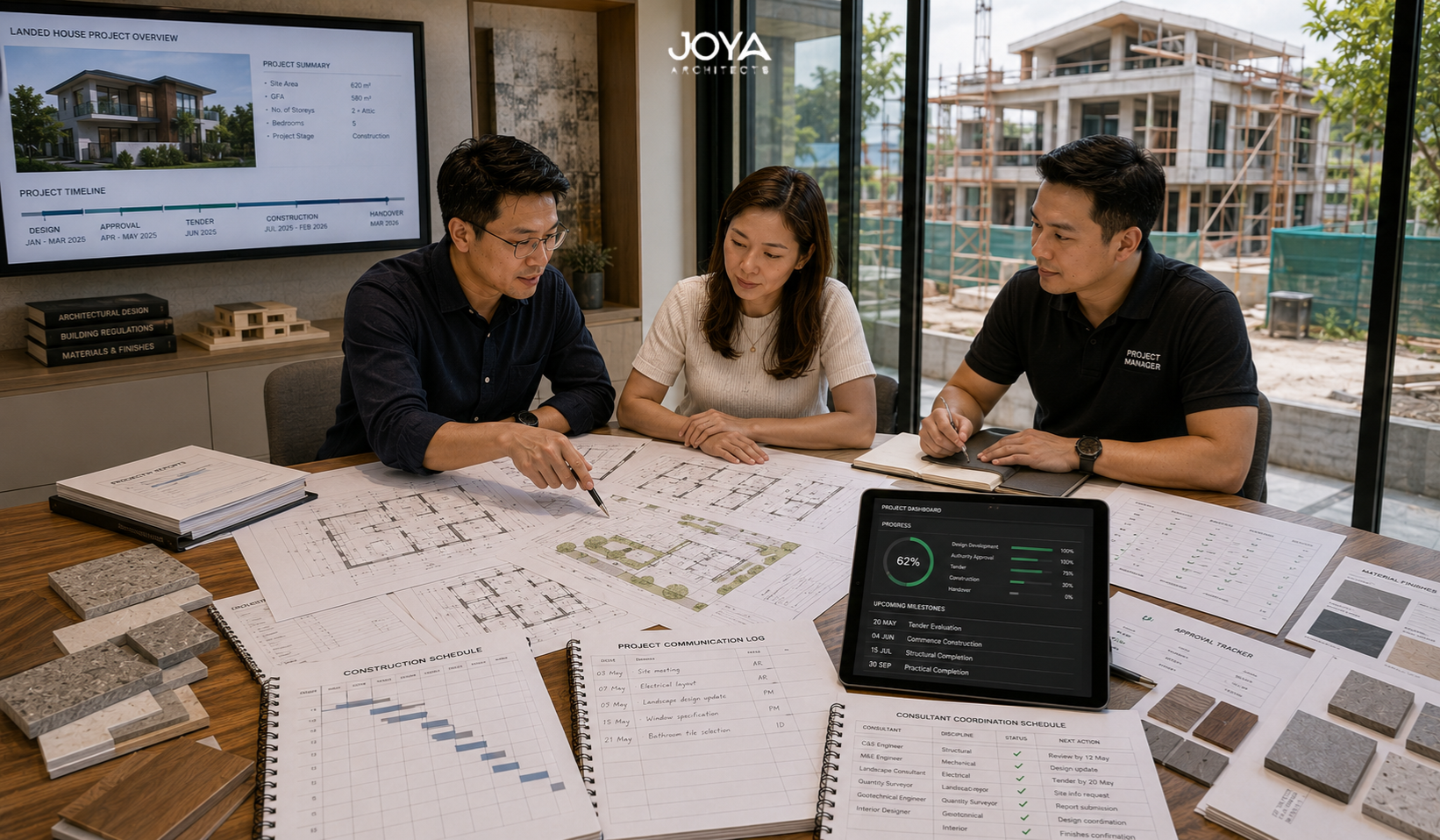
A homeowner in Queenstown came to Joya eighteen months into a landed house rebuild. The project was technically on schedule. But she was exhausted. She’d been fielding messages from the contractor at odd hours, making tile selections on the spot during site visits, and tracking a budget she no longer fully understood. The architect was available, yet communication had drifted into something informal and fragmented. Every decision felt urgent. Nothing felt settled.
What she was describing wasn’t bad luck. It was a project without structure. And that distinction matters, because stress in a Singapore landed house built is rarely random. It comes from specific conditions: unclear decision-making, an incomplete design, fragmented communication, a budget not set up to hold. Fix those conditions, and the project doesn’t stop being difficult. It becomes manageable.
This guide covers where that stress comes from and what homeowners can do about it, starting from the first professional appointment.
The Architect You Choose Sets the Stress Baseline
The single most consequential decision in a landed house project is who you appoint as architect. Not the contractor. The interior designer doesn’t shape it either. The architect’s choice shapes the entire project structure. Their briefing process determines how well your needs are understood upfront. What happens in their design phase shapes how many surprises come up during construction. And on-site, supervision approach determines how the contractor behaves day to day.
A principal-led practice that stays present and accountable throughout creates the conditions for a manageable experience. One that delegates to junior staff and communicates informally doesn’t. The stress difference between these two scenarios shows up early and compounds over time.
Knowing how to evaluate an architect before you appoint one is worth more than any checklist you’ll find after the contract is signed.
Before appointing anyone, ask how the principal architect is involved at each stage. Find out what the communication protocol looks like in practice. Check how decisions are documented. These aren’t difficult questions. A practice with a real process will answer them clearly. One without a real process won’t.
The clearest indicator of a well-run firm isn’t the portfolio. It’s the process.
Discuss Your Architectural Vision
Incomplete Design Is the Root of Most Construction Stress
The most stressful moments in any construction project share a pattern. The tiler is waiting. No tile has been selected yet. The homeowner is standing next to two samples they’ve never seen in context. And the contractor needs an answer now.
That scenario is almost always caused by an incomplete design phase. When the design isn’t fully resolved before construction starts, decisions migrate from the studio to the site. Site decisions are worse in every way. They’re rushed. Made without adequate context. And once the screed is poured, they can’t be undone.
Two extra months in design development cost very little relative to the total budget. Fixing problems discovered after the concrete sets costs a great deal more.
Understanding the full scope of architectural design stages helps homeowners see why the early phases matter. They’re not administrative formalities. That’s where quality gets established.
A thorough design phase means every material selection is made before the contractor arrives. Every detail is resolved on paper before anyone touches a wall. The contract sum reflects the full scope of what will be built, not an approximation that gets refined on site. That completeness is what separates a project that feels manageable from one that doesn’t.
What a Clear Communication Protocol Actually Looks Like
Here’s what informal project communication looks like in practice. A homeowner texts the contractor directly about a concern. The contractor acts on it. Nobody tells the architect. Two weeks later, the action conflicts with something in the drawings. Nobody agrees on what was said or by whom.
That’s not an unusual scenario. It’s one of the most common. And it’s almost entirely preventable.
A clear communication structure means all instructions to the contractor go through the architect in writing. Contractor queries are answered through a formal Request for Information process. After every site meeting, minutes are issued that confirm what was decided and what each party needs to do. Budget position gets reported monthly against the approved contract sum.
The risks that derail reconstruction projects most often trace back to a moment where communication broke down, a verbal instruction here, an informal agreement there, never followed up in writing.
That structure might feel like administrative overhead. But it’s the difference between a project that feels like it’s being run and one that feels like it’s running away from you.
One practical rule worth adopting from week one: never give the contractor a direct instruction. Even if it seems minor. Route everything through the architect.

Budgeting to Avoid the Mid-Project Panic
Most budget stress in Singapore’s home projects follows the same script. The homeowner starts with a contract sum that looks comfortable. A variation comes in. Then another. After that, the external works costs arrive, and they weren’t in the plan. Three months in, the comfortable budget isn’t comfortable anymore.
The fix is straightforward, though it’s not always applied. A realistic budget covers the main contract sum, a 10-15% contingency that is genuinely ring-fenced, external works, professional fees, furniture, and temporary accommodation.
Budget planning for Singapore landed homeowners is more involved than most people expect going in, and the surprises almost always hit those who didn’t account for them.
The contingency is the crucial part. A homeowner who has set aside genuine contingency and kept it untouched manages budget variations as routine. One who spent the contingency on a kitchen upgrade manages them as emergencies. Same variations. Completely different experience.
Monthly budget reporting from the architect, showing the approved sum, all variations to date, and the remaining contingency, turns budget management from anxiety into administration.
How architects protect homeowners from unexpected construction costs comes down, largely, to keeping the budget transparent and up to date throughout the build.
How to Use Site Visits Without Undermining the Process
Site visits can ground a homeowner or unsettle them. Usually, it comes down to structure.
An unstructured visit looks like this. The homeowner arrives, walks around, notices something that worries them, raises it informally with whoever is nearby, gets a reassuring answer they can’t evaluate, and leaves unsure whether they should be concerned or not. That uncertainty doesn’t resolve. It builds.
A structured visit looks different. The homeowner attends the formal site meeting with the architect and contractor. Specific milestones are reviewed against the drawings. Questions go into the meeting record rather than into informal sidebar conversations with the contractor. The architect’s assessment of quality compliance is the reference point, not someone’s verbal assurance.
What principal-led supervision means in practice is, among other things, that the person assessing quality on site is the same person who designed the building.
One thing worth accepting early: not every concern you notice on site is a problem. Construction at different stages looks rough, incomplete, and sometimes alarming to an untrained eye. An architect who is present and accountable is the filter between what you see and what actually matters. Trusting that filter is part of what makes the experience manageable.
Frequently Asked Questions
Is it normal to feel stressed during a Singapore home build project?
Some stress is normal. The stakes are high, and the process is long. But sustained anxiety driven by constant surprises, shifting budgets, and unclear communication isn’t inevitable. It’s usually a sign that the project’s structure needs attention, not that building is inherently stressful.
How do I know if my architect’s communication is good enough?
If you regularly feel uncertain about what’s been decided, who’s responsible for what, or where the budget stands, the communication isn’t working. Good project communication means you always have access to the current decision record, the current budget position, and a clear point of contact. If you don’t, raise it directly with your architect.
What’s the most common cause of budget overruns in Singapore landed home projects?
Design changes made during construction. Variations that weren’t costed before instruction add up quickly, and they’re hardest to absorb when the contingency has already been spent.
Avoiding budget overruns through architectural planning starts well before the contractor is on site, with a complete and detailed design.
Should I visit the site every week?
Attending the formal weekly or fortnightly site meeting is worthwhile. Unstructured visits in between, especially if they lead to informal conversations with the contractor, tend to create more uncertainty than they resolve. If you want to see progress, visit with the architect present.
What if I disagree with my architect’s recommendation on the site?
Raise it in the meeting, not in a side conversation with the contractor. Ask the architect to explain their reasoning. If you still disagree, you have every right to instruct a different approach, though it should be done formally and in writing so the decision and its implications are on record.
What does a well-managed project feel like from the homeowner’s side?
Quieter than you’d expect. Regular updates with no surprises. Decisions made at the right time, with enough information to make them well. Budget variations that stay within the band you planned for. A sense that the project is being managed, not just happening.
Stress in a Singapore landed house project has specific causes, and most of them can be addressed before construction begins. Those who come out the other side describing the experience as manageable aren’t the ones who got lucky. They’re the ones whose projects were set up properly from the start.