Joya Architects » Blogs » How to Choose the Right Architect in Singapore for Your Landed Home
Architectural Process Guides
How to Choose the Right Architect in Singapore for Your Landed Home
By achmad
2026-07-02 00:53:31
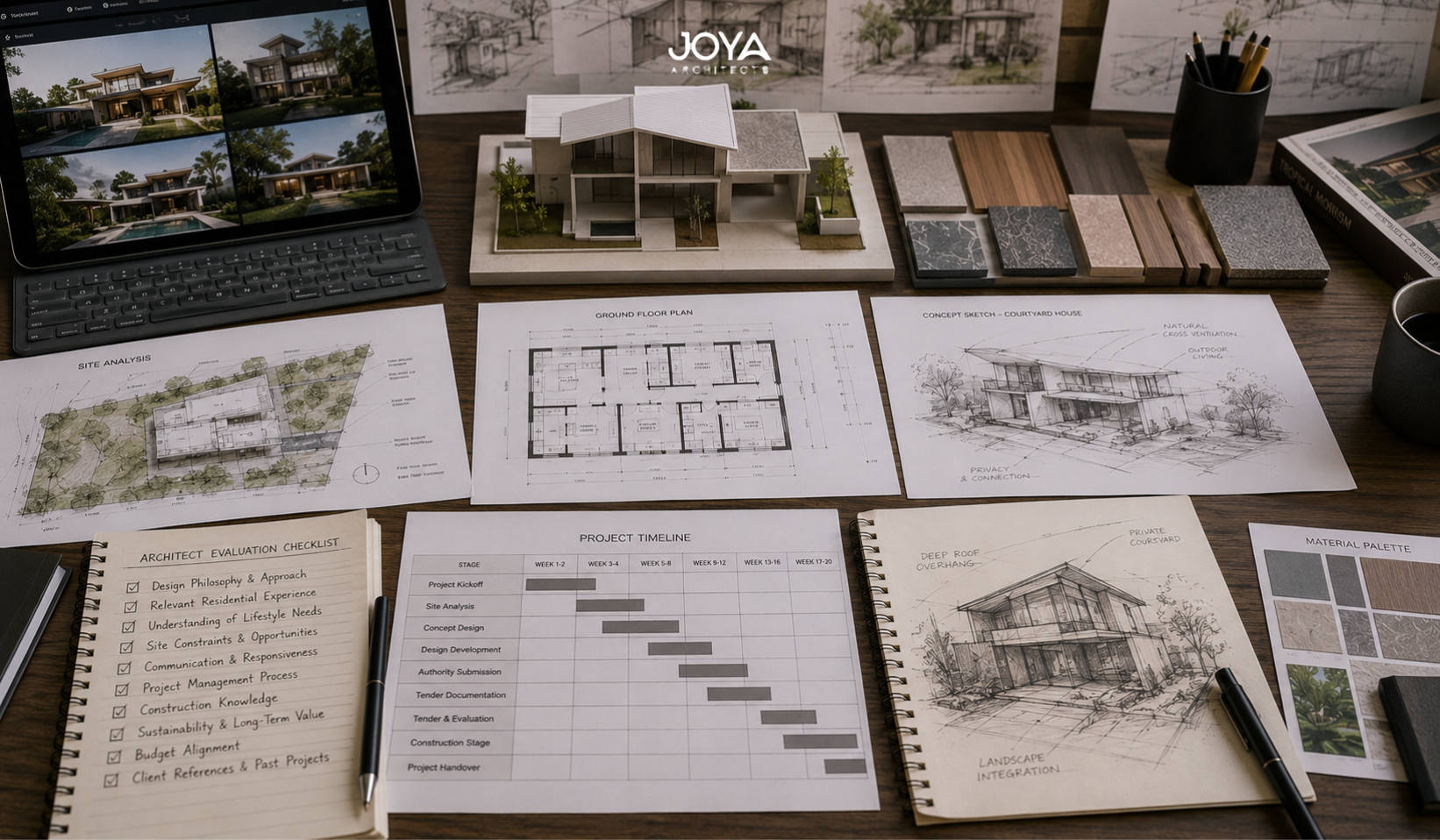
Choosing an architect for a Singapore landed house project is one of the most consequential professional engagements a homeowner will make. The architect shapes not just the appearance of the home, but its spatial quality, its structural logic, its regulatory compliance, and the experience of building it. A good match produces a home that exceeds the homeowner’s initial brief. A poor match produces a project characterised by miscommunication, compromise, and post-completion regret.This guide provides a structured approach to evaluating and choosing an architect for a Singapore landed house project, covering credentials, portfolio analysis, process evaluation, and the specific questions that reveal how a firm actually operates.
Step 1: Confirm Registration with the Board of Architects Singapore
In Singapore, the practice of architecture is a regulated profession. Only persons registered with the Board of Architects (BOA) Singapore may offer architectural services or submit building plans for approval. Before engaging any architect, confirm their current BOA registration at boa.gov.sg.Membership of the Singapore Institute of Architects (SIA) is a further professional indicator, though it is not a statutory requirement. BOA registration is non-negotiable; SIA membership reflects voluntary professional engagement within the architectural community.
Step 2: Identify Firms Specialising in Landed Residential Work
Architecture is a broad profession, and firms vary significantly in their area of practice. A firm whose portfolio is predominantly commercial offices, retail, or institutional will not have the depth of knowledge in Singapore’s landed housing planning parameters, residential-scale structural and services coordination, or the quality sensibilities specific to private homes that a landed residential specialist will have developed.For a landed house new erection, reconstruction, or significant A&A project, the ideal firm is one whose portfolio demonstrates deep and sustained specialisation in Singapore’s private residential landed market, from inter-terrace to semi-detached, detached, and Good Class Bungalow projects.
Step 3: Evaluate the Portfolio Systematically
A portfolio review for a landed house architect should assess several distinct qualities:
Property type match, has the firm designed homes of your type (new erection, A&A, reconstruction) and your approximate property category (inter-terrace, semi-D, detached, GCB)?
Design quality and consistency, is the quality of design consistent across the portfolio, or are there one or two stand-out projects surrounded by undistinguished work?
Regulatory complexity navigated, has the firm handled URA planning applications, BCA approvals, and complex authority submissions for projects comparable to yours?
Construction quality, beyond the design renderings, what do the completed project photographs reveal about construction precision, material quality, and finish standard?
Style range, is the firm capable of executing the design direction you want, or is their portfolio stylistically narrow in ways that may not fit your brief?
Step 4: Understand the Firm’s Project Model
There is a meaningful difference between a principal-led boutique practice, where the founding architect personally manages every project from concept to completion, and a larger firm where projects are managed by directors, associates, or project architects while the principal leads business development.For a private landed home, principal-led involvement is a significant quality advantage. The principal architect who attends your first consultation, understands your family’s lifestyle, and develops the initial design concept is the person best equipped to make the judgement calls that arise throughout construction. When project management is delegated to junior staff, those judgement calls are made by people who lack the embedded design intelligence that the principal developed.Ask directly: who will manage my project from design to construction handover? Will I have access to the principal architect throughout? How is continuity of design intent maintained if staffing changes?
Step 5: Evaluate the Briefing Process
How an architect conducts their first consultation reveals a great deal about how they will manage your project. An architect who arrives with a portfolio and talks about their previous work for most of the meeting is an architect who will struggle to understand your specific brief. An architect who asks detailed questions about how your household functions, what you find compelling in the spaces you have lived in, what you most want to avoid, and how your needs will change over ten years is an architect preparing to design for you rather than for their portfolio.The quality of the questions an architect asks in the first consultation is one of the most reliable predictors of design quality.
Step 6: Clarify Fees, Scope, and Contract Structure
Architectural fees for Singapore landed house projects are typically calculated as a percentage of the total construction cost, ranging from approximately 5% to 10% depending on the scope of services, the complexity of the project, and whether the architect is providing full services (design through construction supervision) or partial services (design only, with the homeowner managing the construction directly).Confirm precisely what the fee includes: schematic design, design development, construction documentation, authority submissions, tender calling, construction supervision, and post-completion services. A fee that appears lower may exclude services that another fee includes, compare scope, not just percentage.Joya Architects specialises exclusively in Singapore private landed residential architecture, with principal architect involvement on every project from first consultation to handover. Explore their landed house architectural services.
Frequently Asked Questions
How many architects should I consult before choosing?
Most homeowners benefit from consulting three to five firms. Fewer than three limits comparative perspective; more than five risks decision fatigue without adding meaningful information. Prioritise depth of conversation in each consultation over breadth of firms surveyed.
Is it better to engage an architect before or after purchasing a landed property?
Engaging an architect before finalising a landed property purchase is valuable, an architect can assess the site’s planning constraints, advise on buildability, and identify planning parameters that affect what can be achieved on the specific plot. This information can influence your purchase decision and negotiation position.
What is the difference between an architect and a design-and-build firm?
A registered architect is a professionally qualified designer with statutory responsibilities for building plan submissions and construction supervision in Singapore. A design-and-build firm combines design and construction services under one commercial entity. Some design-and-build firms have registered architects on staff; others use draftspersons or designers who are not BOA-registered. For a landed home, engaging a BOA-registered architect provides regulatory standing and professional accountability that unregistered designers cannot offer.
Conclusion
Choosing the right architect for a Singapore landed home is a structured process, not a gut-feel decision. BOA registration confirms legal qualification; portfolio depth confirms relevant experience; the briefing process reveals design intelligence; and the project model determines whose expertise actually manages your project. Taking the time to evaluate architects systematically protects one of the most significant investments you will ever make.