Who to Hire for a Landed Home Project in Singapore
By achmad
2026-10-13 19:10:13
Who to hire for a landed home project depends on the proposed changes, site conditions and delivery arrangement. Start by identifying the design, technical, regulatory and construction responsibilities, then appoint people whose scope and qualifications cover those tasks.
A substantial rebuild commonly involves several disciplines, while a limited refurbishment may need a smaller team. The objective is a complete allocation of work, with clear communication between the people doing it.
Start with verifiable professional credentials
The Board of Architects’ register identifies registered architects, while the Professional Engineers Board’s practising-certificate directory helps verify engineers and their branches. Check the named individuals proposed for your project rather than relying only on a firm’s presentation.
Credentials establish a starting point, not the entire appointment. You still need to understand relevant experience, availability, deliverables and how the professional will work with the rest of the team.
Who to hire for a landed home project: begin with the brief
Describe the outcomes you need before assembling a list of consultants. Record whether you intend to retain the house, extend it, reorganise internal spaces or replace it. Include access, privacy, future mobility and any fixed moving date.
Ask an appropriate professional to assess the scope and identify the investigations needed. An unresolved structural condition or drainage constraint can change the team required. An early appointment can therefore be limited to defining the next stage rather than commissioning every service immediately.
Architectural design and overall coordination
An architectural appointment can address the brief, spatial planning, building form, documentation and coordination. Confirm which stages are included and whether the architect will also administer the construction contract or provide other agreed construction-stage services.
Coordination needs a defined output. Ask who combines consultant information, identifies conflicting requirements and issues the current drawing set. A statement that everyone will work together is less useful than a named lead and a documented review process.
Civil and structural engineering
Where the work requires structural assessment or design, identify the civil and structural engineering appointment early. Existing conditions, foundations, retaining structures and proposed openings can affect architectural decisions before the layout is settled.
Ask what information the engineer needs, who commissions investigations and how the engineering work is integrated into the design programme. Avoid assuming that an architect’s coordination fee automatically includes the engineer’s separate services.
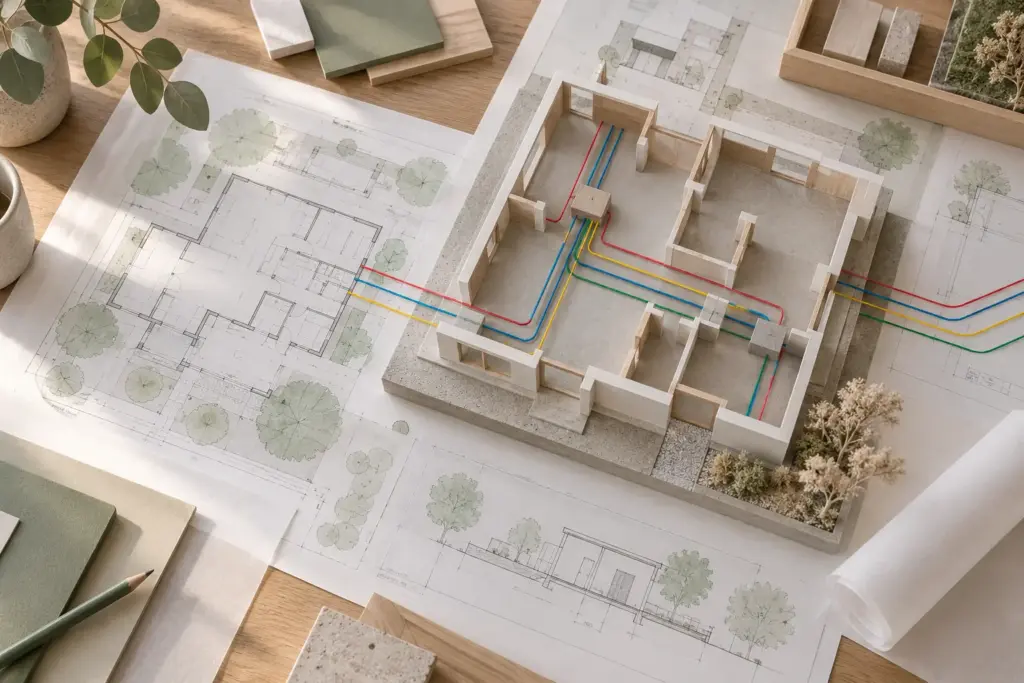
AI-generated conceptual illustration, not to scale; not an approved plan or completed Joya project.
Your landed home, your next step
Looking for an architect for your landed home?
Explore Joya’s principal-led approach to Singapore landed-home projects, from the first design discussions through submissions and construction.
A surveyor can provide the site information needed for design. A quantity surveyor can support cost planning, tender comparison and financial control within an agreed scope. Building-services expertise may be required to resolve particular systems and technical requirements.
Landscape, interior, lighting or specialist consultants can also contribute where the brief warrants them. Ask what decision each appointment enables and whether that work is already included elsewhere. This keeps the team proportionate without leaving an essential task unassigned.
For example, a home lift affects more than the equipment purchase. Its dimensions, structure, power and maintenance access need coordinated decisions. The supplier’s package should be understood alongside the other design responsibilities rather than treated as a self-contained product.
Choose the construction arrangement deliberately
The builder provides construction resources and delivers the contracted work. The timing of appointment and responsibility for design vary with procurement. Ask how the chosen arrangement affects pricing, design development, instructions and the evaluation of changes.
For the options, compare architect, building-designer and contractor-led arrangements. The key issue is the actual allocation of services and responsibilities, not whether one company presents a long list of capabilities.
Do not assume that naming a builder completes the supervision arrangements. Ask the appointed professionals to identify the relevant statutory roles and the contractual site-review services separately. Their requirements and purposes can differ.
Use a responsibility schedule before signing
Create a row for each task with four entries: responsible party, deliverable, appointment status and fee treatment. Include design coordination, submissions, cost advice, contractor queries, changes and handover records. Mark unknowns openly.
Test the schedule with a simple scenario. If a proposed window conflicts with a structural beam, who identifies the problem, develops alternatives, checks cost and communicates the approved decision? A complete answer reveals whether the team can handle an ordinary interface.
Also identify the owner’s responsibilities. Prompt decisions, access to existing records and timely consultant appointments influence progress. The owner should know which requests need a decision and which can be handled within the team’s agreed authority.
Appoint people you can work with throughout the project
The broader guide to choosing an architect for a landed home explains the selection context. Use the architect shortlisting guide to compare candidates and the overview of working with an architect to discuss day-to-day collaboration.
Ask who will actually attend meetings and handle questions, including when the principal is unavailable. A clear team structure matters as much as the first presentation. Request the proposed working arrangement in writing alongside the scope.
Discuss your project team with Joya using your existing plans, priorities and budget range. An early scope review can establish which appointments are needed now and what should be resolved before further commitments.
Frequently Asked Questions
Do all landed projects need the same consultant team?
No. The proposed work, site conditions and required approvals determine the necessary expertise. Begin with a scope assessment and identify responsibilities before appointing every discipline. A smaller refurbishment and a substantial rebuild may need different teams, but both benefit from clear services and coordination arrangements.
Does the architect’s fee include the structural engineer?
Only if the appointment expressly includes that service or consultant charge. Architectural coordination and engineering design are different responsibilities. Ask who appoints and pays the engineer, what deliverables are required and how engineering information will be incorporated into the architectural drawings and overall project programme.
When should a quantity surveyor be considered?
Consider the complexity of the budget, procurement and cost-control needs rather than a universal project-value threshold. Ask what cost advice is already included and where independent estimating or tender analysis would help. Define the quantity surveyor’s deliverables and timing before adding the appointment to the team.
Who should coordinate the different consultants?
Name the coordination lead in the appointments and agree how information is exchanged and reviewed. The role may sit with the architect or another appointed party depending on procurement. Coordination should identify interfaces and decisions while preserving each consultant’s responsibility for their own professional work.
Your landed home, your next step
Start a conversation about your landed home
Share your property type, project priorities and where you are in the planning process. Discuss your next steps with Joya.