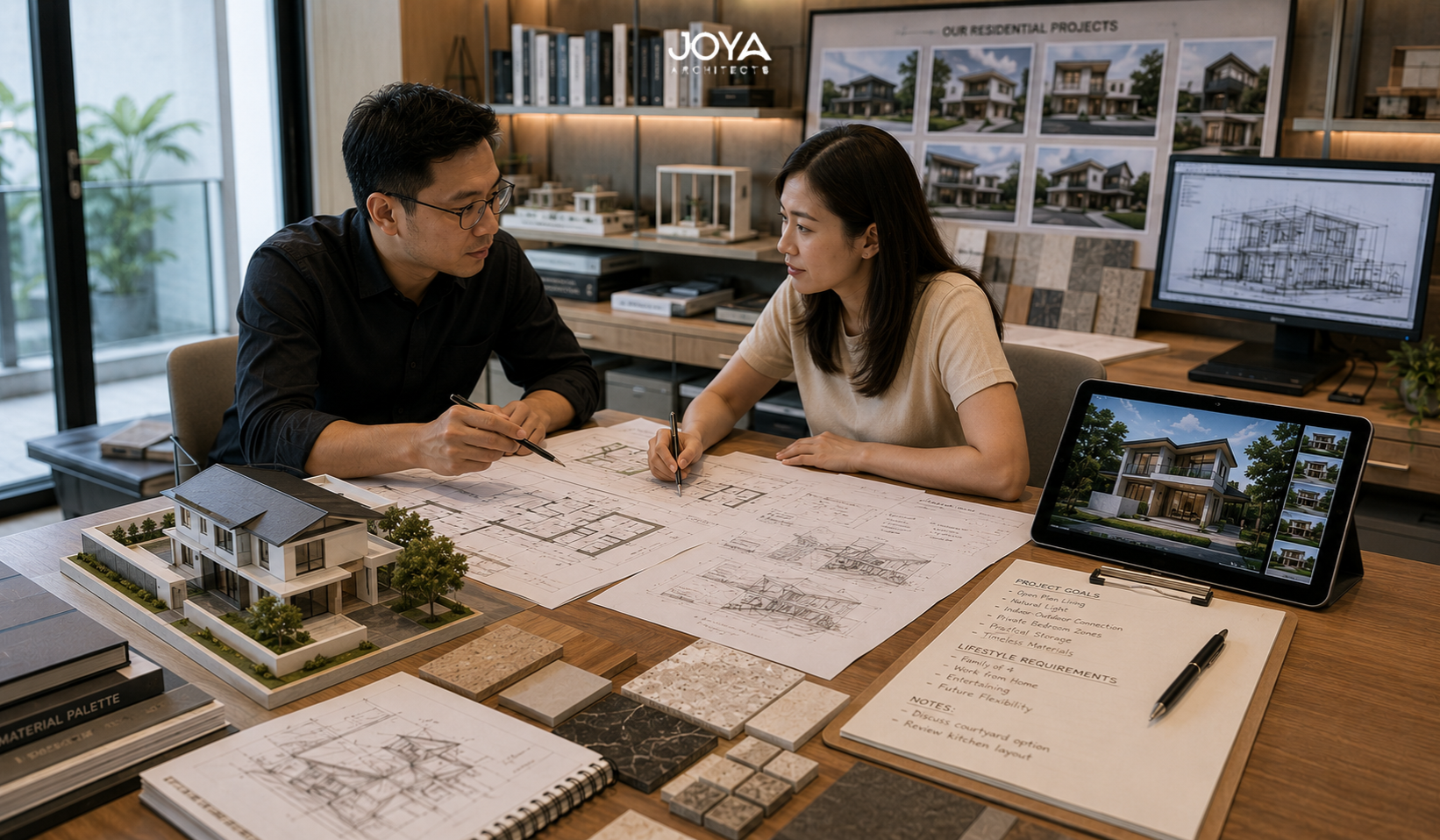
The homes that Singapore architects describe as their best work share a pattern. Budget wasn’t the deciding factor. Neither was site complexity. What set them apart was the quality of the client relationship. The clients were engaged, decisive, and willing to be challenged.
The most difficult projects are almost never the most technically challenging ones. They’re the ones where the client treated the process as a service to be managed rather than a creative partnership. Feedback arrived late and vague. Decisions kept shifting. The architecture suffered.
This is not a coincidence. Architecture in a private home depends as much on the quality of the client relationship as on the architect’s talent. Neither alone is enough. This guide explains what good collaboration looks like, and how homeowners can cultivate it from the very first conversation.
What the Homeowner Needs to Bring
The most common misconception about working with an architect is that the homeowner’s job is to describe what they want and then step back. That model produces competent homes. It doesn’t produce great ones.
Genuine collaboration asks more. Not the homeowner’s time alone, though that matters. It asks for honest self-knowledge about how you actually live, specific language for what you find beautiful, and a willingness to be challenged on what you think you want.
A complete guide to working with an architect in Singapore covers the full process stage by stage, but the foundation is always the same: the quality of what the homeowner brings to the brief.
There’s a meaningful difference between “I want a large living room” and “I want the space where we host friends to feel generous, connected to the garden, and acoustically separate from the bedrooms.” Both are inputs, yet only one gives the architect something to work with. An architect can design a room to feel a particular way. They can’t design toward an adjective.
Prompt, stable decisions matter too. Design development stalls when homeowners revisit agreed choices under the pressure of seeing them built. That instability isn’t just inefficient. It’s exhausting for both parties, and it shows up in the finished home.
Making the Most of Your First Consultation
The quality of the architect-client relationship is often set in the first meeting. Homeowners who arrive with a clear sense of how they live, what they value, and what they want to avoid give the architect the most useful possible starting point.
A folder of saved images from design publications is less useful than it might seem. Images show completed rooms. They don’t reveal the spatial logic that made them feel good. An architect who understands why you respond to certain spaces is better placed to translate that into your specific project.
Choosing the right architect in Singapore matters precisely for this reason: you’re looking for someone who can read what you’re actually describing, not just what you’re literally saying.
The more specific you can be about your life, the more precisely the architect can design for it. Not just how many bedrooms you need. The way you cook matters. Whether you work from home. How you host. Where your children spend most of their time. What the end of a workday feels like in the house you currently live in, and what’s missing from it.
Real spaces you’ve visited and responded to are more useful than design images. A hotel room you loved. The restaurant that felt exactly right. A friend’s kitchen that works in a way yours never has. These give the architect a shared spatial language to understand your sensibility.
Giving Feedback the Architect Can Actually Use
There’s a specific skill involved in giving useful design feedback. It’s not about evaluation. Description matters more.
Evaluative feedback sounds like: “I don’t like this layout.” Generative feedback sounds like: “This layout feels right in terms of room positions, but the kitchen feels too separated from where the family actually spends time.” One tells the architect something went wrong. The other tells them where to go next.
Understanding what happens at each design stage makes it easier to give the right kind of feedback at the right moment.
Architects are trained to translate qualitative language into spatial decisions. Talk about how a space should feel. What relationship between areas matters most. How the sequence of arriving home should feel. The more experiential the feedback, the more precisely it can be incorporated into the next revision.
It helps to lead with what works before saying what doesn’t. Not out of politeness. Because knowing what to keep is as useful as knowing what to change. A homeowner who can say “the living area proportion feels right, but the kitchen needs to connect to the garden differently” gives the architect a much clearer brief than one who says “start again.”
Staying a Good Partner Through Construction
Construction is where the collaboration gets tested most. Progress is visible but imperfect. Decisions made on paper become concrete realities. Unforeseen conditions arise that need fast, collaborative responses.
Homeowners who visit the site regularly, engage constructively with the architect’s assessments, and make decisions promptly when construction queries need them keep the collaboration working through this demanding phase. Those who are unavailable when decisions are needed, who revisit choices agreed months earlier, or who communicate primarily through complaints rather than questions create the conditions for a difficult project conclusion.
Most late-stage disputes trace back to a breakdown in communication during construction, not a flaw in the design. Staying engaged and asking questions tends to hold the relationship together, whereas complaints without questions just create distance.
What principal-led supervision looks like in practice is closely connected to this: a principal architect who is present throughout construction makes it far easier for the homeowner to stay genuinely engaged rather than anxious.
A Singapore landed home is a multi-generational investment. It deserves the homeowner’s engaged attention through construction, not just through design.
What Good Collaboration Produces That Nothing Else Does
The best architecture in a private home requires two kinds of knowledge. Architects bring spatial intelligence, technical expertise, and the ability to translate a life into built form. The homeowner brings the life itself.
Neither party can produce the outcome alone. An architect working without genuine client input designs a home they understand, not a home the client actually lives in. A client without an architect’s expertise gets a collection of preferences, not a coherent space.
What collaboration produces is something neither could make separately. The homeowner’s specific vision, shaped by the architect’s spatial intelligence, creates homes that are genuinely personal. Not just designed for someone. Designed to fit how that specific person lives, in that specific place.
The full landed house design process is the structure through which that collaboration unfolds, stage by stage, from the first brief to the final detail.
That’s the standard worth aiming for. And it’s only reachable through genuine partnership.
Frequently Asked Questions
What if I disagree with my architect’s design recommendation?
Express it early and specifically. An architect who understands your reasoning may revise their recommendation. They may also explain why their approach serves your stated priorities better than your preference. The dialogue is the value. Neither party needs to capitulate, but both need to engage honestly.
How often should I expect to meet my architect during design development?
Every two to three weeks is typical during active design development on a Singapore landed house project. During construction, structured site meetings every two to four weeks are standard. The frequency increases at key decision milestones and pulls back during phases that are primarily technical.
What does the architect need from me before design can start?
Before schematic design begins, an architect typically needs the site survey plan and title deed, URA’s planning parameters for the plot, your family composition and lifestyle brief, a preliminary budget range, and any spatial requirements or design references you’ve identified. More complete information means a more specific initial design response.
What a landed house architect actually does includes helping you build this brief, so don’t worry if you’re starting from scratch.
Is it normal to feel uncertain about design decisions mid-process?
Yes. Design uncertainty is common, especially when moving from sketch designs to more resolved proposals. The key is to raise it with the architect rather than suppress it. Unvoiced concerns tend to resurface during construction, when they’re harder and more expensive to resolve.
The best Singapore landed homes are built on genuine partnership. An architect’s expertise and a homeowner’s specific vision, combined honestly over the length of the project, produce something neither could have made alone. That partnership doesn’t happen by accident. It’s built, conversation by conversation, decision by decision, from the very first meeting.