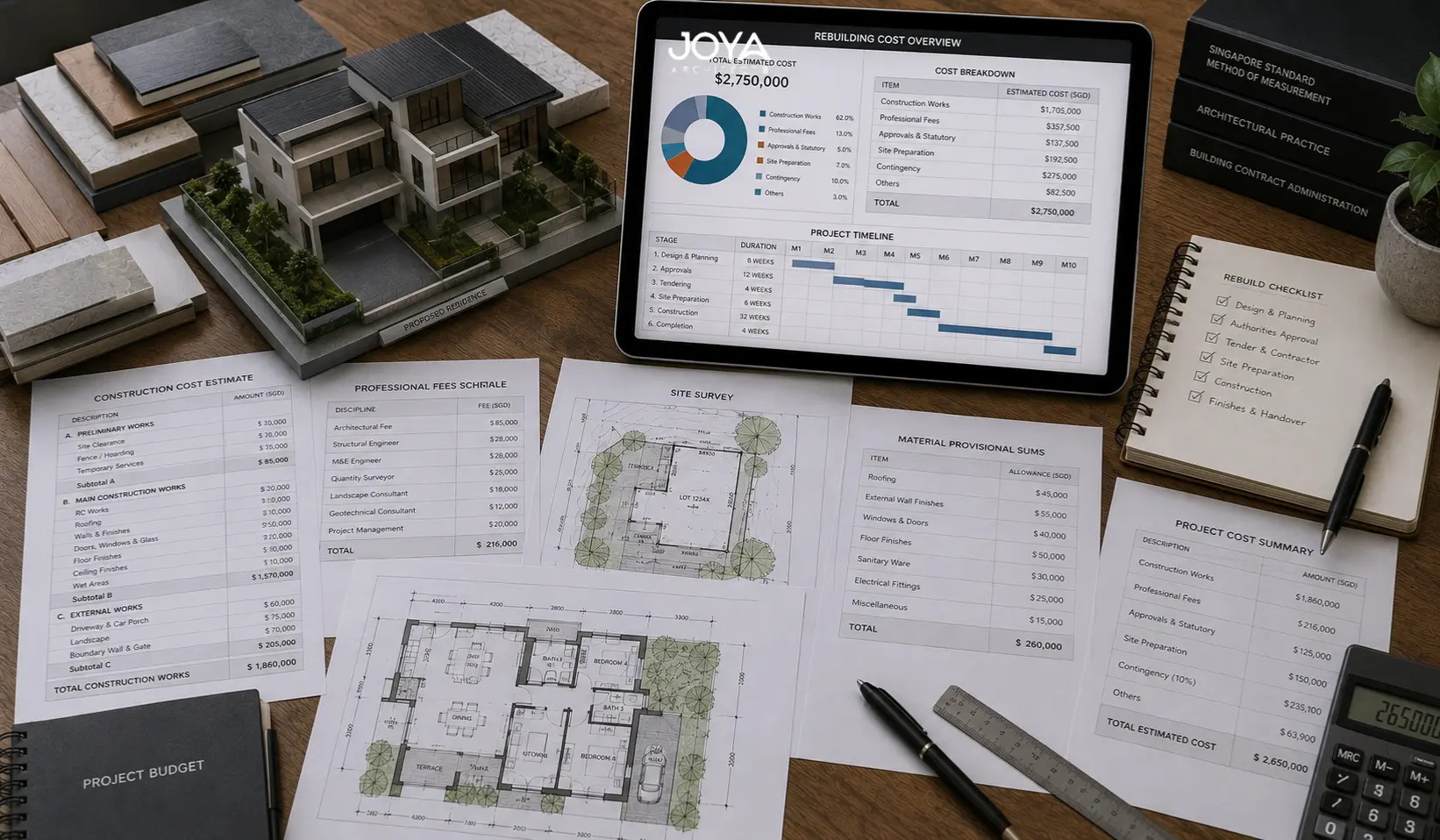
In late 2024, a homeowner in Bishan contacted us after receiving three preliminary quotes for rebuilding his two-storey terrace. The quotes came in at $880,000, $1.05 million, and $1.38 million: all from three contractors who had visited the same site and read the same brief. He wanted to know which one to trust. The honest answer was that none of them, taken alone, told the whole story.
The lowest quote had excluded demolition, assumed a standard foundation without soil investigation, and priced M&E at a level that would have required significant upgrades mid-build. The highest had included items the client had never asked for. The middle quote was closest to reasonable, yet it still omitted BCA and URA submission fees, professional fees, and the contingency that every experienced project manager builds in from day one. By the time the project was properly scoped, the real number was $1.2 million. And that was before finishes were chosen.
This isn’t unusual. The cost of rebuilding a landed house in Singapore is genuinely complex to estimate, and the figures that circulate online tend to be either aspirationally low or vaguely high. What drives the number up, what gets underestimated, and how to read a quote properly: that’s what this guide covers.
Rebuild Cost Ranges by Property Type in 2026
Construction costs in Singapore have stabilised somewhat after the significant escalations of 2021 to 2023, though they haven’t retreated to pre-pandemic levels. Labour costs remain elevated. Certain materials, including structural steel, high-performance glazing, and engineered timber, are priced at levels that would have seemed high even five years ago. The ranges below reflect mid-2026 market conditions for a full demolish-and-rebuild with quality mid-range to upper finishes.
For an intermediate terrace house, expect total construction costs of $800,000 to $1.5 million, not including professional fees or regulatory charges. The lower end assumes a fairly standard structural layout, conventional M&E specification, and modest finishes. The upper end reflects a more complex structure, high-specification building envelope, and premium material choices throughout. A 1,400-square-foot plot terrace with two storeys and an attic, rebuilt to a good standard, sits around $1.0 million to $1.2 million in construction cost alone.
Semi-detached houses run higher, typically $1.5 million to $3 million for construction. The additional gross floor area, the more complex party wall interface on the shared side, and the generally larger M&E specification all contribute. Projects at the upper end of this range tend to involve extensive basement work, custom facade systems, or high-specification swimming pools.
Detached bungalows cover a very wide range: $2 million to $5 million or more for construction, depending heavily on plot size, design complexity, and specification. Good Class Bungalows, given their minimum 1,400-square-metre plot size and the typical level of finish expected at that tier, regularly exceed $5 million in construction cost for a full rebuild. We’ve covered the specific considerations for bungalow reconstruction in Singapore in more depth separately.
What Actually Drives the Cost Up
Demolition is the item most owners underestimate at the start. Bringing down an existing structure, managing the waste, shoring the site, and dealing with any asbestos-containing materials found in older buildings adds $40,000 to $120,000 to the project before a single new foundation pile is placed. Older terraces from the 1970s and 1980s often have construction materials and methods that require specialist handling during demolition.
Foundation work is where projects get expensive fast, and where inadequate early investigation creates budget surprises mid-project. Singapore’s soil conditions vary significantly across different parts of the island. Sites with marine clay, fill material, or proximity to underground infrastructure require more complex foundation solutions: driven piles, bored piles, or raft foundations rather than a simple pad or strip. A soil investigation before design begins costs between $3,000 and $10,000. Skipping it and discovering a complex subsoil condition after demolition has started costs considerably more.
Mechanical and electrical works cover plumbing, drainage, air-conditioning, electrical distribution, data cabling, smart home systems, and security. Together they typically account for 15 to 25% of the construction budget. It’s a category that homeowners consistently underestimate in the brief stage, then upgrade during construction when they realise what the initial specification actually delivers. Specifying M&E properly at schematic design is one of the most effective cost-control moves available.
Structural complexity is another major variable. A straightforward rectangular volume on a flat plot with no basement is the cheapest structural proposition, whereas cantilevers, large-span structural elements, rooftop pools, feature staircases, and basement car parks all increase structural cost significantly. The
Folded Grid House illustrates how structural ambition can produce extraordinary architecture. But that ambition has to be budgeted honestly from the start.
Professional Fees and Regulatory Costs That Often Get Left Out
Architectural fees for a full landed rebuild typically run between 8 and 15% of the construction contract value. On a $1.2 million terrace rebuild, that’s $96,000 to $180,000 in architectural fees. The fee covers schematic design, design development, construction documentation, regulatory submissions, and construction administration. Skimping on the construction administration phase is a common false economy.
Structural engineering fees add another 2 to 4% of construction cost. M&E engineering, for projects where a specialist consultant is engaged separately from the main contractor, adds 1 to 3%. These consultants are typically coordinated through the architect on full-service engagements.
BCA plan checking and building permit fees are charged by the government based on the estimated construction cost. They’re not enormous in the context of the total project, yet they’re real costs that need to be in the budget. Development charge, which applies when a development involves an increase in gross floor area beyond the previous approved built-up area, can be more significant. Whether DC applies to your specific project depends on the planning history of the plot.
One tax that often surprises clients: GST on professional fees. Architect and consultant fees are subject to GST, and for a large project this adds a meaningful sum. Make sure all fee quotes specify whether they include or exclude GST.
The Timeline and How It Affects Total Cost
A full terrace rebuild runs 18 to 24 months in construction. Semi-D and bungalow projects typically require 24 to 30 months. Add 6 to 9 months of design and documentation before construction begins, and you’re looking at 24 to 38 months from first engagement to move-in for most projects.
Time has direct cost implications. If you’re renting during the rebuild, rental costs in Singapore for a family home can add $50,000 to $150,000 or more to the effective project cost over a two-year period. That’s a real budget item that rarely appears in initial cost discussions yet matters considerably in the total financial picture.
Construction cost escalation is a subtler risk. A project that takes longer than planned due to design changes, contractor issues, or approval delays may complete in a cost environment materially different from when the contract was signed. Building in a contingency of 10 to 15% of construction cost is standard practice for good reason. We’ve covered rebuild cost specifically for
terrace house reconstruction with additional detail on what the timeline stages involve.
The design phase investment also has a real return. Projects where the architect spends adequate time on design development typically run closer to budget and with fewer variations than projects where insufficient design time produces an underdeveloped set of drawings. Variations during construction are almost always more expensive than resolving the same issue at the drawing stage.
What Gets Underbudgeted Most Often
Landscaping. It’s consistently treated as a residual budget item, funded by whatever is left after construction wraps. But the landscape is what the occupants see every day from their main living spaces. A serious landscape strategy: considered hard landscaping, water features, boundary treatment, and planting design, costs $50,000 to $200,000 depending on scope. That’s money worth planning for from the start.
Loose furniture, soft furnishings, and lighting are another category that surprises owners who budget only for the build. Outfitting a freshly rebuilt landed home to the standard the architecture deserves typically costs $150,000 to $400,000. This isn’t extravagance. It’s the reality of furnishing a 4,000 to 6,000 square foot home with appropriate quality. Projects like
The Modern Manor show what it looks like when the architecture and interiors are considered together from the beginning.
Contingency, as mentioned, should be 10 to 15% of construction cost. Many clients arrive with a precise budget number and no contingency built in. That’s how projects end with quality cut from the finishes package to stay within a number that was never realistic to begin with. A contingency isn’t pessimism. It’s the professional standard.
It’s also worth reading our
Singapore landed house design guide for context on how property type and planning rules shape what you can build, and our overview of
what a residential architect in Singapore actually does across the full project lifecycle. Both inform how cost decisions get made.
Frequently Asked Questions
How much does it cost to rebuild a terrace house in Singapore in 2026?
Construction costs for a full terrace house rebuild currently range from $800,000 to $1.5 million, depending on the size of the plot, structural complexity, and finish specification. Add professional fees (typically 10 to 15% of construction cost), regulatory charges, and contingency (10 to 15%), and the total project cost for a mid-range terrace rebuild sits between $1.0 million and $1.8 million in most cases.
Is it cheaper to renovate or rebuild a landed house?
Renovation is almost always cheaper than rebuilding in absolute cost, though the comparison isn’t straightforward. An extensive addition-and-alteration project that modifies the structural frame, replaces all M&E systems, and reconfigures the layout significantly can approach 60 to 80% of a full rebuild cost, yet without the benefit of a clean structure. For older houses where the existing structure is in poor condition, rebuilding often represents better value over the life of the building than repeated rounds of costly remediation.
What does an architect charge for a landed house rebuild in Singapore?
Typically 8 to 15% of the construction contract value, though some firms charge a lump sum for early design phases and a percentage for later stages. Fees vary with project complexity, the scope of services included, and the firm’s scale. Make sure the fee proposal specifies what is and isn’t included. Construction administration in particular is sometimes excluded from lower fee quotes, which creates problems during the build. Our
guide on choosing an architecture firm in Singapore covers how to compare fee proposals properly.
How long does it take to rebuild a landed house in Singapore?
From first engagement to occupation, expect 24 to 38 months for most landed rebuild projects. Design and regulatory approval takes 6 to 12 months. Construction for a terrace runs 12 to 18 months, for larger projects 18 to 30 months. Add time for fit-out after practical completion.
Do I need to pay development charge when rebuilding my landed house?
Development charge applies when there is an increase in the development quantum, typically when the proposed gross floor area exceeds what was previously approved. Whether it applies to your specific project depends on the planning history of the site. Your architect will check this during the pre-application consultation stage, before design work is committed. On some plots, particularly those with older low-density approvals, DC can be a meaningful cost.
Rebuilding a landed house is one of the largest financial commitments most Singapore families will make. Going in with a realistic, fully-scoped budget, one that accounts for professional fees, regulatory costs, contingency, and everything after the keys are handed over, is what separates projects that deliver on their promise from ones that stall or compromise mid-construction.