



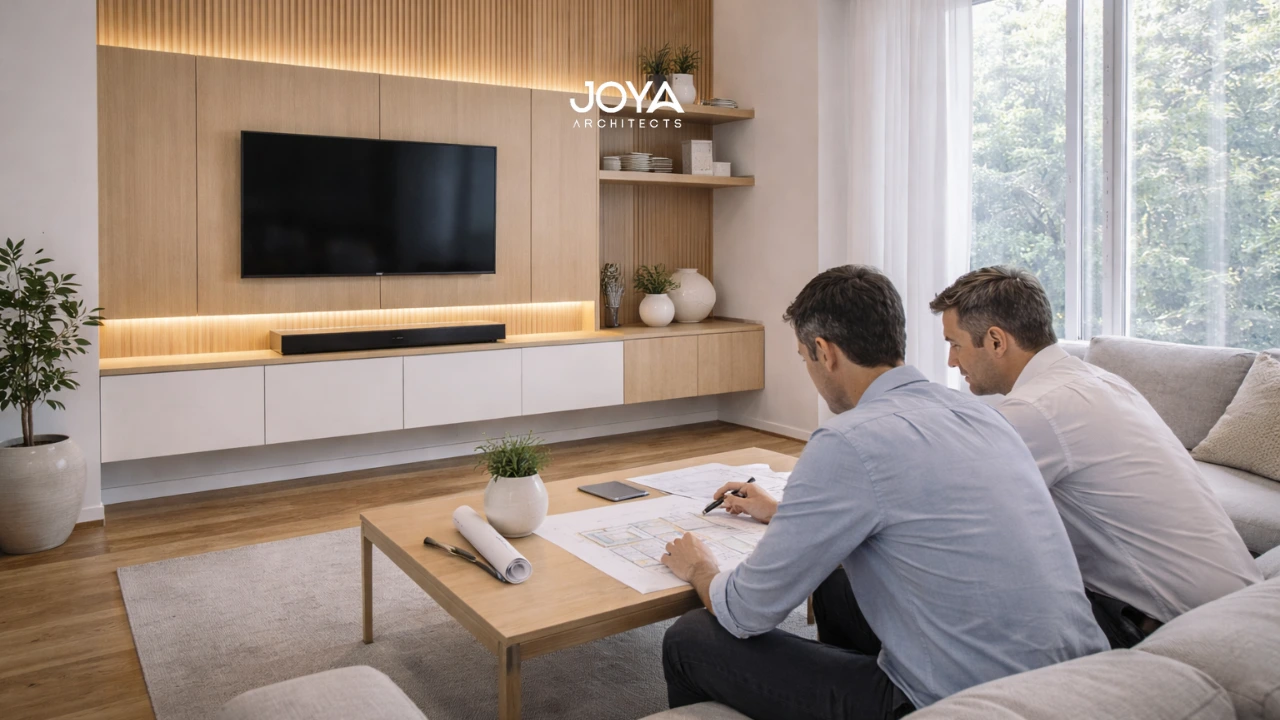
The living room often serves as the visual centerpiece of a home. Whether in a custom build or knockdown rebuild project, it is typically the first interior space encountered when moving from entry areas toward the core living zones.
Because of this central role, homeowners frequently look for living room accent wall ideas that help define the room’s character while maintaining balance with the surrounding architecture.
An accent wall. sometimes called a feature wall. is not simply a decorative surface. When approached thoughtfully, it becomes an architectural element that anchors furniture arrangements, frames visual sightlines, and reinforces the spatial hierarchy of the room.
Understanding what is interior design helps clarify why accent walls work best when integrated with spatial planning, lighting strategies, and furniture placement rather than applied independently.
For homeowners exploring design possibilities, the goal is not to introduce contrast for its own sake but to create a focal point that supports how the room is used and experienced.
Before considering specific accent wall ideas, it is useful to understand what a feature wall is within architectural thinking.
A feature wall is a deliberate point of visual emphasis. It directs attention within the room and often anchors the primary seating arrangement or entertainment area.
In many living rooms, the feature wall becomes the location for the television, built-in shelving, artwork, or integrated lighting. When planned early in the design process, it helps organize the entire spatial layout.
For example, a homeowner designing a custom build may initially focus on furniture placement when imagining the living room. However, once the architect establishes the position of a feature wall, the room’s layout often becomes clearer. Seating naturally orientations toward the focal surface, circulation paths remain unobstructed, and lighting can be layered to reinforce the composition.
Architects frequently evaluate this relationship through architectural planning room layouts, ensuring that the feature wall aligns with sightlines from adjacent spaces such as dining areas or entry zones.
A practical homeowner scenario illustrates this point.
Imagine entering a living room where the feature wall faces the main entry axis. The wall becomes an immediate visual anchor, drawing attention into the space. If the feature wall were placed along a side wall instead, the room might feel less structured, and furniture placement may become less intuitive.
In this way, feature walls contribute to spatial clarity rather than merely decorative effect.
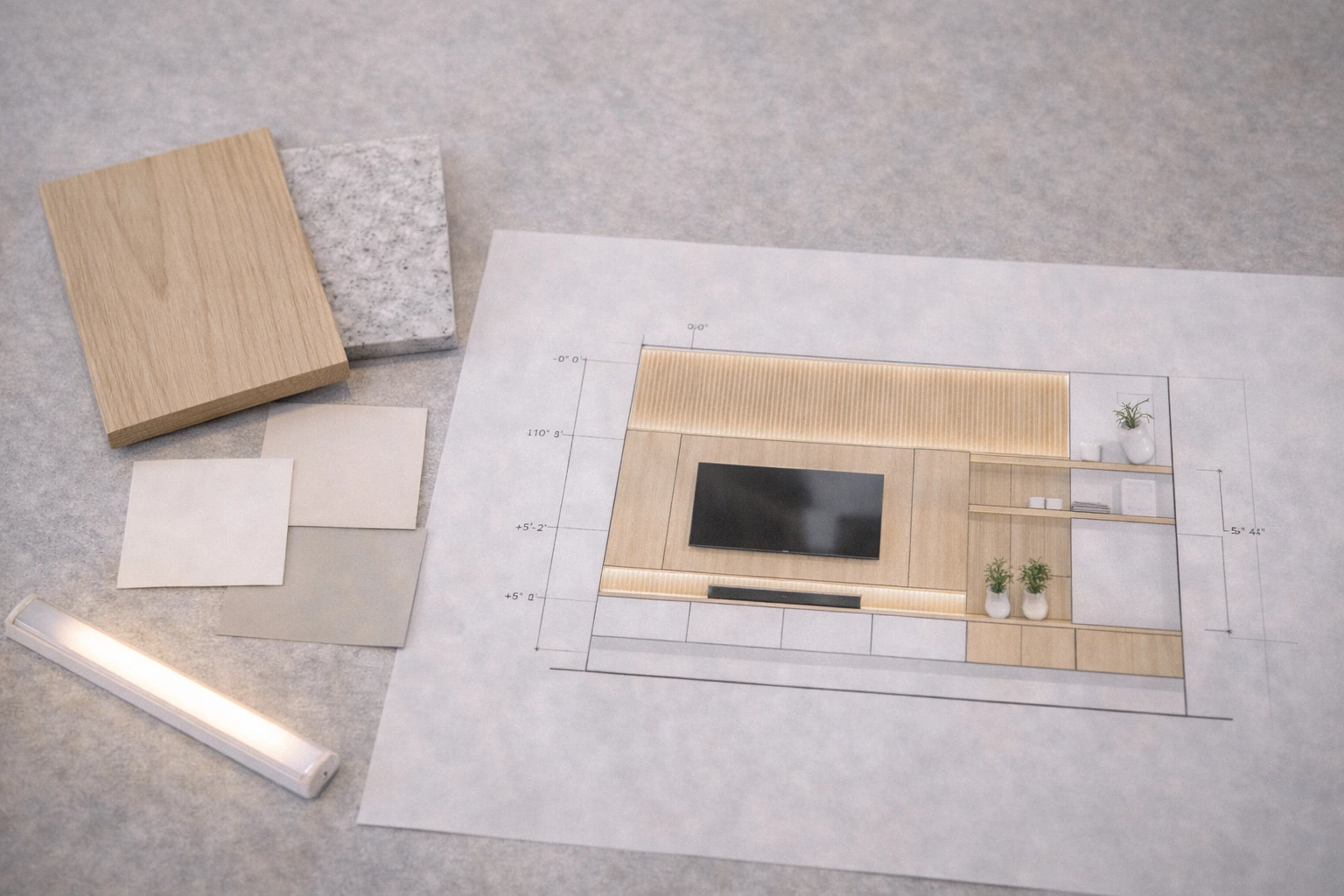
When exploring modern TV feature wall design ideas, homeowners often focus on materials such as stone panels, timber battens, or textured wall finishes. While these elements influence visual impact, the architectural integration of the feature wall is equally important.
One of the most effective approaches is aligning the feature wall with built-in storage or cabinetry.
For instance, a television wall may incorporate recessed shelving, concealed cable management, or integrated lighting. These features allow the wall to function as both a focal point and a practical storage system.
Lighting design plays a particularly important role.
Accent walls often appear more refined when layered lighting highlights texture or depth. Understanding the 3 types of artificial lighting allows designers to combine ambient lighting with accent illumination. such as LED strip lighting behind wall panels or spotlights directed toward artwork.
Material continuity also contributes to successful accent wall design.
A homeowner exploring feature wall designs with paint may choose a contrasting color to define the wall while maintaining harmony with the surrounding palette. When applied thoughtfully, painted accent walls can introduce subtle visual hierarchy without requiring expensive materials.
For example, a muted earth tone or deep charcoal shade behind a television can visually frame the screen while creating a calm atmosphere within the room.
These choices often connect with broader interior strategies such as minimalist color palette planning, where restrained tones help maintain spatial clarity.
A practical scenario demonstrates this clearly.
A homeowner designing a compact living room may initially consider adding textured wall panels behind the television. However, the architect might recommend a painted feature wall combined with integrated shelving instead. This approach preserves budget while achieving the same visual emphasis.
The result is a feature wall that supports both aesthetics and functionality.
While accent walls are primarily design elements, their placement often interacts with spatial planning decisions.
For example, the wall chosen as the focal point should ideally align with the natural orientation of the seating arrangement. If the accent wall conflicts with circulation routes or doorway alignments, the room can feel awkward despite having a strong visual element.
Architects therefore consider how the feature wall relates to the broader spatial flow of the home.
In open-plan living environments, the feature wall may also be visible from dining areas or kitchens. In such cases, the design must remain visually balanced from multiple viewpoints.
Homeowners exploring what is a good accent wall for a living room often discover that the most effective wall is simply the one already positioned as the room’s natural focal point.
Another important factor is scale.
A small living room may benefit from subtle accent walls. Perhaps using paint, lighting, or minimal texture. While larger spaces can accommodate more expressive materials such as timber slats or stone surfaces.
Understanding the 7 essential elements of interior design helps guide these decisions by emphasizing proportion, balance, and harmony within the room.
For example:
A homeowner planning a knockdown rebuild may envision a dramatic stone feature wall in the living room. During the design process, however, the architect may suggest a more refined timber slat wall that aligns with ceiling panels and cabinetry finishes. This creates continuity throughout the living space rather than isolating the feature wall as a separate decorative element.
The result feels cohesive rather than visually overwhelming.
When homeowners ask “what is the rule for accent walls?”, they are often seeking a formula that guarantees visual success.
In architectural practice, however, feature walls are not governed by strict rules. Instead, they are guided by spatial reasoning.
A useful principle is restraint.
The purpose of an accent wall is to create focus. If multiple walls compete for attention. through bold colors, textures, or materials. the room can feel visually fragmented.
This is particularly relevant in compact living spaces where clarity of composition is essential.
Homeowners exploring accent wall living room concepts often find that the most successful designs are those where the feature wall supports the broader architectural narrative of the room.
For example, a minimalist living room may use a simple painted wall behind the television combined with concealed lighting and floating shelves. The design remains understated while still establishing a clear focal point.
These ideas frequently appear in minimalist living room ideas, where simplicity and material restraint allow architectural elements to stand out naturally.
A practical homeowner example illustrates this well.
A family designing a new home may initially consider adding multiple decorative wall treatments across the living area. During design exploration, the architect might consolidate these ideas into a single refined feature wall that integrates cabinetry, lighting, and media storage.
The room ultimately feels more spacious and composed because the focal point is clear.
This strategic approach ensures that accent walls enhance the architecture of the space rather than competing with it.
Accent walls can transform a living room when they are thoughtfully integrated into the architecture of the space. Rather than acting as isolated decorative elements, they help organize furniture layouts, establish visual hierarchy, and reinforce the room’s overall design language.
For homeowners exploring living room accent wall ideas, the most effective solutions often emerge from early design exploration. When feature walls align with spatial planning, lighting strategy, and material continuity, they become enduring elements of the home’s interior character.
Whether through paint, integrated cabinetry, or textured materials, the goal is always the same: to create a focal point that supports both aesthetic clarity and everyday usability.
If you are exploring living room accent wall ideas as part of a custom home or knockdown rebuild project, thoughtful planning during the design stage can help integrate focal elements seamlessly into the architecture of the home.
At Joya Architects, feature walls, material palettes, and spatial layouts are considered together to ensure living spaces feel balanced, refined, and enduring.
Learn more about how our team approaches residential interior design and spatial planning through our residential interior design services.