



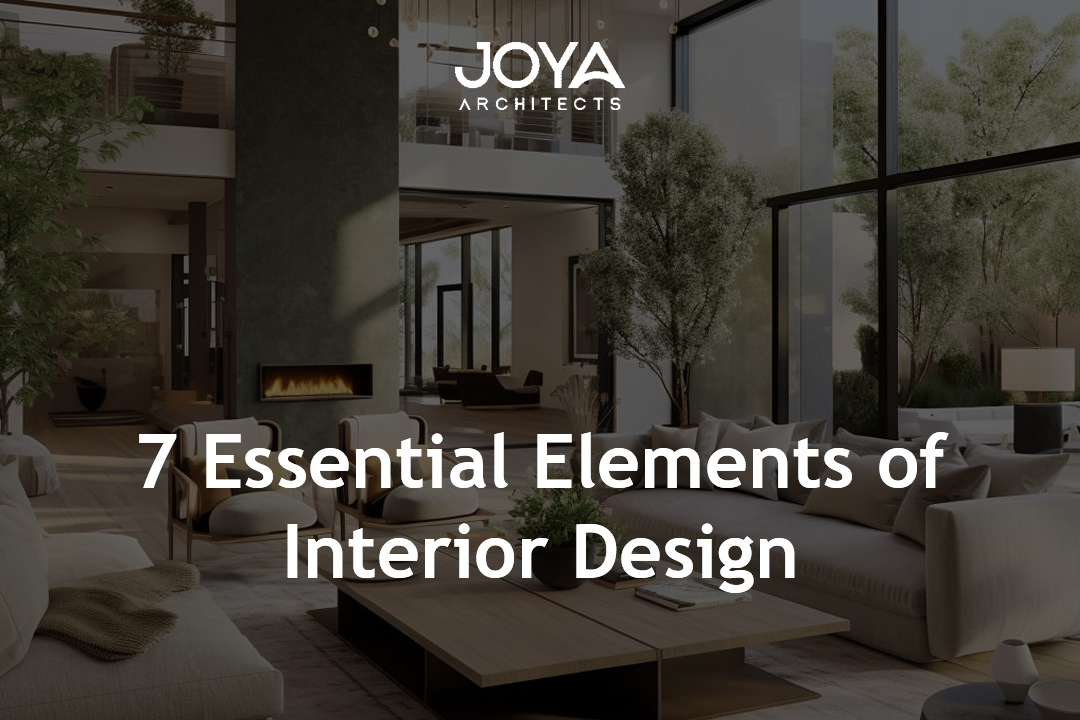
If you’ve ever walked into a room that just feels complete, you are experiencing the work of a designer who has mastered the fundamental building blocks of their craft.
We often talk about the principles of design—like balance, rhythm, and harmony. These are the “rules” or the how of a great design. But what are they working with?
This is where the 7 essential elements of interior design come in.
These elements are the “tools” themselves. They are the what. If the principles are the recipe, the elements are your ingredients. They are the raw materials—Space, Line, Form, Light, Color, Texture, and Pattern—that architects and designers use to compose a beautiful and functional space.
Understanding this toolkit is the key to appreciating why a well-designed home feels so different.

Space is the most essential element. It is the canvas upon which all other elements are placed. It refers to the physical boundaries of a room—the floor, ceiling, and walls—and the area within them.
Professional design thinks about space in two ways:
Why it’s essential: Inexperienced design often tries to fill all the space. In contrast, expert design understands that negative space is not wasted space. It is a crucial element for creating balance, providing a place for the eye to rest, and allowing the positive elements (your furniture) to breathe. In a well-designed home, the empty space is just as important as the filled space.
Lines create shape, define boundaries, and are used to guide the eye through a space. The lines in a room—whether visible in its architecture or implied by the arrangement of furniture—have a profound psychological effect.
A great design skillfully balances these lines to create the desired feeling, whether it’s a serene bedroom (horizontal) or a dramatic entryway (vertical and curved).
Form is the 3D shape of any object in the room, from the sofa to a small vase. It refers to the volume and mass of an object.
The interplay between geometric and organic forms is key. A room with only geometric forms can feel rigid, while a room with only organic forms can feel chaotic. The balance between the two creates harmony.
Light is arguably one of the most transformative elements. It affects the mood, color, and perceived size of a space. Without light, all other elements cease to matter.
A successful lighting plan is built in layers:
And, of course, Natural Light is the most prized. Great architecture is designed to maximize natural light, connecting the home to the outside world and enhancing the well-being of its occupants.
Color is a powerful tool that can instantly change the entire feeling of a space. It has a deep impact on our psychology and can be used to make a room feel calmer, more energetic, larger, or more intimate.
Designers think about color in three parts:
A common professional guideline is the 60-30-10 Rule: 60% of the room is the dominant color (walls), 30% is the secondary color (furniture), and 10% is the accent color (cushions, art, accessories).
Texture is the surface quality of an object—how it feels or looks like it would feel. This is the element that engages our sense of touch and adds crucial depth and warmth to a room.
A space with only one texture (e.g., all smooth and flat surfaces) feels sterile and one-dimensional. Great design layers multiple textures:
Texture is what makes a minimalist design feel rich and inviting rather than cold and empty.
Pattern is the repetition of a graphic motif. It can be found on wallpaper, rugs, textiles, or tiles. While similar to texture, pattern’s job is to add visual energy and break up the monotony of solid surfaces.
The key to using pattern is balance. It can be a bold focal point (like a statement rug) or a subtle background element (like a tone-on-tone wallpaper). A well-designed room balances areas of pattern with solid-color “resting spots” for the eye.
If the Principles (like balance and rhythm) are the recipe, then these 7 Elements (space, line, form, light, color, texture, and pattern) are the ingredients.
You can have all the best ingredients in the world, but it takes a skilled chef to know how to combine them into a truly magnificent dish.
In the same way, an architect or designer is a professional who has mastered this language. They don’t just add a sofa (Form) to a room (Space); they understand how its color, texture, and lines will interact with the light and balance all the other elements to create a single, harmonious, and functional experience.
At JOYA Architects, we speak the language of design.
Our expertise lies in mastering these fundamental elements, composing them to create private landed homes in Singapore that are not just built, but thoughtfully designed around you.
Contact JOYA Architects today to start the conversation about your future home here.