Joya Architects » Blogs » URA and BCA Approval Timelines for Singapore Landed Homes
Architectural Process Guides
URA and BCA Approval Timelines for Singapore Landed Homes
By achmad
2026-10-08 19:01:29
URA and BCA approval timelines depend on the submission route, design readiness and the number of review cycles. A published processing target starts at a defined submission milestone; it does not include all the surveying, design, coordination and revisions needed to reach approval.
For a landed homeowner, the useful question is therefore when the project can become ready for the next activity. A contractor’s proposed start date should be checked against the actual approvals and permits needed for that work.
URA and BCA approval timelines: what official guidance says
CORENET X guidance on joint submissions describes an expected agency response time of 20 working days for a typical project. The clock follows successful submission and payment; its detailed rules distinguish submissions made before and after close of business. A response can require further work rather than grant approval.
BCA’s structural submission guidance separately lists processing standards for other applicable routes and complete permit applications. Ask the Qualified Person, or QP, to identify which route and target apply to your project instead of adding figures from unrelated processes.
Start with the correct submission route
A new house, reconstruction and smaller alteration do not necessarily follow an identical sequence. The QP should identify the regulatory scope, eligibility for any lodgment route and the treatment of an existing project during changes to submission systems.
URA’s landed-house lodgment criteria demonstrate why this assessment matters: eligibility has conditions and documentary requirements. A faster administrative route does not remove the need for a compliant design or other relevant clearances.
Read the step-by-step URA planning submission guide alongside the programme. It explains the planning work behind the milestone, while the programme should name the person responsible for each outstanding input.
Separate preparation, review and revision
Preparation before an application is ready
Boundary and level surveys, existing records, ground information and drainage constraints can affect the initial scheme. If those inputs are missing, the designer may have to revisit the building footprint, floor levels or foundation approach before issuing coordinated information.
Ask for a readiness list with three columns: item required, responsible party and agreed delivery date. This makes a missing survey visible as a project dependency rather than an unexplained authority delay.
Agency review and the team’s response
During review, keep one current register of submissions and responses. Record the submission reference, accepted date, outstanding direction and next action. An email saying that drawings were uploaded is less informative than confirmation that the relevant review has actually started.
When comments arrive, the team may need architectural, structural and specialist input. The time needed to resolve those comments belongs in the programme. It should not be hidden inside a single block labelled approvals.
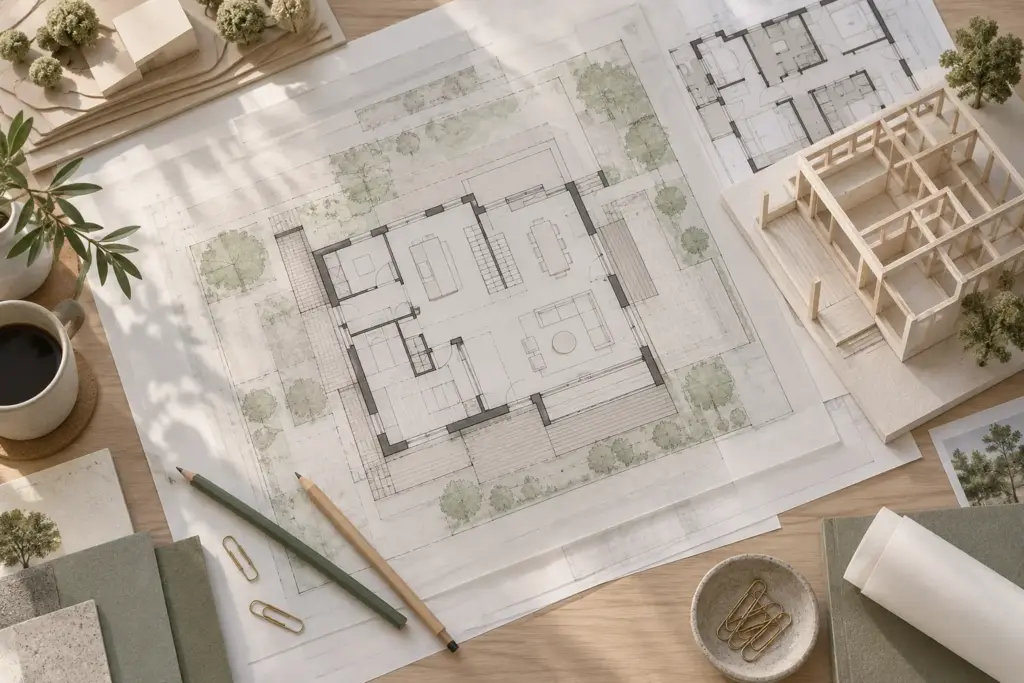
AI-generated conceptual illustration, not to scale; not an approved plan or completed Joya project.
Your landed home, your next step
Planning a project on a Singapore landed plot?
Site conditions and planning requirements shape what can be designed. Explore how Joya brings architectural design and the submission process together for landed homes.
Use a dependency schedule instead of a single deadline
Consider an illustrative sequence: a revised floor level changes the entrance, drainage layout and stair geometry. Even if each revision is modest, several drawings must agree before a coordinated response can be submitted. The controlling task is the last unresolved interface.
In this situation, booking a builder on the assumption that the first response will be final approval creates avoidable exposure. Ask the architect to show a working date, a contingency allowance and the decision that would cause either date to move.
Some design and procurement tasks can progress alongside review, but the team must identify the risk of committing early. Paying for a bespoke component before its dimensions are stable can turn a scheduling shortcut into a replacement order.
Check what approval actually unlocks
A planning decision, technical clearance, approved structural plan and permit serve different purposes. Before mobilisation, request a written start-readiness check for the proposed work package. Include the required approvals, contractor appointment, site arrangements and any remaining conditions.
This is especially useful when work is phased. A document that supports one activity should not be treated as general permission for everything shown in the eventual house design. The appointed professionals should confirm the boundary of the authorised package.
What homeowners can do this week
Confirm the brief, nominate one person to consolidate family decisions and return requested information by the agreed dates. Ask whether a proposed design change affects only finishes or also the submission package. The second category needs a different timing conversation.
Use the full timeline from brief to handover to place approvals within the wider project. For problems beyond statutory review, the companion guide to what can delay a landed project covers decisions, procurement and site dependencies.
Before agreeing a construction start, discuss your project’s approval sequence with Joya. Bring existing plans, the intended scope and any fixed moving date so that the programme can be tested against actual information.
Frequently Asked Questions
Does a 20-working-day response mean my house is approved?
No. The CORENET X target concerns an agency response to a qualifying joint submission. That response may include directions requiring revisions. Preparation before submission, the consultant team’s response work and subsequent review cycles can extend the overall period needed to reach the relevant approval.
Can URA and BCA work happen at the same time?
Some coordination can proceed in parallel, and CORENET X supports joint review at applicable gateways. The exact sequence depends on the route and outstanding conditions. Ask your QP which tasks may overlap and which require an earlier decision before the next submission can proceed.
Can a contractor start once planning permission is granted?
Planning permission alone should not be treated as a complete start authorisation. The team must check the technical approvals, permits and other requirements for the proposed work. Your QP and builder should confirm readiness for the specific package before arranging the relevant construction activity.
How can I reduce avoidable approval delays?
Provide accurate site information, settle the brief early and respond promptly to decisions that affect drawings. Ask for a submission register showing outstanding comments and responsible parties. These actions improve readiness and coordination, although they cannot guarantee approval or determine an agency’s assessment outcome.
Your landed home, your next step
Discuss your property and project plans
Tell us about your property and the work you are considering. Start a conversation with Joya about your project’s architectural scope and next steps.