Joya Architects » Blogs » Landed Home Contingency Budget: Hidden Costs to Plan For
Architectural Process Guides
Landed Home Contingency Budget: Hidden Costs to Plan For
By achmad
2026-10-06 19:45:15
A landed home contingency budget is an allowance for uncertainty in delivering an agreed project. It sits alongside identified costs, rather than replacing proper allowances for demolition, professional services, owner purchases or other work already known to be required.
The right question is not simply which percentage to add. Ask what remains uncertain, how its consequences could be reduced and when better evidence will become available. Keep this reserve visible within the full landed home cost breakdown so it is not mistaken for money available for upgrades.
Why official site information still needs investigation
PUB’s Services Plans guidance requires relevant information and site verification before development design. It explains that some existing connections or common drains may not appear in the plans. This provides a concrete reason to distinguish documentary information from verified site conditions.
The budgeting implication is practical: obtain and interpret the evidence early, then decide what remains uncertain. A reserve does not remove the need for investigation. Equally, having a drawing does not mean that every physical detail affecting the proposed work has already been established.
Build the landed home contingency budget around named risks
Start with a short register of matters that could change scope, cost or programme. Examples include uncertain ground conditions, concealed building fabric, incomplete services information and design decisions still awaiting coordination. Describe the consequence rather than recording only a broad label such as site risk.
For each item, identify what would clarify it, who will obtain that information and which decision depends on the result. This makes the allowance actionable. A risk attached to an investigation has a route toward resolution; a general percentage alone does not.
Separate a known exclusion from a genuine unknown
If required demolition is excluded from the contractor’s price, it needs its own budget line. The same applies to agreed appliances, landscape work or temporary accommodation. Calling these items contingency understates the expected project cost before any uncertain event occurs.
By contrast, uncertainty about the extent of concealed remedial work may justify an allowance until an appropriate assessment establishes the scope. State the assumption behind that allowance. Where access prevents early investigation, record that limitation instead of presenting the amount as a confirmed price.
Keep provisional sums visible
A provisional sum is a contract allowance for specified work whose details or valuation are not fully settled under the relevant contract terms. It is not automatically an additional owner contingency. Read what the allowance covers and how its eventual adjustment will be assessed.
For illustration, a quotation containing a S$30,000 allowance for an identified package has already included that amount in its total. If later information indicates S$38,000, the forecast difference is S$8,000 on the same basis. Do not add the full revised package again.
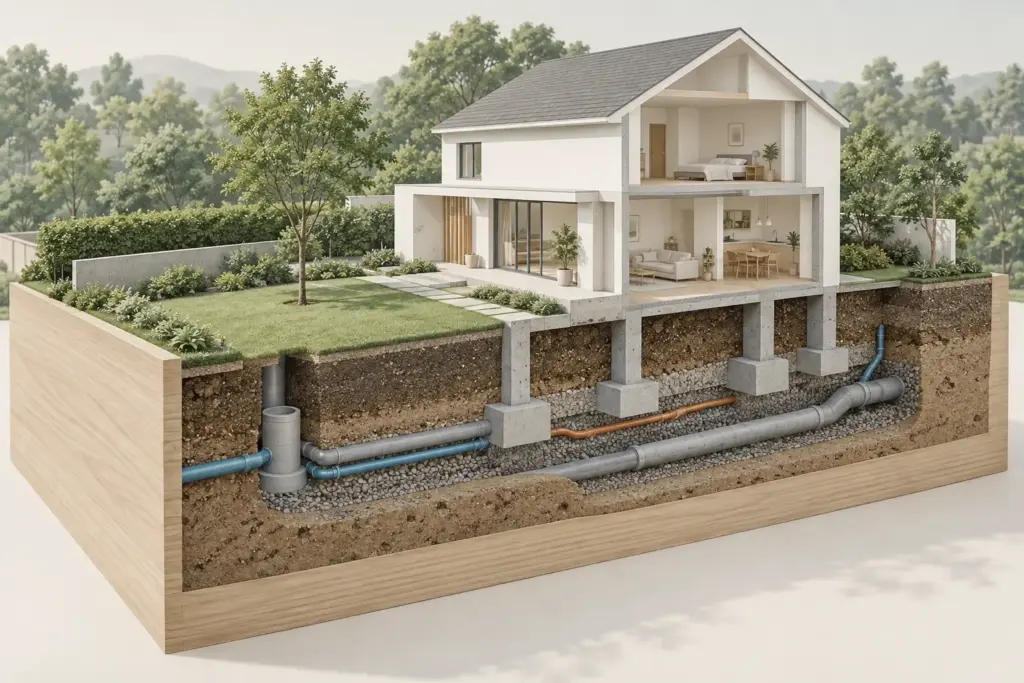
AI-generated conceptual illustration, not to scale; not an approved plan or completed Joya project.
Find hidden costs by tracing the whole project
Walk through the project from surveys to occupation. Ask who pays for investigations, site preparation, utility-related work, required inspections, testing, commissioning and handover items. Include storage, moving and accommodation where relevant to your household’s circumstances.
Read the guide to professional and authority fees to separate service appointments from application charges. A builder’s construction sum may not include either. The owner’s budget should still recognise them before comparing the total with available funds.
Also check the basis of construction cost per square foot. A rate applied to one area definition cannot reliably cover a different one. A measurement or scope mismatch is a budgeting error to correct, rather than a reason to quietly consume contingency.
Allow for time-related consequences
An unresolved decision can affect more than the price of one item. Changed sequencing, extended temporary arrangements or longer accommodation commitments may follow. Ask the team which costs would continue if an identified activity takes longer, and avoid counting the same consequence in several allowances.
A hypothetical two-month extension to accommodation costing S$4,000 monthly adds S$8,000 to that household allowance. It does not establish the contractor’s entitlement to any payment. Contractual consequences require their own assessment under the agreed terms and circumstances.
Set decision dates for long-lead selections and information required by the builder. When a choice changes, ask for its scope, cost and time effects together. A cheaper product arriving too late may not create a saving once the wider consequences are considered.
Review the reserve as evidence improves
Maintain a forecast that distinguishes committed amounts, expected remaining work and unresolved risks. Record approved changes separately from the original budget. The forecast should show what is still needed to finish, not only what has already been invoiced.
As investigations resolve a risk, transfer the established cost into the appropriate work package and reassess the reserve. Do not automatically spend an apparently unused allowance on finishes while other substantial questions remain open. Review the remaining risks as a group before releasing funds.
Keep discretionary upgrades separate too. Changing the brief is an owner decision with its own budget effect. Labelling every preferred enhancement unforeseen makes it harder to understand whether the original scope was adequately planned and whether the remaining reserve is sufficient.
Ask for a budget you can challenge
Bring the current quotations, exclusions and unresolved issues to Joya Architects for a project discussion. Ask which uncertainty could most affect the forecast and what would reduce it. A useful contingency plan turns unknowns into specific next actions.
Frequently asked questions
What contingency percentage should I use for a landed rebuild?
Agree the allowance with the project team based on design maturity, investigations and unresolved risks. A universal percentage cannot reflect every site. Record the basis, distinguish contingency from known excluded work and review the remaining reserve whenever new information materially changes the forecast cost to finish.
Is contingency the same as a provisional sum?
No. A provisional sum is an allowance within the relevant contract for identified work, subject to that contract’s terms. Owner contingency addresses uncertainty in the wider budget. Keep both visible and understand their coverage so the same work or risk is not counted twice.
Can I use contingency for better finishes?
You can decide to increase the specification, but treat that as a deliberate change to the budget. Before using funds reserved for risk, review the unresolved issues and forecast remaining expenditure. An apparently unused allowance is not necessarily available while investigations, procurement or construction questions remain open.
Does a fixed-price contract remove the need for contingency?
No. Read the contract’s scope, exclusions, allowances and change provisions. An owner may still face separate expenses or costs arising from changed instructions and other matters under the agreed terms. Budget certainty improves through clear documents and resolved information, rather than through the fixed-price label alone.