Joya Architects » Blogs » Material Selection for Tropical Landed Houses: Building with Climate Intelligence
Material Selection for Tropical Landed Houses: Building with Climate Intelligence
By achmad
2026-06-17 11:21:48
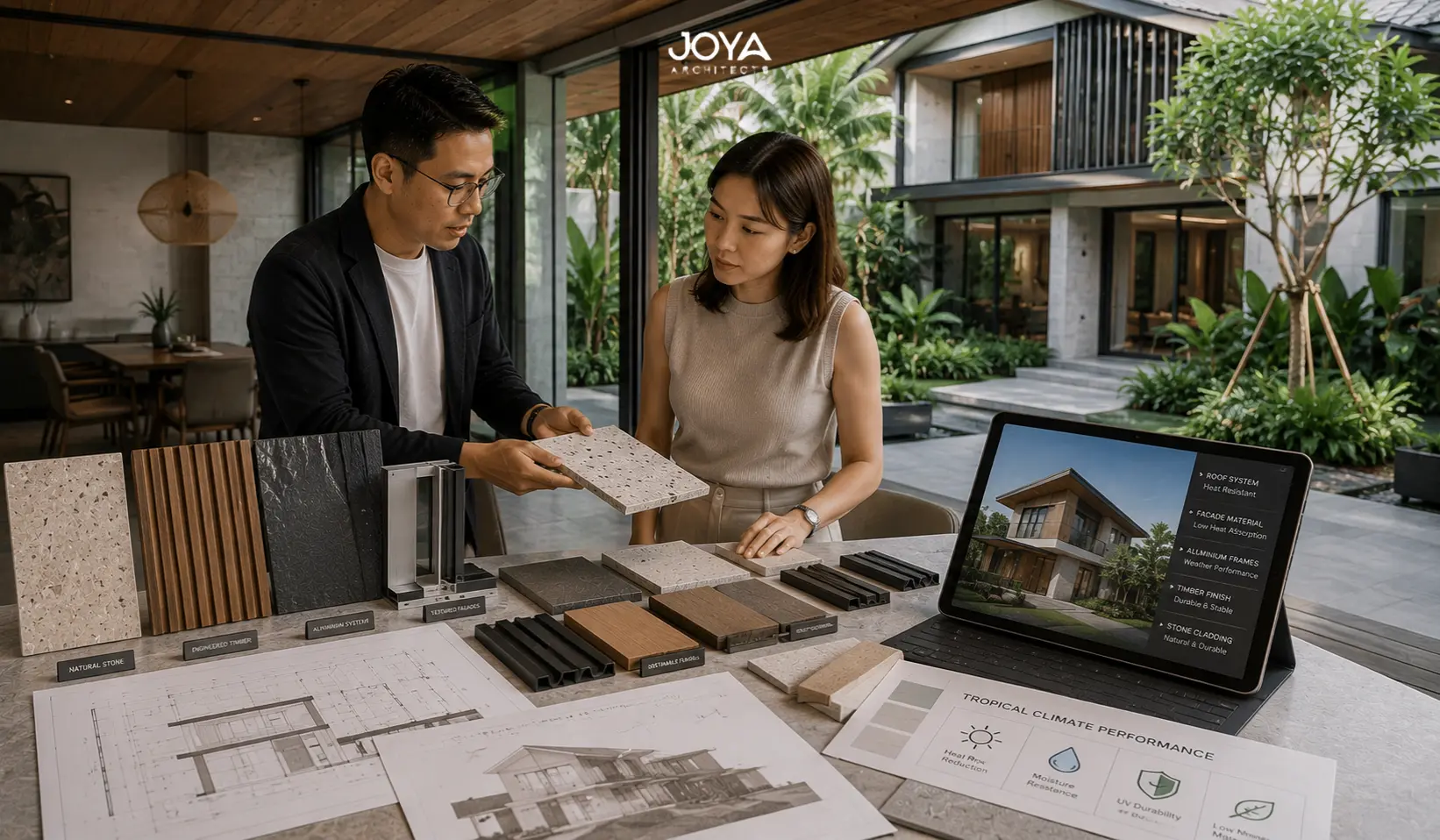
Every material decision in a Singapore landed home is also a climate decision. This is not a dramatic statement about sustainability; it is a practical observation about how Singapore’s tropical conditions interact with building materials over time. Humidity, UV intensity, biological growth, and the thermal cycling between heavily air-conditioned interiors and hot external environments create a set of material performance demands that differ significantly from those in temperate climates.The reference images that arrive in most landed home briefs are sourced from a global pool of architectural publications where a substantial portion of the featured work was designed for climates with cold winters, dry summers, and UV intensities a fraction of Singapore’s. The materials in those images perform the way they do in their photographed state because they inhabit those climates. Transplanted to Singapore without recalibration, many of them will behave quite differently within five years of installation.Architects who practice seriously in Singapore’s tropical context approach material selection as a climate-first discipline. Aesthetic quality is a genuine consideration; it is simply not the primary filter.
How Singapore’s Climate Tests Building Materials
Singapore’s climate tests materials through four primary mechanisms, each of which operates continuously rather than seasonally.Humidity is the most pervasive stress. Relative humidity in Singapore averages between 70% and 90% throughout the year and reaches saturation during and after rainfall. Materials with high moisture absorption expand and contract repeatedly, developing cracks, delaminations, and biological growth at any point where moisture can accumulate. Timber species without adequate moisture resistance warp, cup, and develop surface mould. Plaster finishes with inadequate bonding or waterproof additive detach from substrates. Adhesive-based tile installations fail at the bond line.UV intensity at Singapore’s latitude is approximately twice that of central Europe. External materials without adequate UV stability bleach, fade, and degrade their polymer bonds. Paints without UV-resistant formulations require recoating on cycles of two to three years rather than five to seven. Polymer-based seals and gaskets harden and crack, creating pathways for water ingress.Thermal cycling between conditioned and unconditioned environments creates expansion and contraction differentials at material interfaces. A tiled floor that transitions from an air-conditioned interior at 22 degrees to an external patio at 32 degrees undergoes a thermal differential across the transition zone that, over years of daily cycling, produces movement at the grout lines and eventually cracking at the tile edge.Biological growth, including mould, algae, and lichen, occurs on any surface that retains moisture and receives sufficient ambient light. External walls in particular develop biological discolouration within months of construction if surface porosity is high and the climate management strategy assumes that cleaning is the primary maintenance tool.
Categories of Tropical-Appropriate Materials
The material vocabulary appropriate for tropical Singapore landed homes is well-established within the architecture of the region, even if it is not always what appears in international reference images. It encompasses a range of materials for exterior, structural, and interior applications that share a consistent set of performance characteristics: moisture resistance, UV stability, thermal mass, and minimal maintenance burden.Fired clay products, including brick, terracotta tiles, and clay roof tiles, have been the dominant material of tropical architecture for centuries across Southeast Asia for good reason. They are dimensionally stable in high humidity, resistant to biological growth when well-fired, and thermally massive in ways that moderate the temperature swings between day and night. Their surface texture is not affected by UV intensity, and their colour, which comes from the mineral composition of the clay body rather than applied pigment, does not bleach under prolonged sun exposure.Natural stone, particularly granite, bluestone, and sandstone, performs strongly in Singapore’s climate when selected for appropriate porosity. Dense, low-porosity stones resist moisture absorption and biological colonisation effectively. Highly porous sedimentary stones used in external applications require impregnation treatments that must be maintained, making them more demanding in operational terms.Concrete, whether precast, off-form, or rendered, is among the most climactically appropriate structural and surface materials for Singapore’s tropical environment. It is thermally massive, moisture-neutral in cured form, and biologically resistant when surfaces are adequately treated. Off-form concrete expressed honestly as the finished surface of a wall or element has a material integrity that requires no maintenance beyond periodic cleaning and avoids the delamination risks of applied render systems.
Exterior and Structural Materials
The exterior of a Singapore landed home is the material system most directly exposed to the full force of the tropical climate, and it is where material selection decisions carry the longest consequence. Façade materials, roof systems, external flooring, and landscape elements are all subject to the combined stresses of UV, humidity, thermal cycling, and biological growth throughout the year.Fibre cement boards offer a practical exterior cladding option with good moisture resistance and dimensional stability compared with natural timber. They accept paint finishes and can be detailed to create contemporary façade expressions without the maintenance demands of natural timber alternatives.Aluminium in powder-coated or anodised form is appropriate for external joinery, louvre systems, and structural frames because it is dimensionally stable, corrosion-resistant, and does not absorb moisture. The quality of the coating system matters: architectural-grade powder coating systems with adequate film thickness and UV-stabilised pigments perform significantly better than lower-grade alternatives over a ten-year horizon.For external decking in terraces and pool surrounds, composite decking formulations have largely replaced natural timber in serious tropical residential architecture. Solid hardwoods such as teak and chengal remain viable options when properly specified, sourced, and maintained, but the maintenance commitment is genuine: regular cleaning, occasional oiling, and periodic sanding to manage surface weathering. Homeowners who are not prepared for that maintenance commitment are better served by composite systems.Roof systems are among the most consequential material decisions in a Singapore landed home because roof failure has a cascading consequence across all the spaces below. Metal roofing with adequate insulation and thermal break detailing offers strong performance in terms of longevity, drainage, and thermal management. The specification of the insulation layer and the design of the condensation plane are details that distinguish a thermally effective roof from one that produces ceiling condensation in air-conditioned spaces below.
Flooring and Interior Materials
Internal material selection in a tropical landed home operates under the climate pressure of the transition between conditioned and unconditioned environments, and under the specific humidity conditions of a building envelope that, however well detailed, will admit some degree of ambient moisture.Stone flooring at ground level requires consideration of the slab’s relationship to the ground plane. Ground-bearing slabs in Singapore have a high humidity interface at the ground contact, and stone laid directly without adequate damp proof membrane and screed system may develop efflorescence and delamination over time. The detail is standard practice for experienced contractors but is not always applied with the discipline required.Engineered timber flooring is generally more appropriate for Singapore’s interior conditions than solid hardwood. The cross-ply core of engineered timber resists the dimensional changes associated with humidity variation more effectively than the solid grain of natural hardwood. This distinction matters particularly on upper floors where the humidity exposure is lower than the ground level but the thermal cycling from air-conditioned spaces is significant.Wall finishes in wet areas must be specified with waterproofing system compatibility as the primary criterion. Tiles over a properly detailed waterproofing membrane perform reliably in Singapore’s high-humidity bathroom and kitchen conditions. The quality of the membrane system and the consistency of its installation are more important to long-term performance than the quality of the tile itself.
Materials to Approach with Caution
Certain materials that appear frequently in international residential architecture publications require careful reconsideration in the Singapore tropical context.Exposed natural timber on external applications without a robust protection strategy degrades visibly and structurally over a five-year horizon in Singapore’s conditions. The commitment to regular maintenance that tropical timber requires is genuine and ongoing; it is not a one-time specification decision.Applied render systems on external walls that use polymer-based renders over poorly bonded scratch coats are consistently among the most maintenance-demanding exterior finish systems in Singapore. The delamination and cracking patterns that result from moisture cycling behind the render surface are not resolved by repainting and require periodic removal and reinstallation.High-gloss internal wall finishes in large-area applications tend to amplify ambient light conditions in ways that can reduce, rather than enhance, spatial calm. They also show surface imperfections and marks more readily than flat or semi-gloss alternatives, increasing the perceived maintenance burden of the interior.
Sustainable Material Selection in Tropical Design
The material selection principles appropriate for tropical climate performance align substantially with sustainable design values. Materials that perform honestly in their natural state, that require minimal processing to achieve their performance characteristics, and that age with dignity rather than degrading rapidly are both climatically appropriate and environmentally considered.Locally sourced materials, where available, reduce the embodied energy associated with transportation and tend to be better adapted to the regional climate conditions than materials imported from markedly different climates. Reclaimed timber, locally quarried stone, and regional ceramic products all carry lower embodied carbon than imported equivalents and perform with the accumulated intelligence of materials that have been tested in this climate over generations.The sustainability dimension is not the primary driver of the material-driven architectural design process, but it is a consistent alignment: what works for the climate also tends to work for the environment.
Frequently Asked Questions
Why do materials in Singapore seem to require more maintenance than in homes I’ve seen in other countries? Because Singapore’s climate is more demanding than most climates where international architectural reference images originate. The combination of humidity, UV intensity, and biological growth creates material stress conditions that require specific attention to material selection and specification that may not be necessary in temperate climates.
Is natural timber a viable exterior material in Singapore? It can be, with appropriate species selection, surface treatment, and maintenance commitment. Hardwood species with high natural oil content, such as teak or chengal, perform better than softer species. The maintenance commitment is real and recurring, typically requiring annual oiling or cleaning treatments on exposed horizontal surfaces.
How do I compare the long-term cost of different material systems? The useful comparison is total cost of ownership over a ten to twenty year period rather than installed cost. Materials with higher initial cost but lower maintenance burden and longer replacement cycles frequently represent better value than lower-cost alternatives with high ongoing maintenance requirements.
What is the most common material failure in Singapore landed homes? External render delamination and timber degradation on exposed surfaces are consistently among the most common. Both are predictable and preventable through specification decisions at the design stage rather than through post-occupancy management.
Conclusion
Material selection for tropical landed houses in Singapore is not a catalogue decision. It is a climate analysis applied to a specific building, on a specific site, with a specific programme and maintenance commitment. The materials that photograph well in an international design publication and the materials that perform well across twenty years of Singapore’s tropical conditions are not always the same. The architect’s role is to ensure the brief is resolved in favour of the latter, with genuine quality in both.Climate-first material thinking does not produce a less beautiful home. It produces a home that remains beautiful as it ages.