Joya Architects » Blogs » Can We Stay at Home During Landed Renovation With Children or Older Parents?
Architectural Process Guides
Can We Stay at Home During Landed Renovation With Children or Older Parents?
By achmad
2026-11-12 05:15:18
Whether you can stay at home during landed renovation depends on the work scope, the site’s arrangements and advice from the responsible project professionals. With children or older parents, do not assume that an unused bedroom makes continued occupation workable. First establish whether occupation is permitted and appropriately managed, then test whether essential household routines can actually continue.
This is a planning exercise, not an occupancy clearance or medical assessment. Where a family member has specific health or care needs, involve their clinician or care provider as appropriate alongside the project team.
What official guidance says about occupation and renovation exposure
BCA’s TOP and CSC guidance explains occupation requirements associated with building works and the QP’s application role. Ask the appointed professional how these requirements apply to your scope and any proposed phased occupation. Do not treat this as a claim that every minor decorative job needs a new TOP.
The US Environmental Protection Agency’s renovation indoor-air guidance recommends keeping occupants, especially children, away from work areas and controlling pollutants at source. These are general exposure-management principles, not Singapore statutory rules. A closed bedroom door alone does not answer the wider occupancy question.
Can we stay at home during landed renovation? Start with the work sequence
Ask the architect and builder to describe the affected rooms and routes at each stage, not only the finished layout. Identify demolition, structural work, roof work, service interruptions, deliveries and reinstatement where relevant. The smallest work area may still sit on the household’s only route to the bathroom or exit.
Have the responsible professionals explain what they can establish now and what remains conditional. An early suggestion that phased work might be possible is not the same as a coordinated plan for continued occupation. Ask who will review changes and communicate when an earlier assumption no longer holds.
Keep the classification question separate from convenience. The guide to A&A versus reconstruction helps frame the broader work scope, but neither label tells you that living beside the works is suitable. The actual site conditions and proposed sequence need their own assessment.
Which essential rooms and routes would become unavailable?
Test a full day, including the night
Trace waking, bathing, dressing, meals, school departure, rest and bedtime for each person. Include night-time bathroom trips and any help an older parent needs. A route that is manageable once in daylight may not be suitable for repeated use when someone is tired or needs assistance.
Identify essential dependencies: water, electricity, refrigeration, lighting, communications and any care equipment the household relies on. Ask the team about planned interruptions and how uncertain timings will be managed. Do not improvise temporary electrical or service arrangements to make an otherwise unsuitable occupancy plan appear workable.
Check the alternative arrangements as carefully
If you plan to use another bathroom or entrance, check how the household reaches it and whether the route remains separate from work and deliveries. A bathroom is not a usable alternative if access depends on crossing an active work area. Include visitors, carers and emergency access in the discussion.
Likewise, a relative’s spare room or temporary rental needs to suit the people using it. Check access, sleeping arrangements, meals, school travel and care support before relying on it. A relocation plan should reduce uncertainty, not merely replace one untested arrangement with another.
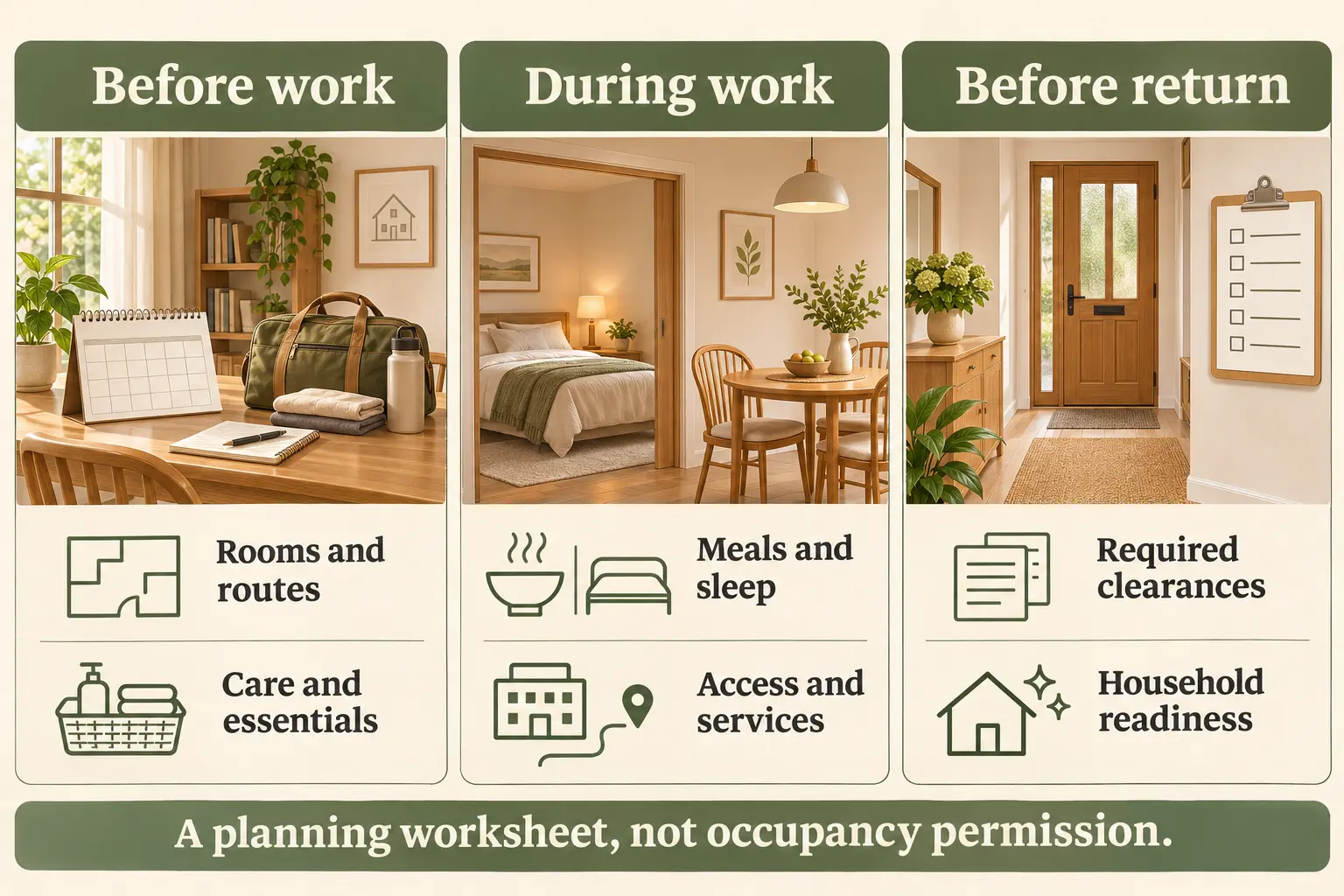
AI-generated household planning illustration. This worksheet does not authorise occupation or certify that a home is ready for return.
Build a household routine and relocation-dependency worksheet
Complete one version for each proposed work stage. The examples below are illustrative prompts, not a finding that any stage is suitable for occupation. Assign someone to confirm each dependency and record what would require a change of plan.
Household planning worksheet for discussion with the project team
Routine or dependency
What the household needs
Question for the stage plan
Alternative to prepare
Sleep and rest
Suitable rooms at the required times
Will works, exposure or access restrictions prevent their use?
Confirmed sleeping arrangement away from affected works
Bathroom and washing
Usable facilities and a suitable route
Which fixtures and services remain available, and when?
Alternative accommodation if essential provision is interrupted
Meals and food storage
Suitable preparation, eating and refrigeration arrangements
Is the kitchen unavailable, and for which stages?
Planned meals at the temporary residence
Care and medicines
Established routines, access and required equipment
What do the care provider and project team need to coordinate?
Care arrangements checked before relocation
School, work and visitors
Predictable departures, access and communications
How do delivery and work zones affect daily movement?
Travel and appointment arrangements from the alternative address
Add dates, responsible people and unresolved items to your own copy. Write a specific change-of-plan trigger beside essential dependencies, agreed with the relevant advisers. “We will manage somehow” is not a substitute for knowing where the household will go if the arrangement stops being workable.
What should the project team establish about occupation?
Ask for a coordinated review of the proposed occupation arrangements, including applicable permissions, segregation, access, services and changes in work stages. Clarify the responsibilities of the architect, relevant engineers and builder. No single informal assurance should stand in for the assessments their respective roles require.
Discuss the circumstances that would require occupants to leave or delay returning. Unexpected conditions, changed demolition scope or a longer service interruption may invalidate an earlier plan. Confirm who has authority to stop the affected arrangement and how the family will receive instructions promptly.
Keep children away from work areas and do not rely on their remembering boundaries in a familiar home. Ask about the complete arrangement rather than selecting one protective measure and assuming it settles the issue. Household supervision cannot replace the site’s professional controls or an unsuitable physical separation.
Prepare relocation before it becomes urgent
Compare remaining elsewhere throughout the affected works with any professionally supported phased option. Include the effort of repeated moves, changing routines and storing household items. This is a household decision alongside the technical assessment, not a reason to negotiate away a requirement to vacate.
Pack essential documents, school items, ordinary clothing and care necessities separately from stored possessions. Identify the person coordinating updates with the builder and another household contact if they are unavailable. Keep an alternative address and practical transport arrangement ready for the period you may need it.
A hypothetical family may initially expect to sleep upstairs while the ground floor is altered. The stage review could reveal that the only stair route passes through affected work or that bathroom services will be interrupted. In that situation, the spare bedroom does not resolve the dependency; the living arrangement must change.
What should be ready before the family returns?
Ask the responsible professionals to confirm the applicable occupation requirements and the status of relevant inspections, clearances and outstanding work. Request a handover explanation covering access, usable rooms, services and any restrictions. A room looking freshly finished is not evidence that every return condition has been met.
Then check household readiness: furniture in place, clear routes, functioning essentials and care arrangements suited to the revised home. Ask the team about cleaning, ventilation and any product-specific requirements following the works. Avoid choosing a universal return date based only on smell, a photograph or a calendar allowance.
Make living arrangements part of the initial brief
Bring the household worksheet and proposed scope to Joya’s architectural consultancy. Explain children’s routines, older parents’ needs and any non-negotiable service dependencies early. The next step is to coordinate design and work-stage questions with the appropriate professionals, while preparing realistic accommodation alternatives.
Frequently Asked Questions
Can we stay upstairs while the ground floor is renovated?
Do not assume so. Access, services, work segregation and the actual construction scope may affect the whole household even if bedrooms are untouched. Ask the responsible project professionals to assess the specific arrangement, including applicable occupation requirements, and prepare an alternative if essential dependencies cannot be maintained.
Is it enough to move children out during working hours?
Not necessarily. Conditions and restrictions can continue after workers leave, and the home’s access or services may remain affected. Ask the project team to assess the complete daily arrangement rather than the work timetable alone. Keep children away from work areas and follow the agreed occupation plan.
Does having an older parent mean we must always relocate?
The answer depends on the works, occupation requirements and the person’s actual routines and needs. Discuss access, rest, bathroom use and care dependencies with the project team, involving their clinician or care provider where appropriate. Do not decide solely from age or from the renovation label.
Can we move back as soon as the contractor finishes painting?
Painting completion is not a complete return criterion. Confirm applicable occupation requirements, outstanding works, essential services and household readiness with the responsible team. Follow relevant cleaning, ventilation and product guidance, and obtain individual care advice where needed rather than relying on a fixed number of days.