



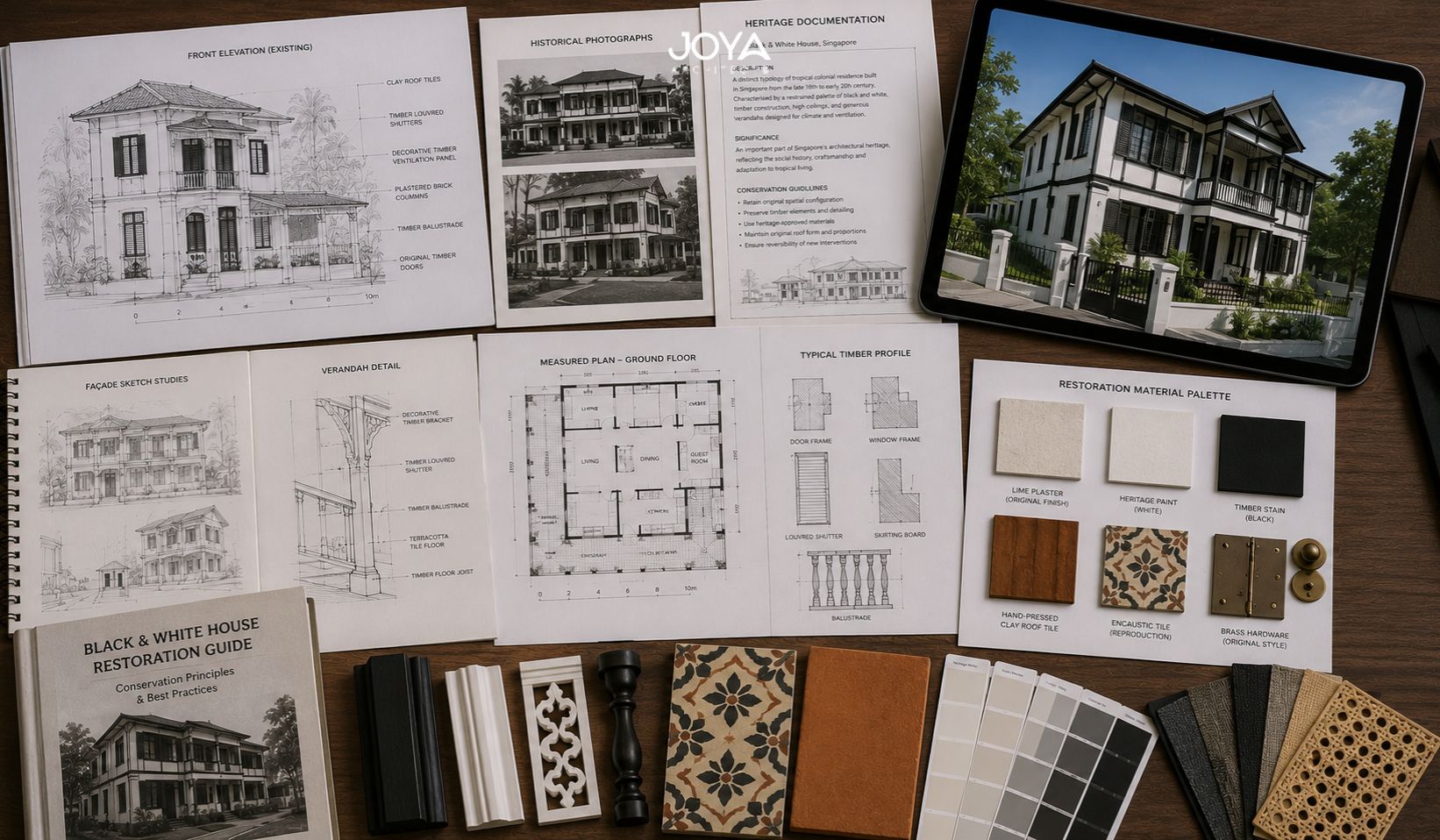
A property practitioner rang us about a black-and-white bungalow in Holland Road. He wasn’t buying it. He was inheriting the SLA lease from a family member who had lived there for nineteen years and was returning to London. The house was 4,800sqft of original colonial timber and plaster, with a verandah that wrapped three sides of the ground floor and a pitched roof that had last been inspected in 2019. He’d already received a quote from a contractor to “freshen things up.” The quote was $280,000. He wanted to know if that was reasonable.
We told him to put the quote down and start over. Not because the number was wrong on its face. Because a $280,000 quote that doesn’t mention conservation guidelines, SLA approval, or structural timber assessment isn’t quoting on the same house he actually holds a lease for. Black-and-white bungalows in Singapore are some of the most tightly regulated residential properties in the country. A contractor who doesn’t know that shouldn’t be touching one.
This is what restoration of a black-and-white bungalow actually involves.
Black-and-white bungalows were built by the British colonial administration from roughly the 1890s through the 1940s. They were never private property in the conventional sense. Built as government housing for civil servants, military officers, and senior administrators, they remained state assets after independence. Today they are managed primarily by the Singapore Land Authority, with some clusters under the Singapore Tourism Board and the National Parks Board. SAF retains a small number on military estates.
Tenants hold long-term leases granted by SLA, typically at above-market rents that reflect the heritage nature and generous land area of the properties. A black-and-white bungalow in an estate like Ridout Road, Cluny Road, or Nassim Road might sit on a plot of 10,000 to 30,000sqft, surrounded by mature trees that are themselves under conservation orders. The lease is the right to occupy, not to own. That distinction shapes everything about what a tenant can and cannot do to the property.
Restoration works require SLA approval before a single contractor begins. The scale of approval required depends on the nature of the works. Repainting using approved colours may require a simpler notification. Structural work, changes to the verandah, or any alteration to the external form of the building triggers a fuller conservation submission that is reviewed against URA’s conservation guidelines and, in some cases, referral to the National Heritage Board.
The defining features of a black-and-white bungalow are also the most difficult to restore. Black timber framing set against white lime plaster, pitched roofs with deep overhangs, full-width verandahs with timber louvres and decorative brackets, sash windows with original hardware, and internal timber floors over ventilated subfloor voids. These aren’t decorative decisions. They are the practical response of British colonial architects to a tropical climate they found uncomfortable. The deep verandah shades the interior walls from direct sun. The sash windows stack hot air upward and exhaust it through the upper sash while drawing cool air through the lower. The timber floor over a ventilated void stays cooler than a concrete slab on grade.
The problem is that these features age. Timber rots. The lime plaster that gives the exterior its distinctive matte white finish is not the same as modern cement render, and it doesn’t accept the same repair methods. Sash window hardware corrodes. Verandah brackets crack. The original roofing materials, whether clay tiles or Mangalore tiles, degrade and require like-for-like replacement rather than substitution with modern profiled metal sheeting.
Each of these is a specialist trade. Not every contractor in Singapore still works in traditional lime plaster. Finding a team that can repair original sash window hardware without replacing it is harder than it sounds. The heritage architecture traditions that produced the black-and-white bungalow existed in a building industry that no longer operates in quite the same way, which is part of why a casual contractor quote rarely captures the real scope of what restoration requires.
The short answer: less than most tenants initially assume. The external appearance of a black-and-white bungalow is protected. The colour palette is fixed, the timber framing must remain visible on the facade, the verandah cannot be enclosed permanently, and the roof form and pitch cannot be altered. Even the colour of the external timber, traditionally black in imitation of pitch or creosote treatment, is not a design choice left to the tenant.
Internal works have more latitude, though still within limits. A tenant can upgrade the kitchen and bathrooms, replace floor finishes, rewire the electrical system, and upgrade the plumbing. What is usually not permitted: removing or significantly altering the internal timber staircase, removing original timber floors without approval, or adding extensions that alter the footprint of the main building. Some conservation bungalows have ancillary outbuildings that can be adapted more freely, yet the main bungalow structure is treated as a fixed element of the heritage landscape.
The practical implication is that a tenant planning works needs an architect who understands the conservation submission process and has dealt with SLA’s technical team before. A submission that doesn’t address the right questions in the right format gets returned. That delay, repeated across two or three rounds of submission, can add six to nine months to what might otherwise be a straightforward project.

Colonial-era construction in Singapore was built to last a generation, not a century. Many black-and-white bungalows are now eighty to ninety years old, and the structural systems that support them were not designed for the level of deferred maintenance they have sometimes received. Timber beams in sub-floor voids are vulnerable to dry rot and termite damage that doesn’t announce itself from above. A floor that feels solid underfoot can have significantly degraded structural members beneath it. The only way to assess this accurately is to lift sections of floor and inspect the structure below.
The M&E situation is often similarly complex. Original electrical wiring in some bungalows is still single-core rubber-insulated cable rated for loads that no modern household would recognise. The wiring doesn’t trip. It just ages. A full rewire in a 5,000sqft bungalow with original ceiling roses, timber-clad walls, and a sub-floor void that the cables run through is a significant piece of work, and it has to be done with care not to damage the heritage elements during installation.
Water ingress is the third common problem. Deep verandahs protect the main facade, but roof junctions, parapet walls, and the connections between the main roof and ancillary structures are regular sources of long-term water infiltration. Where this has gone unaddressed, the plaster behind a seemingly intact wall can be saturated. The fix is not repainting. It is stripping the plaster, waterproofing the substrate, and relaying the finish in a material compatible with the original.
A black-and-white bungalow restoration that addresses the structural, M&E, and conservation fabric of a 4,000 to 6,000sqft property typically runs from $600,000 to $1.5 million in Singapore’s current market. The range is wide because the scope varies enormously. A bungalow that has been well-maintained by successive tenants and needs primarily cosmetic and services work sits at the lower end. A bungalow that has had structural timber degradation, roof leaks, and two generations of ad-hoc wiring and plumbing sits at the upper end, or beyond it.
This cost is entirely separate from the ongoing rental, which for a heritage bungalow in a prime estate can itself run to $10,000 to $25,000 per month depending on location and plot size. Tenants who approach the restoration as a temporary upgrade to a temporary home tend to underinvest. Those who treat it as a long-term stewardship commitment . Recognising that the lease is long even if it isn’t ownership, and they tend to make better decisions about the scope of work they commission.
For comparison, a new landed house of similar size rebuilt from scratch might cost $2 million to $4 million in construction, but the land itself would cost far more than the annual rent of a black-and-white bungalow lease. For a family that wants to live in a mature, forested estate on a large plot close to the Botanical Gardens or Dempsey, the restoration cost is often the more economical path to that lifestyle. The trade-off is the complexity of working within conservation constraints, rather than the freedom of a clean new build.
The cost dynamics of landed reconstruction more broadly are covered in the posts on bungalow reconstruction in Singapore and the cost of rebuilding a landed house, which offer useful reference points even though the black-and-white context is distinct.
Our work on projects like Casa Terra and Lumen House has shaped how we think about the relationship between heritage constraint and design possibility. Those projects weren’t conservation restorations, yet they dealt with the same underlying question: what is the house trying to do, and what does the structure need in order to do it well? That question doesn’t change when the property happens to be a national heritage asset.
Working on a landed property project?
No. Black-and-white bungalows are state assets managed by the Singapore Land Authority and are available only for lease, not for purchase. The lease is awarded through SLA’s leasing process, typically via open tender or invitation. Tenants hold a right to occupy, not a transferable freehold or leasehold interest in the conventional property market sense.
Lease terms vary and are set by SLA. Many are structured as one-year tenancies with renewal options, rather than long fixed-term leases. This affects how tenants approach restoration : a tenant uncertain about renewal is less likely to invest in major structural works, which is one reason some properties accumulate deferred maintenance over successive short-term occupancies.
The responsibility depends on the terms of the specific lease. In some cases SLA contributes to structural repairs; in others, the works fall to the tenant. In either case, structural works on a conservation property must go through the appropriate approval process involving a qualified person, and materials and methods must be compatible with conservation guidelines. A contractor who proposes a standard structural repair approach without reference to conservation requirements is not the right contractor for this work.
Yes, though the pool is smaller than the pool of architects working on new landed homes. What to look for: experience with URA conservation submissions, familiarity with traditional lime plaster and timber joinery methods, and a track record of working with SLA’s technical team on heritage properties. The guide on choosing a residential architect in Singapore covers the selection process in practical terms.
Per square foot, almost always yes. The materials are specialist, the tradespeople are harder to source, and every significant alteration requires conservation approval. That said, tenants who maintain the properties conscientiously tend to face lower per-visit repair costs because problems are caught early. The bungalows that become expensive are the ones where deferred maintenance has allowed water ingress or structural degradation to compound over years.
A black-and-white bungalow is not a simpler version of a landed house. It is a different category of property entirely, with its own rules, its own specialists, and its own relationship between the building and the people who occupy it. Treat it accordingly and it performs well. Treat it as a straightforward renovation project and the constraints will make themselves known in ways that are both expensive and time-consuming to resolve.