



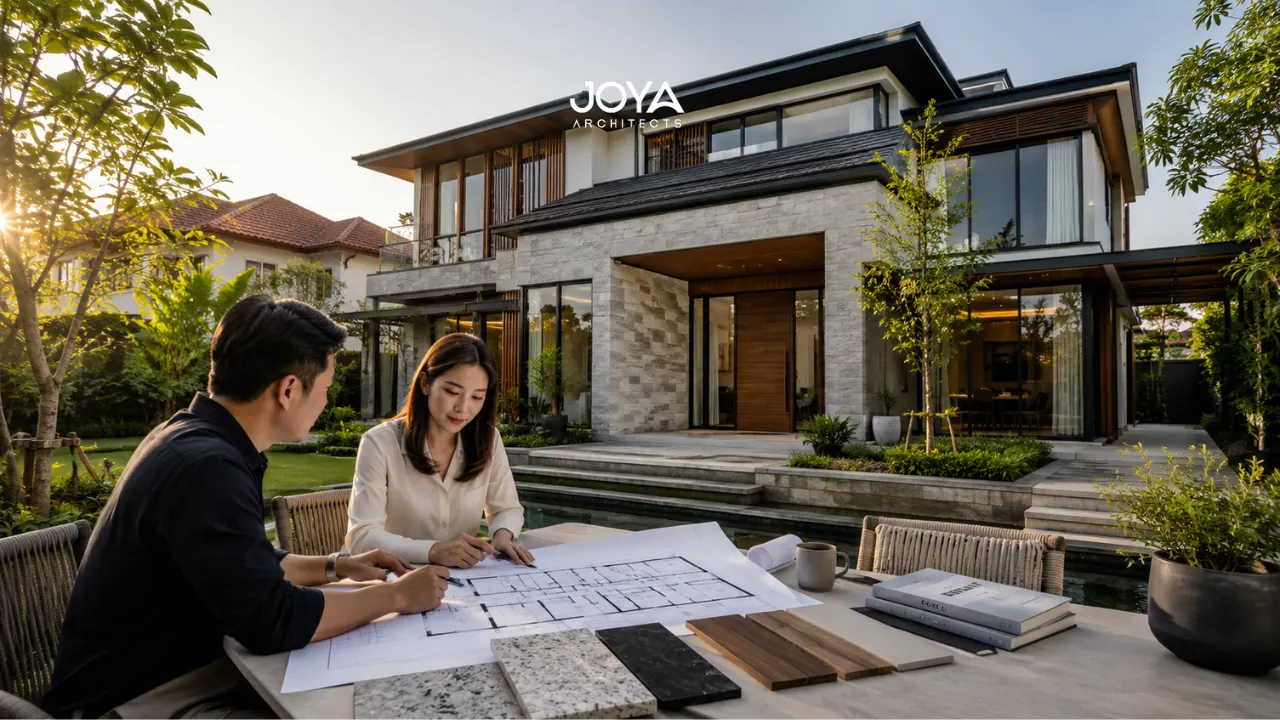
Every trend in residential design follows the same arc. It enters through aspirational references, peaks in widespread adoption, then begins to date precisely because it became widespread. For a condominium interior that can be re-skinned in six weeks, this cycle is manageable. For a landed house in Singapore, where structural decisions are embedded for decades, it is not.
Timeless landed house design is not a stylistic preference. It is a strategic one. Homeowners who build to a design moment pay the renovation toll multiple times across the life of their property. Those who build to a design principle tend to find that the home they created twenty years ago still functions with dignity, still attracts strong buyer interest, and still feels genuinely inhabited rather than preserved.
This distinction, between the moment and the principle, is the foundation of every architectural decision at Joya Architects.
Timeless landed house design is design that derives its coherence from underlying spatial and material principles rather than from the aesthetic language of a specific period. It is recognisable less by its “look” and more by the quality of its spatial experience: the way light enters a room, the proportion of a ceiling relative to its floor area, the honest performance of the materials underfoot and overhead.
Timeless design is not synonymous with minimalism, traditionalism, or any other stylistic category. A home can be decoratively expressive and still be timeless if the expression is rooted in principle rather than trend. What it cannot be is dependent on a specific cultural moment for its legibility. The moment passes. The home remains.
For Singapore’s landed market, this has particular relevance. The typical resale horizon for a landed property spans one or more renovation cycles. A home whose spatial character holds across that span maintains its buyer appeal and its premium positioning. One whose coherence depends on a design trend that has run its course requires intervention before it can be effectively repositioned.

Trend-led designs are not easy to identify at the time of construction because trends, by definition, feel contemporary in the moment of their adoption. The retrospective read is always clearer.
Several markers, however, tend to appear consistently in landed homes that age into their era rather than beyond it. Feature walls composed of a material treated as decorative rather than structural tend to date because the material choice was made for visual impact rather than honest performance. Spatial configurations that reference a specific lifestyle typology, the open-plan loft, the resort corridor, the boutique hotel lobby, tend to date when that typology falls out of cultural alignment.
Façade treatments that borrow from an architectural language without genuinely understanding its structural logic are particularly vulnerable. A façade articulated with applied decorative elements rather than structural expression creates a surface effect that becomes legible as decoration, and decoration ages faster than structure.
None of this is a criticism of aesthetic ambition. The issue is the relationship between form and logic. When form is derived from logic, it has a kind of internal authority that allows it to outlast specific cultural associations. When it is derived from reference, it remains dependent on the vitality of that reference.
The characteristics that produce timeless outcomes in Singapore landed homes are consistent across architectural practices with strong design positions. They do not reduce to a single aesthetic but share a structural commitment.
Spatial proportion is the most fundamental. A room whose ceiling height, floor area, and window placement are in genuine dialogue with each other creates an experience that reads as right across periods. Proportion is not a stylistic invention; it is a geometric relationship with deep cultural consistency. A well-proportioned room feels correct to inhabitants who have never studied architecture and to buyers who cannot articulate why they prefer one home to another.
The resolution of circulation is equally important. In a landed home, how you move through the building, how stairs are positioned, how levels relate to each other, and how outdoor and indoor space connect, is a structural decision that shapes daily inhabitation over the entire life of the home. Circulation that is logical and generous ages well. Circulation that was compressed for floor area or distorted to create a design effect creates friction that only becomes more pronounced over time.
Programme legibility, meaning the clarity with which each space declares its purpose and its relationship to adjacent spaces, contributes significantly to perceived timelessness. A home where it is obvious what each room is for and how it connects to the overall spatial narrative is a home where inhabitants and future buyers orient themselves with ease. That ease reads as quality.
The material palette in a timeless landed home tends to be narrow, honest, and internally consistent. This is not aesthetic conservatism. It is an understanding of how materials perform and age in Singapore’s tropical climate.
Materials used in their own logic, rather than as substitutes for something else, develop a patina that reads as intentional rather than neglected. Natural stone with consistent veining across surfaces creates a narrative of selection and quality. Structural concrete expressed honestly acquires a presence over time that applied renders cannot replicate. Timber specified for its actual performance characteristics in humid conditions, rather than its visual resemblance to a more expensive species, holds its structural and aesthetic integrity across decades.
The discipline lies in resisting the impulse to use materials as visual effects. Every material in a timeless home should be present because it performs its function honestly, not because it creates an impression of having done so.
Our bespoke timeless home design services approach material selection through this lens: what does the material actually do, how does it respond to Singapore’s climate, and what does it look like after ten years of honest use rather than immediately after installation?
Restraint in architectural design is often misunderstood as absence. It is more accurately understood as the decision not to add what is not necessary. A room that needs no additional complexity to function at its best has already been designed well. The instinct to add features, finishes, or formal gestures to such a room tends to reduce rather than enhance its quality.
This is where the long view is essential. A home that functions beautifully in plain light, with thoughtful materiality and generous proportion, does not require constant updating to remain appealing. It simply is what it is, and what it is continues to be sufficient. A home that depends on the quality of its decorative decisions for its appeal is only as good as those decisions remain in fashion.
The Singapore landed homeowner who thinks about their home across a thirty-year horizon, accounting for how their household will change, how the market will evolve, and what they will want to be true of their home at each resale moment, benefits directly from this architectural discipline. Timeless design is the longest-lever return on architectural investment available in this property type.
Timeless design is not inherently more expensive than trend-led design. The cost differential, where it exists, is in quality of specification rather than quantity of design complexity. A material palette that is narrow and high-performing in its category may cost more per square metre than a layered palette of lower-performing materials. Over the life of the home, however, the maintenance and replacement cost of the latter substantially exceeds the original premium.
Renovation cycles in Singapore’s landed market are driven largely by material fatigue and aesthetic dating. Homes with high-quality, honest materials and timeless spatial logic require fewer renovation interventions and maintain their appeal at each resale event without pre-sale remediation costs.
There is also a less quantifiable but real cost to trend-led design: the psychological friction of inhabiting a home that no longer feels current. Homeowners who build to a trend and later feel that the home does not represent them face a choice between living with that dissonance or investing in a renovation that restarts the cycle.
In Singapore’s landed resale market, buyers are discerning and compare across multiple properties before transacting. A home that reads as “of its period” in a way that has not aged gracefully signals several things: that maintenance decisions may have followed aesthetic fashion rather than material logic, that renovation investment will be required before the space can be inhabited comfortably, and that the design brief was trend-responsive rather than principled.
None of these signals increase buyer confidence or justify a premium. The outcome is either price negotiation to account for anticipated renovation costs, or reduced buyer interest in a property that commands a strong land price but a qualified built premium.
Timeless design removes this signal. A home that reads as spatially coherent and materially honest, regardless of the decade in which it was built, projects a different message: that decisions were made with long-term conviction rather than short-term reference.
Is timeless design the same as a particular architectural style? No. Timeless design is characterised by its spatial logic, material honesty, and proportional discipline, not by its aesthetic category. A home can be modernist, tropical contemporary, or classically influenced and still be either timeless or trend-dependent depending on the quality of its underlying design thinking.
How do I know if my brief is trend-led or principle-led? If the reference points in your brief are primarily images from current publications or social platforms, the brief is likely trend-responsive. If the reference points are qualities you want the home to possess, such as calm, clarity, warmth, longevity, the brief is moving toward principle.
Does timeless design mean avoiding features that feel contemporary? No. It means ensuring that contemporary design choices are grounded in spatial and material logic rather than being decorative responses to a cultural moment. Many contemporary design moves are genuinely principled; many are not.
What role does the architect play in guiding toward timeless outcomes? The architect’s role is to translate aspirational references into spatial and material decisions that produce the intended qualities without anchoring the design to a specific moment. This requires the discipline to distinguish between a quality and the stylistic convention that currently expresses it.
Timeless landed house design is not a conservative option or a safe default. It is an architectural position that requires genuine understanding of spatial logic, material performance, and the long view that a landed home in Singapore demands. The homes that endure, that hold their owner’s affection and their market premium across decades, are those where design principle outlasts design fashion.
For homeowners considering a landed build or major reconstruction, the question worth asking at the outset is not what the home should look like in the year of completion, but what it should still be true of that home in thirty years. Contact us now!