Joya Architects » Blogs » How Material Logic Affects Longevity and Maintenance in Landed Homes
Lifestyle Space Planning
How Material Logic Affects Longevity and Maintenance in Landed Homes
By achmad
2026-06-22 11:47:01
Most renovation spending in Singapore landed homes is not random. It follows a consistent pattern that, when traced back far enough, points to decisions made at the architectural and specification stage of the original construction. The external render that requires stripping and reinstatement was specified for appearance rather than for the performance requirements of Singapore’s climate. The bathroom tile installation that developed water ingress behind the substrate was detailed without adequate waterproofing system coordination. The timber flooring that warped and cupped in the ground-floor bedroom was installed without consideration of the humidity interface between the concrete slab and the air above it.These outcomes are predictable from the material logic embedded in the original design. They are not the result of bad luck or inadequate maintenance. They are the consequence of material systems that were not designed with longevity as a primary criterion, and they are therefore not preventable through maintenance alone once the original decisions have been made.This is the core argument for treating material logic as an architectural discipline rather than a specification afterthought: the long-term maintenance profile of a landed home is determined primarily by decisions made at the drawing stage, not by decisions made during the building’s operational life.
What Material Logic Means
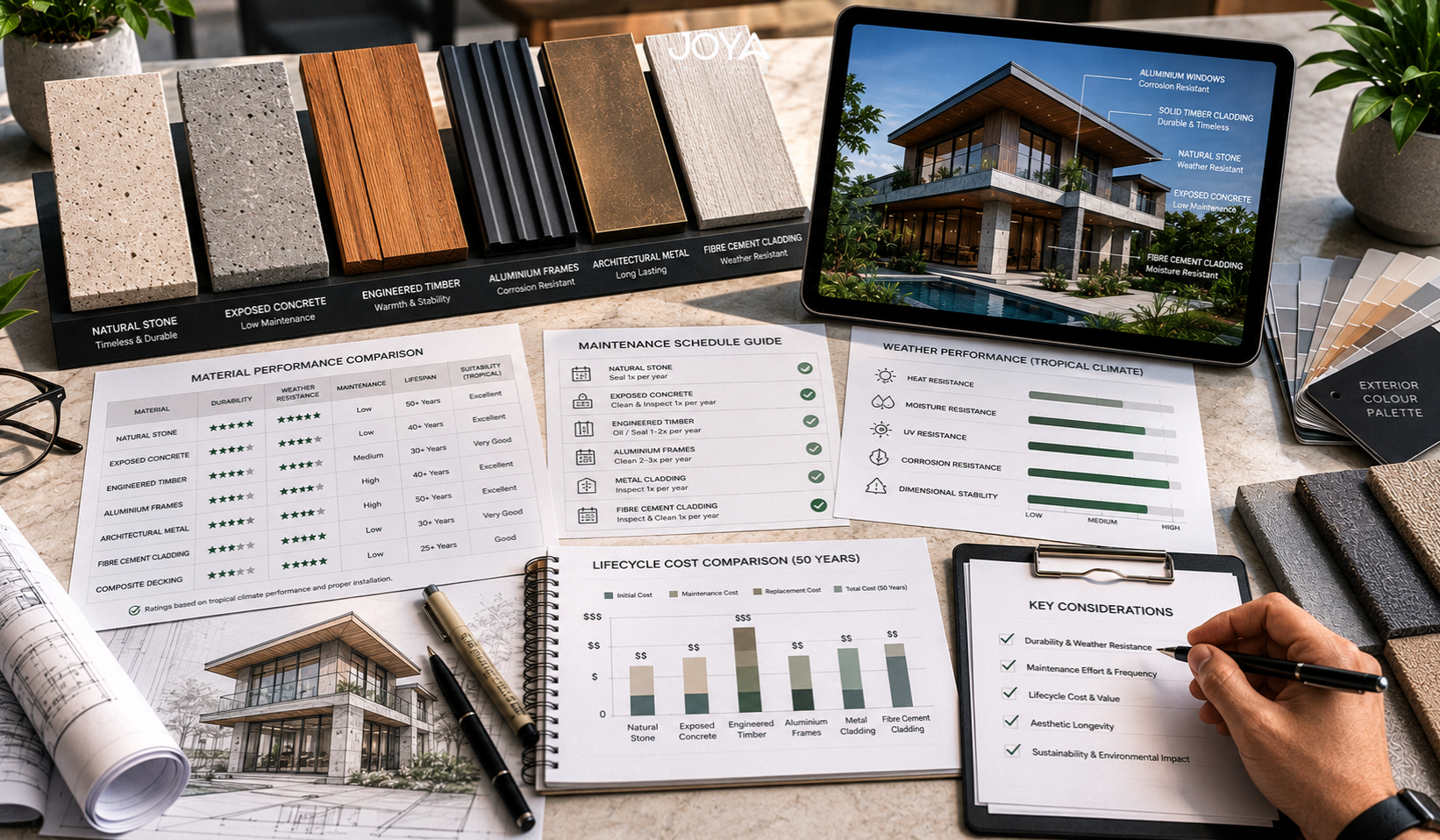
Material logic, in the context of architectural design for longevity, means selecting and deploying each material with a clear understanding of how it will perform across the full range of conditions it will encounter over the life of the building. It means specifying materials for their actual performance characteristics rather than their initial visual quality, and detailing their installation in ways that account for the movement, moisture exposure, thermal cycling, and maintenance access they will experience.Material logic is distinct from material quality. A high-quality material specified without understanding of how it performs in Singapore’s tropical climate will fail at a different rate from a lower-quality material but will still fail if the logic of its deployment is wrong. The expensive stone selected for an external terrace will delaminate from its bed if the adhesive system was not specified for the temperature and moisture cycling the terrace will experience. The premium timber floor will warp if the substrate moisture content was not adequately managed before installation.Conversely, a relatively standard material deployed with genuine understanding of its performance requirements and detailed accordingly can serve the life of the building without significant intervention. Rendered masonry on an external wall, painted with an appropriately specified coating system and detailed at corners and penetrations with adequate sealant allowance, can perform reliably for many years in Singapore’s climate. The same render system with inadequate corner detailing and an undersized expansion joint programme will crack, admit moisture, and require remediation within a few years.Material logic is therefore about the relationship between the material, its application, and the conditions it will face, not about the material in isolation.
How Singapore’s Climate Amplifies Material Decisions
Singapore’s tropical climate amplifies the consequences of material logic errors in ways that a temperate climate does not. The combination of sustained humidity, UV intensity, biological growth pressure, and thermal cycling creates a demanding and unrelenting material testing environment.In temperate climates, a detail that is marginally inadequate for moisture management may perform acceptably because the moisture load is seasonal and is followed by dry periods that allow evaporation and recovery. In Singapore, moisture load is continuous. A detail that admits moisture in a temperate climate will admit it continuously in Singapore, without the seasonal recovery that limits damage in cooler climates.Similarly, a surface coating with marginal UV stability may maintain its integrity for seven to ten years in a northern European climate where UV intensity is low and cold temperatures limit the biological degradation that compounds UV failure. In Singapore, the same coating may require replacement within three to four years because UV intensity is high year-round and biological growth colonises degraded coating surfaces rapidly.These amplifications mean that material specifications that would be adequate in other climates may be inadequate in Singapore, and that the gap between adequate specification and inadequate specification in terms of maintenance consequence is correspondingly larger. A decision that might be a minor inconvenience in a temperate climate becomes a significant operational burden in Singapore.
Exterior Performance Over Time
The exterior envelope of a Singapore landed home bears the full force of the tropical climate across the life of the building. Its performance, and the maintenance programme it requires, are determined by the material logic applied at the specification and detailing stage.External wall systems in Singapore landed homes fall broadly into two categories: applied render systems and cladding systems. Each has a distinct maintenance profile that is a function of its material logic.Applied render systems, where a cement-based or polymer-modified render is applied to a masonry substrate and finished with a paint system, are among the most common exterior wall treatments in Singapore residential construction. Their maintenance profile depends primarily on the quality of the render substrate preparation, the detailing of control joints and penetrations, and the specification of the paint system.Render systems with adequate control joint programmes, proper penetration flashing, and paint systems specified for Singapore’s UV and biological growth conditions can perform for seven to ten years between major maintenance interventions. Those without these provisions tend to develop cracking at weak points within three to five years, and once cracking admits moisture behind the render, remediation requires removal and reinstatement rather than surface repair.Cladding systems, including natural stone, brick, or panel-based claddings, have different maintenance profiles. Natural stone claddings properly bedded and jointed with appropriate movement allowance perform for the life of the building with periodic cleaning and occasional resealing. Brick is among the most maintenance-minimal exterior materials available in Singapore’s tropical context: well-laid brickwork with properly tooled mortar joints is biologically resistant, dimensionally stable, and requires no coating maintenance.Roof systems are among the most consequential material decisions in terms of longevity. A roof system that fails admits water across a large area of the building below it, and the consequences compound across the spatial and material systems the roof protects. Metal roof systems with adequate insulation, correctly designed condensation management, and appropriate fastener systems for Singapore’s thermal movement conditions are among the most reliable long-term performers. The quality of the installation, particularly the sealing of penetrations and the management of valley and ridge details, is as important as the material quality of the roof covering itself.
Interior Material Systems and Long-Term Stability
Interior material systems face different but still demanding conditions in a Singapore landed home. Air-conditioned interiors experience a significant humidity gradient between the external air and the conditioned space. This gradient drives moisture movement through the building envelope and creates specific performance demands at the floor, wall, and ceiling interfaces of conditioned spaces.Ground-floor concrete slabs in direct contact with Singapore’s soil interface carry a persistent moisture load that must be managed through the construction detail rather than through the material specification of the finished floor above. A damp proof membrane system of adequate specification, correctly installed at the slab level, is the foundation on which all ground-floor interior material systems depend for their longevity. A floor system installed over an inadequate or poorly installed membrane will eventually exhibit moisture-related failure regardless of the quality of the floor material.Internal wet areas, including bathrooms, kitchen areas, and laundry spaces, require waterproofing systems that are designed as integrated systems rather than as individual material specifications. The performance of a tile installation in a wet area is a function of the waterproofing membrane behind it, the adhesive system between it and the substrate, the grout and sealant at its perimeter, and the drain detail at the junction of the floor and wall waterproofing systems. Failure in any of these components compromises the system as a whole.The long-term material planning services that Joya Architects provides treat interior material systems as integrated performance systems rather than as sequences of individual specification decisions.
What Good Material Logic Looks Like Architecturally
Good material logic in a landed home is not visible as a specific aesthetic. It is visible as the absence of material failure over time and the consistency of maintenance burden with what was anticipated at the specification stage.A home built with good material logic has external walls that do not crack or delaminate within the first five years, roof details that do not admit water at any point across the first building cycle, and floor systems that do not exhibit moisture-related distress despite Singapore’s demanding ground-level humidity conditions.It has bathroom systems that perform without water ingress for fifteen or more years because the waterproofing detail was designed as a system and installed with the discipline that system requires. It has external decking that weathers consistently and predictably because the material was specified for its tropical performance characteristics rather than its visual resemblance to a material with poorer tropical performance.The architectural process that produces this outcome begins with a material performance brief: a systematic understanding of the climate conditions each material will face, the performance characteristics each material must deliver, and the detailing that must be executed to ensure those characteristics are realised in the installed building.This process is not more expensive than the absence of it. The cost of material logic is the cost of thinking at the specification stage. The cost of its absence is the maintenance and remediation cost borne across the operational life of the building.
The Cost of Wrong Material Logic
The financial consequence of material logic errors in a Singapore landed home compounds across the cycles of maintenance and remediation that wrong logic produces.An external render system with inadequate control joints may cost 10% to 15% less to install than one with properly designed expansion allowance. Within five to seven years, that system will require partial or full reinstatement at a cost that, in most cases, substantially exceeds the original saving. The remediation cost is not the material cost alone; it includes the scaffolding, the disruption, and the associated works required to make good the surfaces affected by the water ingress that the failed system admitted.A bathroom waterproofing system installed without adequate membrane detailing at the perimeter may not exhibit failure within the first five years. By the ten-year point, water ingress behind the tile installation will have compromised the substrate, and the remediation required is strip, reinstate waterproofing, re-tile: a work scope substantially more expensive than the margin saved by the original specification shortcut.These cost trajectories are predictable. They follow from the material logic decisions made at the architectural and specification stage. They are not preventable through maintenance once the wrong material logic has been embedded in the built structure; they are only preventable at the design stage.For Singapore landed homeowners who think about their homes across a twenty to thirty year ownership horizon, this is the most direct argument for engaging an architect whose material specification discipline is rigorous and whose design detail quality is consistently high. The architectural fee does not protect against renovation cost in any single event. It protects against the accumulated renovation cost of material systems that were not designed to last.
Frequently Asked Questions
How can I assess whether a contractor is applying good material logic in their specification? Ask them to explain the performance rationale for each major material decision, particularly for the external envelope and wet areas. A contractor who can articulate why each material system is appropriate for its specific location and climate exposure is applying material logic. One who specifies by reference to what is most commonly used or most economical without performance rationale is not.
Is it worth investing in better material logic for a property I intend to sell within ten years? Yes, for two reasons. First, material failure within the ownership period creates remediation costs and reduces the property’s condition for sale. Second, buyers in Singapore’s landed market are increasingly sophisticated about material quality and maintenance burden. A home with demonstrably low maintenance material systems commands a different level of buyer confidence at sale.
What are the highest-priority material logic investments in a Singapore landed home? The roof system, the external wall waterproofing and render detail, the ground-floor moisture management system, and the wet area waterproofing systems. These are the locations where material logic failure has the most consequential cascading effects on the home as a whole.
Can good material logic in the original build genuinely reduce renovation frequency? Yes, materially. Homes built with climate-appropriate material systems, properly detailed and installed, can complete fifteen to twenty years of use with maintenance that is predominantly cleaning and periodic sealing rather than the strip-and-reinstate remediation that dominates the renovation profile of homes with inadequate material logic.
Conclusion
The maintenance profile of a Singapore landed home is not primarily determined by how well it is cared for after occupation. It is determined by the material logic embedded in its design and construction. Material decisions made with genuine understanding of tropical climate performance, structural integrity, and long-term operational implications produce homes that are reliable and inexpensive to maintain across the full horizon of landed ownership.For homeowners in Singapore planning a landed project, this understanding has a direct practical implication: the specification stage is where long-term value is established, and the architect’s role in that stage is among the most consequential commitments of the entire project.