Joya Architects » Blogs » Honest Materials vs Decorative Finishes in Architecture: What Endures and What Doesn’t
Honest Materials vs Decorative Finishes in Architecture: What Endures and What Doesn’t
By achmad
2026-06-19 11:37:10
There is a principle in architectural practice, developed through the modernist tradition and traceable back to the Arts and Crafts movement, that holds that a material should be used in its own logic: for what it actually is, not for what it can be made to resemble. Concrete should read as concrete. Timber should be used where timber performs. Stone should be selected and placed for its structural and tectonic properties, not merely as a surface effect applied over a different structural substrate.This principle, variously called material honesty, truth to materials, or honest material expression, is not an aesthetic ideology. It is a design intelligence rooted in the observation that materials used in their own logic age more gracefully, require less maintenance, and produce a spatial quality that applied finishes cannot replicate.In Singapore’s tropical climate, where material performance is tested continuously by humidity, UV, and biological growth, this distinction between honest material expression and decorative finish application has real operational consequences. The decorative finish that looks sophisticated on installation may require replacement within five years. The honestly used structural material it was applied over may have served without intervention for fifty.
What Honest Materials Mean in Architecture
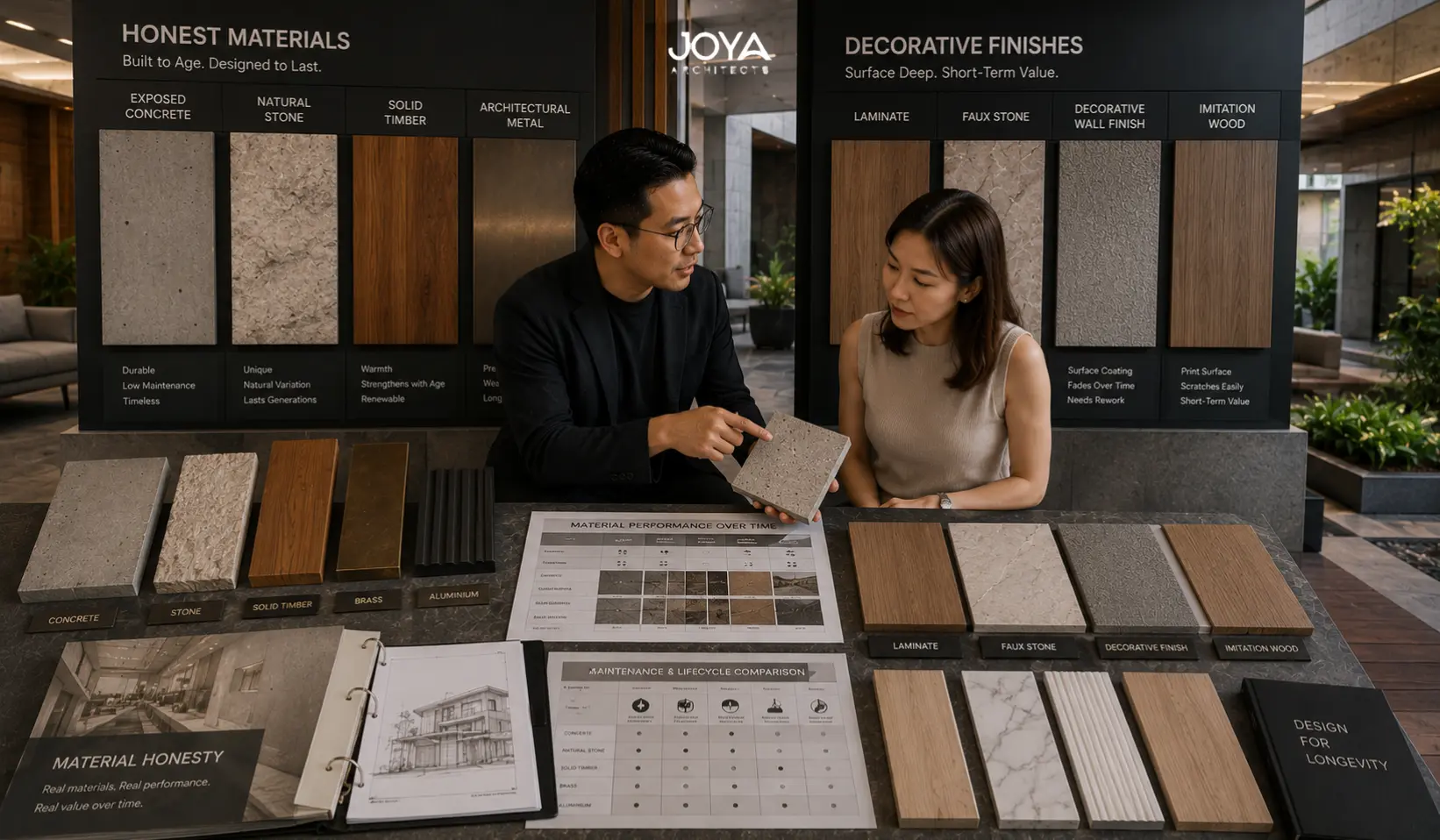
Honest materials architecture means using each material for what it genuinely does rather than for what it can be made to look like. Concrete expressed as the finished surface of a wall or column is being used honestly: it is structurally concrete and aesthetically concrete, and there is no gap between its structural truth and its aesthetic presentation. A thin concrete-look tile applied to a plastered partition wall is using the visual language of concrete without its structural honesty, and this gap tends to express itself over time in the fragility and dependence of the finish on the substrate it conceals.This is not a purist rejection of applied finishes in all circumstances. It is an argument for understanding the distinction and making material decisions with awareness of the consequence. A render applied to a structural wall to create a smooth surface is an honest use of render: it does not pretend to be the wall, it finishes it. A composite panel applied to resemble natural stone is a representation of stone: it uses the visual conventions of the material without its structural and tectonic reality.The architectural significance of this distinction lies in how each performs across time and climate. Materials in their own logic tend to age in ways that are consistent with their nature. Weathered concrete develops surface character. Exposed brick acquires patina. Structural timber weathers along its grain. These changes are legible as the material doing what materials do over time: they are not failures.Applied decorative finishes tend to age differently. They were specified for their initial appearance and their long-term performance is a function of the adhesion, flexibility, and UV resistance of their system. When these degrade, the finish fails: it peels, delamines, fades, or cracks in ways that read as a condition requiring remediation rather than a material with natural character.
The Decorative Finish Trap
The decorative finish trap is entered through the brief. Homeowners arrive with reference images of homes whose material character they admire: the warmth of natural timber, the solidity of stone, the restraint of concrete. The aspiration is for the quality those materials bring to a space. The temptation is to achieve that quality through the most accessible and economical interpretation, which is often a decorative finish that references the original material.Timber-look tiles can achieve the visual warmth of natural timber at lower cost and with higher moisture resistance in wet areas. This is a legitimate and sensible decision in specific contexts. The problem arises when the timber-look tile becomes the primary material system across the home, applied not because it performs best in each location but because it delivers a consistent visual reference to natural timber without the commitment of the original.Stone-effect porcelain on a kitchen wall is a different material from the stone it references: not worse in every dimension, but dishonest in the specific sense that it uses the visual language of stone without its structural and tectonic reality. Over time, this dishonesty tends to express itself in the quality of the space: it feels less settled, less materially resolved, and less capable of developing the patina that makes stone environments feel genuinely inhabited.The trap closes when the decorative finish requires replacement before the structural building element it was applied to has reached its service limit. The wall is sound; the finish is dated or failed. Remediation means removing and reinstalling a surface that was never part of the building’s structural logic to begin with.
Where the Philosophy Comes From
The principle of material honesty has a long intellectual history in architectural theory. It is most closely associated with the modernist movement of the early twentieth century, where it was articulated as a counter-position to the decorative historicism of nineteenth century architecture. The Bauhaus movement taught truth to materials as a fundamental design principle: materials should be used in their most honest form, selected and applied for their actual properties rather than as substitutes for other materials.Architects including Louis Kahn and Alvar Aalto built entire design philosophies around honest material expression. Kahn’s Salk Institute, constructed in board-formed concrete and teak, achieves its spatial quality through the honest use of two materials at their highest calibration. The concrete reads as concrete in every detail. The timber reads as timber. The combination produces a spatial quality that has not dated across six decades of international architectural discourse.This historical grounding is not offered as an argument for adopting a particular historical style. It is offered to demonstrate that the principle has been tested across time and climate, and that buildings which embody it consistently hold their spatial quality and their professional regard in ways that buildings built to the conventions of their period often do not.
How Honest Material Logic Applies to Singapore Landed Homes
The durable material selection process in a Singapore landed home applies the principle of material honesty through the specific lens of tropical climate performance. This produces a set of material recommendations that overlap substantially with the broad philosophical principle and are grounded in the specific demands of the environment.Exposed concrete is among the most climate-appropriate structural materials for Singapore’s tropical context. It is thermally massive, biologically resistant when adequately sealed, and does not absorb moisture in a way that causes structural degradation. When used as the finished surface of a wall, ceiling, or column, it requires no maintenance beyond periodic cleaning and avoids the delamination risk of applied render systems. Its aesthetic character in Singapore’s light, whether as board-formed surface texture or as smooth-cast material, is a genuine expression of its structural nature.Natural stone used in its own structural and tectonic logic, selected for appropriate density and porosity for its application, ages with a character that manufactured stone products cannot achieve. The veining and mineral variation of natural stone develops a richness over time that is the product of geological process rather than design specification. This richness is available to the material that is honest about what it is; it is not available to the composite that resembles it.Structural timber used for its actual structural and surface properties, rather than as a decorative appliqué, has a tectonic integrity that timber-look alternatives do not possess. In Singapore’s climate, the specification of the timber species, the treatment protocol, and the installation detail are the critical variables: properly specified and detailed structural timber in appropriate locations performs reliably and ages with genuine character.
The Maintenance Dimension
The maintenance argument for honest material expression is not simply philosophical. It is financial and operational, and it operates across the long horizon of a Singapore landed home’s life.A home whose material system is built on honest expression tends to have a maintenance profile characterised by periodic cleaning and occasional sealing of specific surfaces, without the remediation cycles associated with failing decorative finishes. The concrete wall that has developed a slight surface stain requires cleaning, not resurfacing. The stone floor that has worn slightly at the threshold requires polishing, not replacement. The exposed brick that has developed a moss patina in a shaded corner requires a biological treatment and cleaning, not a paint system.A home whose material system relies heavily on applied decorative finishes has a maintenance profile characterised by cycles of surface failure and replacement that are driven by the service life of the finish system rather than by the structural life of the building element beneath it. The paint system on a rendered external wall in Singapore requires recoating every three to five years under sustained UV and biological growth pressure. The composite cladding panel applied to resemble stone has a surface coating with a finite UV stability that, once exceeded, begins to fade and yellow in ways that require replacement rather than maintenance.These maintenance cycles are not unforeseen. They are predictable from the material specification and they have direct financial implications over the twenty to thirty year horizon of typical landed ownership in Singapore.
What Material Honesty Looks Like in Practice
Material honesty in a Singapore landed home does not produce a home that is stark, unfinished, or architecturally severe. It produces a home where every material has been chosen for what it genuinely contributes and where the combination of honest materials creates a spatial quality that is settled, authoritative, and deeply inhabitable.In practice, this looks like a living room where the floor is natural stone specified for its actual density and vein pattern, where the ceiling is smooth-formed concrete sealed to resist moisture, and where a single wall of structural timber panelling provides warmth against the restraint of the stone and concrete. Each material is present because it does something structurally and aesthetically appropriate to that space. None is present as a reference to something it is not.It looks like a bathroom where the wet zone is tiled in an unglazed natural stone with adequate porosity characteristics for its application, where the vanity top is the same stone continued as a single slab, and where the hardware is solid brass that will develop a patina rather than a plated brass that will wear through its surface coating.It looks like an external wall where the rendered surface has been designed with the render system as the honest finish, properly detailed at corners and penetrations, painted with a system appropriate for Singapore’s UV and biological growth conditions, and specified with the expectation that recoating is a maintenance event rather than a failure.
Frequently Asked Questions
Does material honesty mean I cannot use any applied or composite materials? No. It means that applied and composite materials should be used with awareness of what they are and what they can deliver, rather than as substitutes for materials they are not. A composite material specified for its own performance characteristics and aesthetic properties is a different proposition from one specified to simulate a more expensive or difficult-to-maintain material.
Is honest material expression more expensive than decorative finishes? At the point of installation, honest materials can be more expensive, particularly when natural stone or exposed structural concrete is the reference. Across the life of the building, the maintenance cost difference often offsets or reverses this premium, particularly in Singapore’s demanding tropical climate.
How does material honesty relate to the trend toward Japandi or minimalist interior styles? There is significant alignment, because both sensibilities favour materials used in their own logic and spatial compositions where the material palette is narrow and consistent. The difference is that material honesty is a principled position about how materials are used rather than a stylistic category, and it does not require adherence to any particular aesthetic convention.
What is the first material decision to get right in a Singapore landed home? The structural and exterior material system, because these decisions are permanent and the external materials face the most demanding climate conditions. Getting the exterior material logic right at the specification stage is significantly less expensive than correcting it post-construction.
Conclusion
The distinction between honest materials and decorative finishes is the distinction between design that serves a home’s long-term quality and design that serves its initial photography. In Singapore’s tropical climate, where material performance is tested continuously and maintenance decisions compound across decades, this distinction has direct financial and spatial consequences. The homes that age with the greatest dignity, and that continue to feel resolved and authoritative across years of inhabitation, are consistently those where material decisions were made with honesty about what each material is and what it genuinely contributes.Material intelligence is not a luxury quality. It is the foundation of architectural longevity.