Financing a Landed Rebuild or Renovation in Singapore
By achmad
2026-10-12 18:06:15
Financing a landed rebuild or renovation starts with matching the proposed works to an appropriate funding arrangement and a realistic cash-flow plan. Confirm the eligible costs, your contribution, drawdown conditions and repayment terms before making commitments that depend on borrowing.
A property value or an indicative loan amount does not establish that every project cost is funded. This guide explains the questions to take to a lender and your advisers; the suitable arrangement depends on your finances, property and approved project scope.
What official guidance says about CPF and affordability
CPF Board’s renovation guidance states that CPF savings cannot pay for renovation, improvement or repairs. Do not treat an Ordinary Account balance as available renovation cash.
There is a separate CPF route for building a house on vacant land, subject to conditions. Its application is submitted through a lawyer after the Temporary Occupation Permit, or TOP, is issued. Do not assume a rebuild qualifies or that this supplies funds during construction; obtain confirmation for your circumstances.
MoneySense’s affordability guidance also distinguishes borrowing limits from the need to meet upfront and ongoing expenses. A lender’s assessment is one input to the household’s decision, not a substitute for its full budget.
Financing a landed rebuild or renovation: define the scope first
Bring the lender a clear description of the works: internal refurbishment, additions and alterations, reconstruction or a new house. Ask which facility can support that scope and what technical information is required for assessment.
A construction facility may be relevant to substantial building works. For example, UOB’s home construction loan page describes financing for several landed-property scenarios and conversion to a home loan after TOP. This illustrates an available product structure, not a recommendation or a promise of eligibility.
For a smaller renovation, ask whether the proposed facility permits the actual works and covers the required amount. The product name alone does not establish that structural work, professional fees or owner purchases are eligible.
Separate the project budget from the loan amount
Prepare a cost schedule covering construction, consultants, investigations, authority charges, financing costs and temporary living arrangements. Mark which items the bank will fund and which require your own resources. Keep uncertain items visible instead of silently excluding them.
A purely illustrative S$1.2 million project with S$800,000 of confirmed project funding leaves S$400,000 to be sourced before allowing for anything omitted from that budget. The example is arithmetic, not a lending ratio or estimate for a particular house.
Review the wider landed-home budget planning framework before treating that difference as your final cash requirement. Existing debt, household expenses and separate reserves also affect what you can comfortably commit.
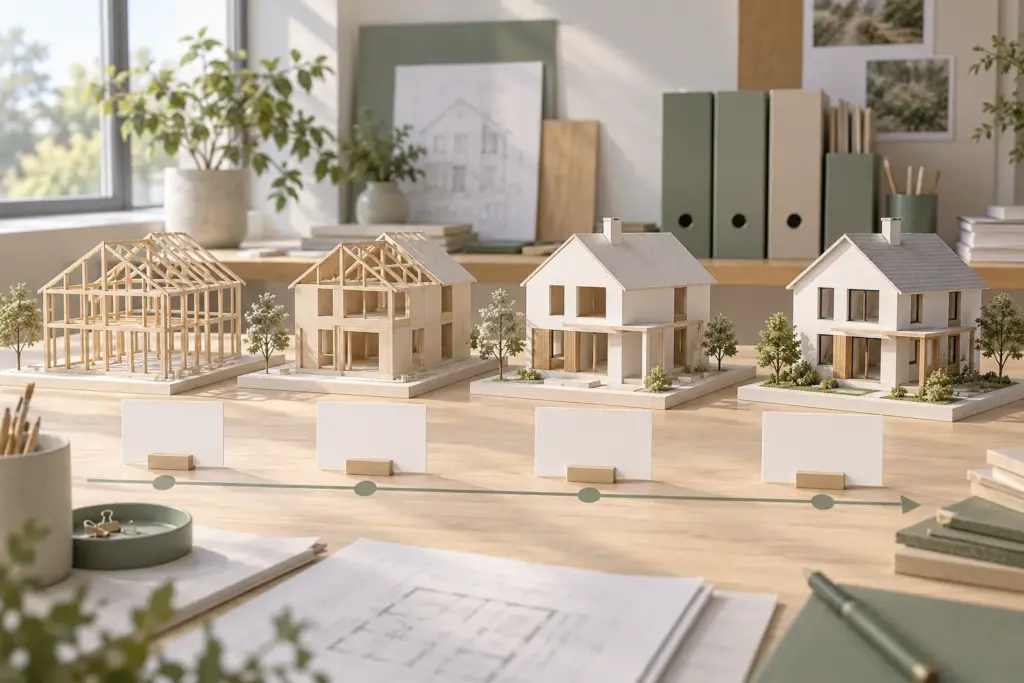
AI-generated conceptual illustration, not to scale; not an approved plan or completed Joya project.
Your landed home, your next step
Planning the budget for your landed home?
Your property, project scope and priorities shape the budget. Explore how Joya supports Singapore landed-home projects, from architectural design and submissions to construction.
A construction loan may release funds against specified evidence and conditions rather than transferring the whole amount at the start. Ask about your contribution, the first drawdown requirements, subsequent claims and the time needed to process complete documents.
UOB’s published construction checklist includes project documents and payment evidence for disbursement. Use it as an example of the questions to ask, while obtaining the current checklist and offer terms for your own facility.
Build a monthly funding schedule beside the contractor’s payment programme. If a payment is due before a drawdown can be completed, resolve the gap in advance. An approved facility can still require careful coordination of cash and paperwork.
Compare the whole borrowing arrangement
Ask for an explanation of the interest calculation, fees, repayment obligations and the conditions for moving from construction finance to a longer-term housing loan. Request repayment illustrations for both the building period and the period after completion.
If changing an existing mortgage is proposed, review outstanding obligations, possible exit costs, legal work and the effect on the new facility. Do not assume a higher future property valuation automatically produces additional money available now.
Compare offers using the same project assumptions and borrowing period. A headline rate can be less informative than the combined cost and flexibility under a realistic programme. Have the lender explain unfamiliar terms before you commit.
Test a delay and a cost increase
Run a scenario in which completion takes longer and some project costs rise. Recalculate rent, financing expenses, professional commitments and the amount of your reserve remaining. Ask what happens if the approved facility does not increase with the budget.
Also test reduced household income without relying on an anticipated bonus, asset sale or unapproved refinancing. The purpose is to see whether the plan remains workable when expected receipts arrive later or are lower than assumed.
The companion guide to common landed-home budget mistakes explains how exclusions and unrecorded commitments can distort this exercise. Update the funding plan when those assumptions change.
Prepare for the lender discussion
Assemble the property details, proposed scope, working budget, programme and existing loan information. Ask the lender for its documentation list and written clarification of eligible costs, drawdown conditions and repayment terms.
Discuss the architectural scope and programme with Joya so the project information supports that conversation. Confirm borrowing suitability with your lender or financial adviser, and CPF eligibility with CPF Board and your lawyer where relevant.
Frequently Asked Questions
Can CPF pay for a landed renovation?
CPF Board states that CPF savings cannot be used for renovation, improvement or repair works. Do not include your Ordinary Account balance as available renovation funding. If you believe a separate housing or construction provision applies, confirm the exact eligibility and process before relying on it.
Can I use CPF during construction of a new house?
CPF Board’s published vacant-land house-building route requires the application through a lawyer after TOP is issued. It should not be assumed to provide construction-period cash. Ask CPF Board and your lawyer how the conditions apply to your property, loan and intended use of savings.
Will a construction loan cover the entire project budget?
Not necessarily. The approved amount, eligible costs and drawdown conditions depend on the lender’s assessment and facility terms. Identify costs requiring your own funds, including any excluded services or expenses. Keep a separate allowance for uncertainty rather than assuming further borrowing will be available later.
What happens if construction finishes later than expected?
A longer programme can extend financing and living costs and affect the timing of loan conversion or other conditions. Review the offer terms with your lender before signing. Update the cash-flow forecast and confirm whether an extension requires approval, additional documents or further fees for your facility.
Your landed home, your next step
Discuss your landed-home plans
Tell us about your property, the work you are considering and your planning stage. Start a conversation with Joya about the next steps for your project.