Joya Architects » Blogs » Boutique vs Large Architectural Firms in Singapore: What Actually Matters for Your Landed Home
Architectural Process Guides
Boutique vs Large Architectural Firms in Singapore: What Actually Matters for Your Landed Home
By achmad
2026-07-02 10:00:23
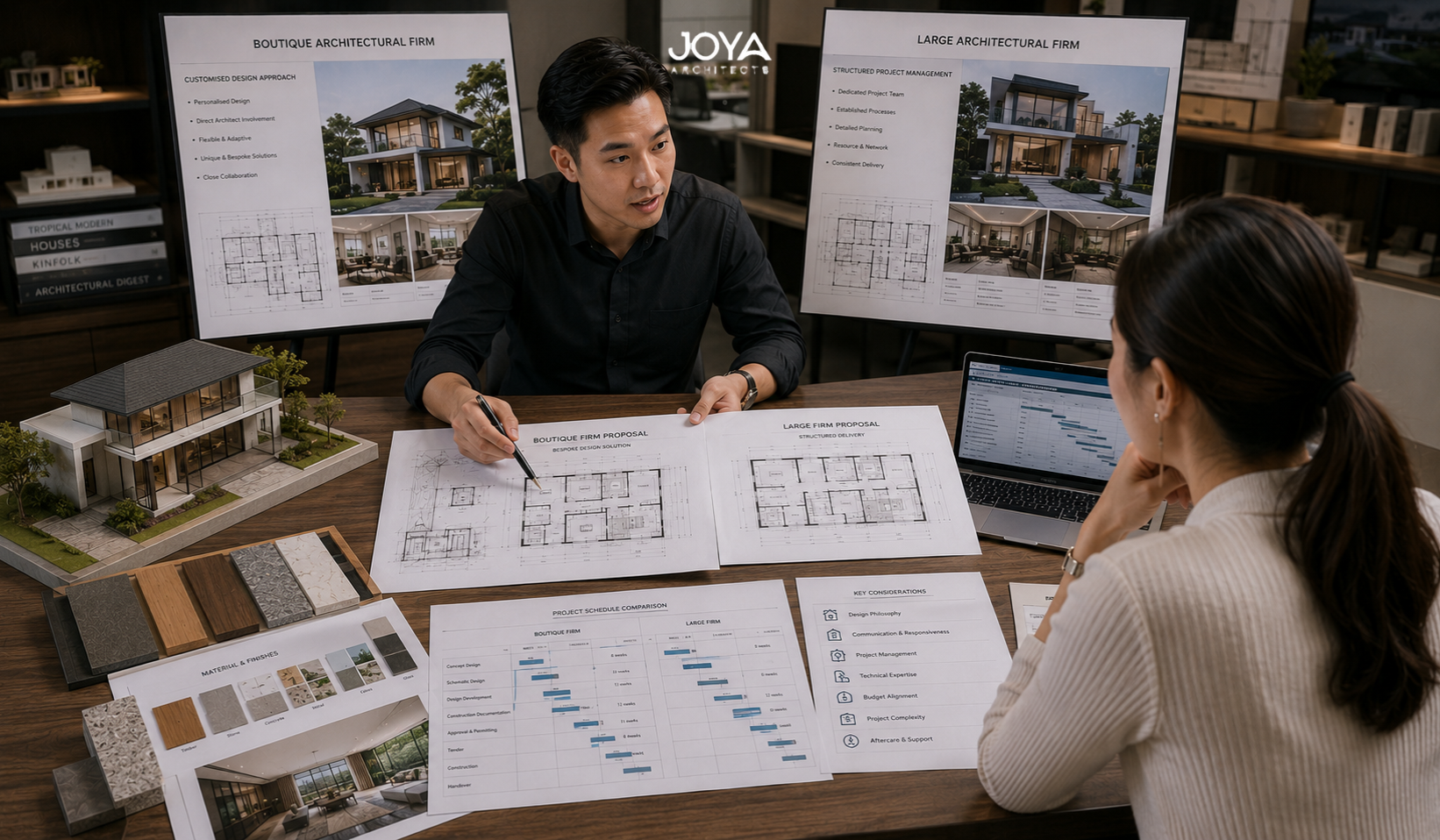
Singapore has architectural firms that range from solo practices to multinational studios with thousands of staff across dozens of offices. For a homeowner planning a landed house project, a new erection, a reconstruction, or major A&A works, the choice between a boutique practice and a large firm is one of the most significant decisions in the engagement process. The differences are real, structural, and directly relevant to design quality, accountability, and the homeowner’s experience of the project.This guide explains what boutique and large architectural firms in Singapore actually offer, where they differ, and which is better suited to private landed residential projects.
What Defines a Boutique Architecture Firm
A boutique architecture firm is defined not by its size per se but by its operational model: the principal architect, the founding or senior architect whose expertise and design sensibility define the firm’s identity, is directly and continuously involved in client work. In a genuine boutique practice, the principal leads every project from the first client consultation through design development, construction documentation, authority submissions, and construction supervision.This model produces a specific set of characteristics. Clients deal with the most experienced person in the firm, not a relationship manager. Design decisions are made by the person best equipped to make them. The design intent embedded in the early concept has a single custodian throughout the project. And the firm’s reputation depends directly on the quality of every project, because the principal’s name is attached to every outcome.
What Happens in Larger Architectural Firms
Larger architectural firms in Singapore are structured to manage multiple projects simultaneously across diverse sectors. Their organisational model is necessarily hierarchical: partners and directors lead client relationships and high-level design direction; project architects manage design development and documentation; junior architects and graduates handle detail drawings and production. Site supervision is often managed by separate construction administration teams.For large-scale commercial, institutional, and public sector projects, where project complexity, regulatory requirements, and team coordination demands exceed what a small practice can resource, this model is appropriate and effective. For private landed residential design, where the quality of the home depends on the sustained attention of a single experienced design mind, the model has structural limitations.
The Principal Involvement Question
The single most important question to ask any architectural firm, boutique or large, about a landed home project is: who will be involved in my project, at what stages, and in what capacity?In a boutique practice, the honest answer is typically: the principal architect who met you today will lead your project from first brief to construction handover. In a larger firm, the honest answer is more nuanced: the senior architect or director who met you today will set the design direction for the concept; a project architect will develop the design and manage documentation; construction administration may be handled by a separate team. The senior architect remains available for key milestones but is not the day-to-day presence on your project.Neither model is inherently wrong. But for a landed home whose spatial quality, material precision, and architectural coherence depend on sustained design intelligence, the boutique model’s principal continuity is a meaningful advantage.
Portfolio Depth and Specialisation
Large architectural firms in Singapore are typically generalist practices, their portfolio spans commercial, retail, hospitality, institutional, and residential sectors. This breadth is appropriate for clients seeking a firm with multi-sector capability, but it means landed residential design is one of many competencies rather than a deep specialisation.Boutique practices that specialise in Singapore landed residential architecture accumulate specific expertise that generalist firms cannot match: detailed knowledge of URA’s landed housing planning parameters; experience managing A&A works on specific property types; relationships with contractors who specialise in residential quality construction; and design sensibilities refined by years of working at the scale and intimacy of the private home.
Fee Structures and Value
Fee structures vary between boutique and large firms, but the relationship between fee level and value delivered is not straightforward. Some large firms apply a premium based on brand recognition rather than project-specific value. Some boutique practices price at a premium that reflects their principal’s expertise and reputation. Others price more modestly but deliver exceptional quality.The more useful comparison is scope-adjusted value: what does the fee include, who is delivering the services, and what is the track record of the firm on comparable projects? A boutique practice whose fee reflects full principal involvement across design, documentation, and supervision may represent better value than a larger firm whose comparable fee supports a team model in which the senior architect’s involvement is intermittent.
When a Larger Firm Might Be Appropriate
There are circumstances where a larger firm’s breadth of capability is genuinely relevant to a landed home project. Projects that involve complex mixed-use components, a home integrated with a commercial or workshop space, a property with significant landscape and civil engineering requirements, or a historically significant property requiring heritage consultant coordination, may benefit from the multi-disciplinary resources a larger practice can access.For the vast majority of Singapore landed home projects, new erections, reconstructions, and A&A works, the boutique principal-led model delivers more consistent design quality and greater accountability.Joya Architects is a principal-led boutique practice specialising exclusively in Singapore private landed residential architecture. Every project is personally led by the principal architect from first brief to construction handover. Explore their principal-led boutique architectural practice.
Frequently Asked Questions
Are boutique architecture firms more expensive than larger ones?
Not necessarily. Fee levels depend on the scope of services, the reputation and experience of the practice, and the complexity of the project, not on the size of the firm. In fact, boutique practices with lower overhead than large firms sometimes price more competitively for comparable service scope.
Do large architectural firms provide better regulatory knowledge?
Not inherently. Singapore’s landed housing regulatory framework (URA, BCA, SCDF) is well-understood by experienced practitioners in both boutique and large firms. What matters is whether the architect handling your specific project has deep experience in landed residential submissions, regardless of the firm’s size.
What should I look for in a boutique architecture firm’s portfolio?
Consistency of quality across multiple projects; evidence of principal architect involvement in projects at your scale and type; completed homes that demonstrate the design sensibility you are looking for; and verifiable client references from recent projects.
Conclusion
For Singapore landed homeowners, the boutique vs. large firm decision is ultimately a question about who will be responsible for the quality of your home. A boutique principal-led practice offers direct accountability, continuous design intelligence, and specialisation that generalist large firms cannot replicate. Evaluate every firm on its specific proposal for your project, not on its brand or its headcount, and choose based on who will actually be designing and supervising your home.