



Why do some rooms feel instantly calming and “right,” while others feel chaotic or “off,” even if they’re filled with expensive furniture? The answer isn’t magic—it’s design.
Behind every beautiful, functional, and comfortable space is a set of time-tested rules. These are the 7 key principles of interior design.
Think of these principles as the grammar of a language. You can put words together, but without grammar, the message is confusing. Similarly, you can put furniture in a room, but without these principles, the space won’t feel cohesive.
Whether you’re planning a renovation or just want to understand why you love certain spaces, mastering these concepts is the first step. These are the exact tools that professional architects and designers use to transform a simple house into a truly remarkable home.
Let’s explore each one.
Balance is all about distributing the “visual weight” of objects in a room to create a sense of stability and harmony. It’s the anchor that makes a space feel grounded.
Rhythm is the “music” of interior design. It’s a visual pattern that guides your eye through the space, creating a sense of movement and flow. Without rhythm, a room can feel static.
You can create rhythm through:
Harmony is the ultimate goal: the feeling that all the elements in a room belong together and work in concert. Unity is the result of achieving harmony.
When a space has harmony, nothing feels out of place or jarring. This is achieved by linking all the other principles. The colors, materials, furniture style, and lighting all share a common thread or theme. This doesn’t mean everything must match—that’s boring. It means they must coordinate to tell a single, clear story.
Every great room has a star. The principle of emphasis is about creating a focal point—one area or object that draws the eye and anchors the design. A room without a focal point can feel scattered.
Common focal points include:
All other elements in the room should play a supporting role, helping to frame and draw attention to this main feature.
Contrast is the “spice” of interior design. It’s what prevents a room from feeling flat or monotonous. It creates visual interest and energy by placing opposite elements next to each other.
You can introduce contrast in many ways:
This is one of the most important (and often missed) principles.
Professionals often use mathematical concepts like the Golden Ratio (a ratio of 1:1.618) to create proportions that are naturally pleasing to the human eye.
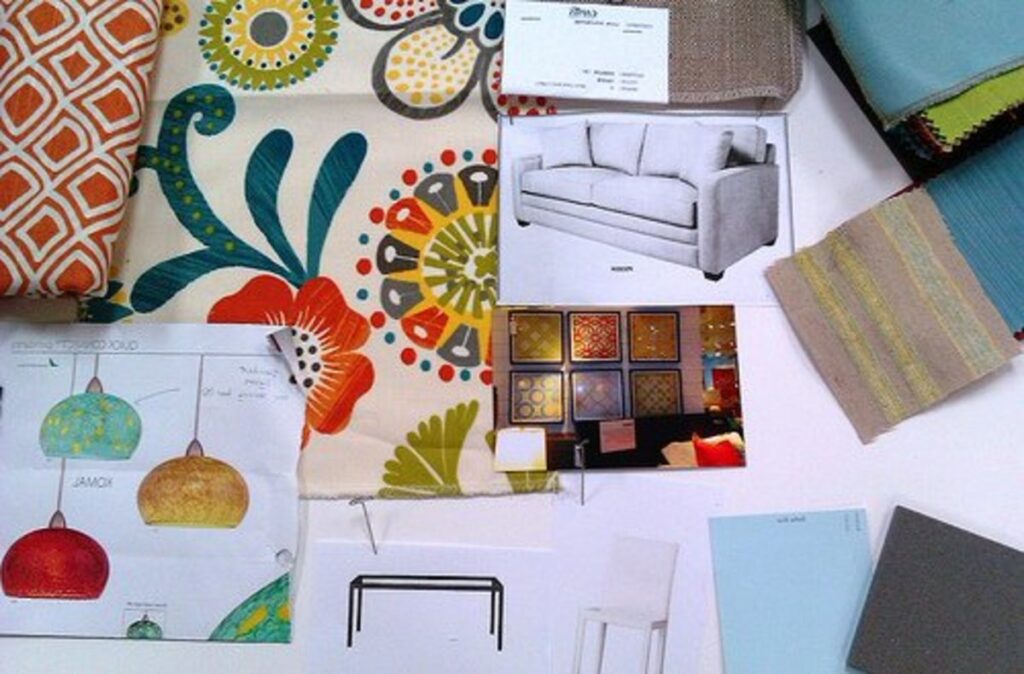
Texture is the secret weapon of sophisticated design. It refers to the tactile quality of a surface—how it feels, or looks like it would feel. It’s what adds depth, warmth, and complexity.
A room that only uses smooth, flat surfaces (like plain painted walls, a simple cotton-weave sofa, and a metal table) will feel cold and one-dimensional, even if the colors are great.
Mix your textures:
Pattern acts as a visual texture, adding another layer of life. By layering different textures and patterns, you create a rich, inviting space that engages all the senses, not just the eyes.
Interior design trends come and go. One year it’s “Coastal Grandma,” the next it’s “Maximalism.” These fads can be fun, but they are fleeting.
The 7 principles, however, are timeless.
They are the underlying structure that makes any style—whether minimalist, traditional, or eclectic—actually work. A professional architect doesn’t just copy a trend; they use these principles to interpret a style in a way that is balanced, harmonious, and perfectly scaled for your specific home.
Understanding these 7 key principles—Balance, Rhythm, Harmony, Emphasis, Contrast, Scale, and Texture—is the first step to creating a truly exceptional space. They are the essential tools that separate a room that is simply “decorated” from one that is truly “designed.”
While it’s empowering to know the rules, applying them to create a single, cohesive vision is a complex art. It requires a trained eye to see how all the pieces fit together.
At JOYA Architects, we live by these principles.
We specialize in designing private landed homes in Singapore where every single element works in perfect harmony. Our approach goes beyond trends to create timeless, functional, and beautiful spaces that are a true reflection of you.
Contact JOYA Architects today to schedule a consultation and begin your design journey.