When you hear “industrial design,” your mind might immediately go to exposed brick walls, steel pipes, and concrete floors. While that’s part of the story, it’s not the whole story. This popular look is just one facet of a much deeper, more powerful concept: architectural industrial design.
This term is often misunderstood. It’s not just an aesthetic; it’s a sophisticated
process and hybrid discipline. It represents the intersection of two powerful fields: architecture (the design of space and place) and industrial design (the design of products and systems).
Understanding this fusion is key to unlocking spaces that aren’t just visually striking but are also impeccably functional, efficient, and deeply human. It’s a philosophy that changes how we build, from the macro-scale of a skyscraper to the micro-detail of a door handle.
Here, we’ll explore what architectural industrial design truly is, how it’s different from the “industrial style” you see on TV, and how its core principles can create a superior modern home.
The Common Misconception: Industrial Style vs Industrial Design
To understand what architectural industrial design
is, we must first clarify what it
is not. The biggest point of confusion lies between the
look and the
process.
What is Industrial Style (The Look)?
This is the popular interior design aesthetic most people are familiar with. It’s a “look” inspired by 19th and 20th-century factories, warehouses, and industrial spaces.
Key features of the
industrial style include:
- Exposed Elements: Bare brick walls, visible metal beams, exposed ductwork, and ventilation pipes.
- Raw Materials: A heavy use of concrete, metal, and unfinished or reclaimed wood.
- Open Spaces: High ceilings and large, open-concept floor plans that mimic factory lofts.
- Neutral Palette: A color scheme built on gray, black, white, and earthy browns.
This style is about
aestheticizing the functional elements of old buildings, often through adaptive reuse (like turning a warehouse into a loft).
What is Architectural Industrial Design (The Process)?
This is something far more profound.
Architectural industrial design is a methodology—a way of thinking and problem-solving. It’s a hybrid discipline that applies the rigorous, human-focused, and system-based logic of industrial design to the creation of buildings and spaces.
It’s defined not just by
what it looks like, but by:
- How it’s designed: Prioritizing the user’s experience above all.
- How it’s made: Using manufacturing logic for precision and efficiency.
- Why it works: Focusing on functionality and system integration.
In short, while industrial
style is a decorative choice, architectural industrial
design is a deep, functional philosophy.
The Core Principles: Where Product and Place Collide
At its heart, this hybrid discipline borrows core principles from industrial design and scales them up to an architectural level. This is where the true value lies for a modern home.
1. User-Centered Design (UCD): Designing for People
Traditional architecture can sometimes focus on the architect’s singular “vision.” Architectural industrial design, by contrast, starts with
empathy for the end-user. It’s a process that “places the needs and preferences of end-users at the center” of every decision. It replaces guesswork with data, asking:
- How will this space actually be used every day?
- What are the user’s pain points?
- How can the design make their life easier, healthier, and more enjoyable?
2. Ergonomics and Human Factors: A Perfect Fit
This principle is “the study of human fit.” It uses the science of anthropometry (measuring the human body) to ensure a space is perfectly tailored to its occupants. In your home, this translates to:
- Kitchen counters at the perfect height to reduce back strain.
- Hallways with enough space for comfortable movement.
- Light switches placed in the most intuitive locations.
It’s a “human-fit” approach that ensures the home works
for the body, not against it.
3. Design for Manufacturing (DfMA): Precision and Quality
This is the principle of thinking like a manufacturer. By applying DfMA logic, architects can leverage off-site construction and prefabrication. For a homeowner, this means:
- Higher Quality: Components built in a controlled factory setting are more precise than those built on-site in unpredictable weather.
- Faster Construction: Less time on-site means less disruption.
- Less Waste: Manufacturing is more efficient and sustainable.
4. Honesty of Materials: Form Follows Function
This principle bridges the
process back to the
aesthetic. In industrial design, materials are chosen for their performance. Their “look” is secondary to their function.
This leads to an “honesty” in the design—if a steel beam is needed for support, it’s left exposed and celebrated for its strength. This is why the industrial
look is so raw: it’s a direct result of a philosophy that avoids ornamentation and lets materials speak for themselves.
A Legacy of Innovation: Where This Idea Comes From
This hybrid thinking isn’t new. It was pioneered by 20th-century masters who refused to see a boundary between a product and a building.
- The Bauhaus (1919-1933): This legendary German school sought to “unify individual artistic vision with the principles of mass production.” They designed everything from chairs and light fixtures to the school buildings themselves with the same integrated philosophy.
- Charles and Ray Eames (1940s-1970s): This iconic duo is the pinnacle of the practice. They designed molded plywood furniture, toys, and films. Their architectural masterpiece, the Eames House (Case Study House #8), was a revolutionary experiment in building a home “using pre-fabricated materials ordered from industrial… catalogs.” It was a system, not just a house.
- Jean Prouvé & High-Tech (1950s-1970s): French designer Jean Prouvé was a manufacturer who “transferred manufacturing technology… to architecture.” This philosophy culminated in the High-Tech style, seen in buildings like the Centre Pompidou in Paris, which famously exposes its entire structure, ventilation, and circulation on the outside like a “factory aesthetic.”
What Architectural Industrial Design Looks Like Today
Today, these principles are more relevant than ever and are being pushed to new heights by technology.
- Prefabrication and Modular Homes: In dense urban areas like Singapore and across Southeast Asia, modular buildings are seen as a critical solution to housing challenges. They are a direct descendant of Jean Prouvé’s dream of factory-made houses, offering speed, quality, and cost-effectiveness.
- Smart, Sustainable Homes: Modern smart homes are a perfect example of architectural industrial design. They integrate lighting, climate, and security into one seamless system focused on the user’s experience and energy efficiency.
- Bespoke Components & Kinetic Facades: This philosophy scales down to the smallest detail and up to the entire building envelope.
- Micro-Architecture: As architect Juhani Pallasmaa said, “the door handle is the handshake of the building.” This is the “first moment our bodies engage with a house.” Designing a door handle is a serious act of micro-architecture.
- Kinetic Facades: On a larger scale, buildings like the Al Bahr Towers in Abu Dhabi feature dynamic “smart” facades that open and close in response to the sun, actively managing the building’s climate like a responsive product.
Bringing the Industrial Design Ethos to Your Home
You don’t need to build a factory-made house to benefit from this powerful philosophy. You can apply the
principles of architectural industrial design to any private home to create a space that is profoundly better.
- Prioritize Function First: Before you think about finishes, think about flow. How will you use this space every single day? Design for your life, not for a magazine.
- Embrace Material Honesty: Let materials be themselves. The natural grain of wood, the cool smoothness of polished concrete, the strength of a steel accent—these elements bring a timeless, honest character to a space.
- Invest in “Micro-Architecture”: Pay attention to the things you touch every day. The weight of a door handle, the solid click of a light switch, the smooth glide of a cabinet drawer. These tactile points of contact define the quality of your daily experience.
- Think in Systems: Consider your home as one unified system. How do the lighting, storage, and spatial layout work together? A well-designed system is seamless, intuitive, and simply works.
A New Standard for Modern Living
Ultimately, architectural industrial design is far more than an aesthetic trend of exposed brick and metal. It is a rigorous, human-centric philosophy. It’s the “why” behind the “what”—the reason a space
feels right.
It is a commitment to creating spaces that are not just beautiful, but are also functional, efficient, and deeply aligned with the people who inhabit them.
At JOYA Architects, we specialize in designing private landed homes in Singapore that are both beautiful and impeccably functional.
We believe that great design is born from a deep understanding of the people who live in it. We apply the principles of precision, user-centered design, and material honesty to create timeless homes that truly work for you.
Contact JOYA Architects today to start designing a space that is truly built for you.
Have you ever been in a room that looks stunning but feels impractical for daily life? Or a space that’s beautiful on Instagram but awkward to actually live in? This is a common disconnect where aesthetics are prioritised over the actual human experience. The bridge between a beautiful space and a truly liveable home is a powerful methodology: design thinking.
At its core, design thinking is a human-centered problem-solving process that puts people first. It’s a shift from asking “How should it look?” to asking “How will it be lived in?” For architects and designers, it provides a structured framework to move beyond trends and create spaces that are not only beautiful but also deeply functional, personal, and meaningful.
This guide will break down the 5-step design thinking process in interior design and show you how it transforms a house into a home that genuinely supports and enhances your life.
What Exactly is Design Thinking in Interior Design?

While the term originated in the world of product design and tech innovation, its principles are perfectly suited for creating private homes. What is design thinking in interior design? It’s a structured approach to solving problems by understanding the user’s needs and developing solutions to meet those needs. It’s less about a specific style and more about a specific mindset.
Beyond Aesthetics: A Focus on the Human Experience
Traditional design can sometimes focus heavily on the visual outcome—the colour palette, the furniture selection, the material finishes. Design thinking goes deeper. It prioritises the human experience within the space. It considers your daily routines, your emotional responses, your frustrations, and your moments of joy. The goal is to design a home that actively improves your quality of life, not just one that looks good in photographs.
It’s Not a Rigid Formula, It’s a Flexible Mindset
The five steps of design thinking—Empathize, Define, Ideate, Prototype, and Test—are not a rigid, one-way street. Think of it as a flexible, iterative cycle. Insights from the “Test” phase might send the design team back to the “Ideate” phase to brainstorm new solutions, or even back to “Empathize” to better understand a newly discovered need. This flexibility ensures the final design is thoroughly considered and refined, reducing the chance of costly mistakes or post-renovation regrets.
The Core Goal: Solving Problems for the People Who Inhabit a Space
Every home has problems, whether it’s a lack of storage, poor natural light, or an awkward layout that disrupts family flow. Design thinking frames these issues not as flaws in the house, but as problems to be solved for the people living there. It transforms the role of a designer from a decorator to a creative problem-solver, dedicated to making your space work seamlessly for you and your family.
The 5 Core Steps of Design Thinking in Interior Design
To make this process clear, we’ll follow a single, relatable example through all five steps: a client who is struggling with the new reality of working from home.
Step 1: Empathize – Understanding the People, Not Just the Space
The first and most crucial step is Empathize. The goal here is to gain a deep, empathetic understanding of your lifestyle, daily routines, habits, frustrations, and emotional needs. It’s about listening to what is said and observing what is unsaid.
- Methods: This involves in-depth interviews, observing how you currently use your space, reviewing inspiration materials like your Pinterest boards, and repeatedly asking “why” to uncover the root motivations behind your requests.
- Practical Example: A designer from JOYA Architects meets a client who works from home and says they feel constantly stressed and unproductive. A traditional approach might be to simply ask where they’d like a desk. The design thinking approach is to Empathize. Through conversation and observation, the designer notices the client’s “home office” is the dining table—a high-traffic area with poor lighting and constant interruptions from family members. The stress isn’t just about work; it’s about the lack of separation between professional and personal life.
- Tools to Use: Client Questionnaires, User Personas, Empathy Maps.
Step 2: Define – Pinpointing the Right Problem to Solve
The Define stage is where you synthesize the findings from the empathy stage into a clear, actionable problem statement. This is critical because it reframes the challenge in a human-centric way, ensuring you’re solving the right problem.
- Methods: This involves analysing observations and identifying specific pain points. Common pain points include a “lack of division between work and life,” “no dedicated storage,” or “inadequate task lighting.”
- Practical Example: The problem isn’t simply “the client needs a home office.” Based on the empathy stage, the problem is much deeper. The defined problem statement becomes: “How might we create a designated, organized workspace that promotes focus during the day and allows for a clear mental separation from personal life when work is over?” This statement opens the door to far more creative solutions than just placing a desk in a corner.
- Tools to Use: “How Might We…” Questions, Pain Point Analysis.
Step 3: Ideate – Generating a Spectrum of Creative Solutions
With a clear problem defined, the Ideate stage begins. This is a judgment-free brainstorming phase focused on generating a wide range of ideas. The goal is quantity over quality at this point, encouraging diverse and creative possibilities.
- Methods: Brainstorming sessions, sketching multiple floor plans, mind-mapping the functions a single room could serve, exploring unconventional materials, and even considering “wild ideas” that push the boundaries.
- Practical Example: For our work-from-home client, the design team might ideate several solutions to the “How Might We…” statement:
- A custom-built desk and shelving unit in an unused alcove.
- A convertible “cloffice” (a closet that transforms into an office), which can be closed up at the end of the day.
- Using a stylish folding screen or sliding partition to visually separate the workspace.
- Designing a multi-functional piece of furniture that serves as a console table by evening and a desk by day.
- Tools to Use: Mind Maps, Sketching, Brainstorming Sessions.
Step 4: Prototype – Visualizing and Making Ideas Tangible
The Prototype stage is where ideas become tangible. A prototype is a low-cost, scaled-down representation of a potential solution. This crucial step helps everyone visualize the solution and test its viability before committing significant time and money to construction.
- Methods & Technology: Prototypes in interior design can range from simple to high-tech. They include scaled 2D floor plans, physical mood boards with material samples (wood, tiles, fabrics), and increasingly, digital tools like 3D renderings or even Virtual Reality (VR) walkthroughs that allow you to “stand” in the space.
- Practical Example: The designer decides the “cloffice” concept is the most promising solution. They create two prototypes:
- A simple 3D rendering showing how the closet doors open to reveal a functional workspace.
- A mood board with samples of the proposed paint colours, desktop material, and lighting fixtures for the client to see and touch.
- Tools to Use: Mood Boards, 2D Floor Plans, 3D Rendering Software (e.g., SketchUp, Foyr Neo), Painter’s Tape (for mapping furniture layouts on the floor).
Step 5: Test – Gathering Feedback, Learning, and Refining
Finally, the Test stage involves presenting the prototypes to you, the client, to gather feedback. This is not about selling an idea; it’s about co-creating the best solution. It’s a critical loop that validates or invalidates ideas and ensures the final design truly works.
- Methods: This could involve walking you through the 3D renderings, letting you feel the material samples, and asking targeted questions like, “How does this flow feel to you?” or “Can you imagine yourself comfortably working here for several hours?”
- Practical Example: The client views the “cloffice” rendering. They love the space-saving concept and the ability to “close away” work. However, by seeing the 3D model, they realize they need more legroom than the initial design allows. This is invaluable feedback. The designer makes a quick adjustment in the prototype, increasing the depth of the desk area. This small change, identified early, prevents a major construction issue and ensures the final built-in is perfect.
- Emphasis on Iteration: This feedback might lead the process back to the Ideate or Prototype stage, but that is a sign of success. It means the process is working to refine the design before it’s too late.
Design Thinking vs a Traditional Design Process: What’s the Difference?
Understanding the distinction highlights why this human-centered approach is so effective for creating personalized homes.
Problem-Finding vs Solution-Jumping
- Traditional Process: Often starts by presenting solutions. A designer might ask, “What style do you like? Scandinavian? Industrial?” and then build a design based on that aesthetic.
- Design Thinking: Starts with problem-finding. The first question is not about style, but about life. “What does your morning routine look like? What is the most frustrating part of your current kitchen?” It digs deep to find the real problem before any solution is even considered.
Collaborative & Iterative vs Linear & Presentational
- Traditional Process: Can be linear. The designer has an initial consultation, goes away to create a design concept, and returns for a “big reveal” presentation. Feedback at this stage can be difficult and costly to implement.
- Design Thinking: Is fundamentally collaborative and iterative. You are part of the process at every stage, from defining the problem to testing prototypes. The constant feedback loop ensures the design evolves with your input, eliminating surprises.
Focus on “Why” vs Focus on “What”
- Traditional Process: Often focuses on “what.” For example, “You need a bigger sofa.”
- Design Thinking: Always asks “why.” “Why do you feel you need a bigger sofa?” This might reveal the real need isn’t a larger piece of furniture, but a better layout to facilitate family conversation, leading to a much more effective and creative solution.
The Tangible Benefits of This Approach for Homeowners
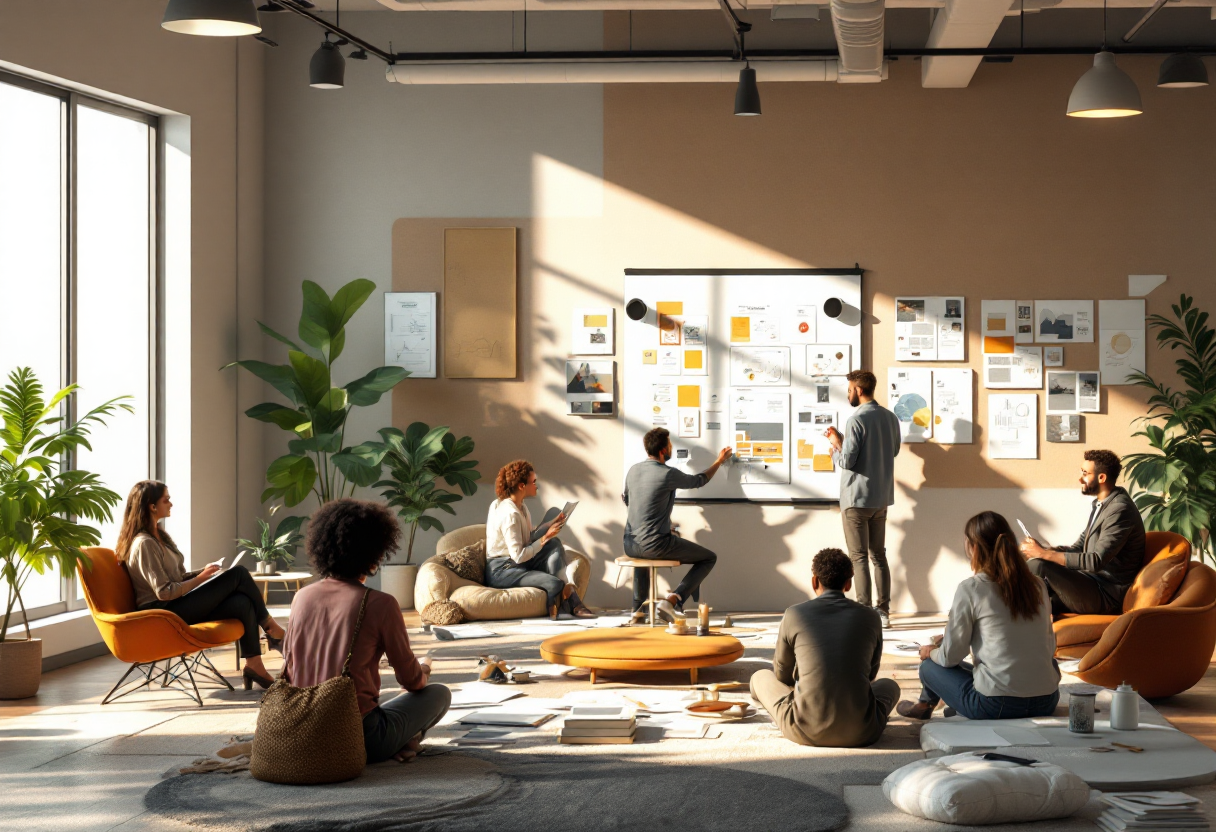
Adopting a design thinking methodology isn’t just a philosophical choice; it delivers real, tangible benefits that you will appreciate for years to come.
Get a Final Space That Truly Fits Your Life and Habits
Because the entire process starts with a deep understanding of you, the outcome is a home that is custom-fit to your lifestyle. It’s the difference between a house that you adapt to and a home that is adapted for you, making everyday life more seamless and enjoyable.
Reduce the Risk of Costly Changes and Post-Project Regrets
The “prototype and test” phases are designed to catch issues when they are just ideas on paper or pixels on a screen. Identifying that a layout feels cramped or a material isn’t right before orders are placed or walls are built saves you immense stress, time, and money.
Feel Empowered and Heard Throughout a Collaborative Process
Design thinking demystifies the design process and makes you an essential collaborator. You are not just a client receiving a service; you are a co-creator in the journey of shaping your home. This empowerment leads to a greater sense of ownership and satisfaction with the final result.
Achieve More Innovative and Personalized Design Solutions
By focusing on your unique problem statement (“How might we…”), design thinking pushes beyond generic, trend-based solutions. It encourages creativity and can lead to truly innovative features or layouts that you may have never considered, resulting in a home that is uniquely yours.
How to Apply Basic Design Thinking to Your Own Home Project
Even if you’re not undertaking a major renovation, you can use these principles to improve your own space.
Empathize with Yourself
For one week, keep a “home diary.” Use a notebook or your phone to jot down small moments of frustration or joy in your space. Examples: “Always tripping over shoes at the entryway.” “The afternoon sun in the living room is beautiful but creates too much glare on the TV.”
Define Your Core Problem
Look at your diary and pick the biggest frustration. Turn it into a “How might I…” question. For instance, the shoe problem becomes: “How might I create an organized and efficient system for shoes at the entryway so it’s no longer a cluttered drop-zone?”
Ideate with No Limits
Grab a piece of paper or open Pinterest and brainstorm every possible solution to your question. For the entryway, this could be anything from a slim shoe cabinet, a vintage bench with storage underneath, wall-mounted racks, or even a custom-built solution. Don’t filter your ideas yet.
Create a Simple Prototype
You don’t need fancy software. The simplest prototype is painter’s tape. Want to see if a 30cm-deep console table will fit in your entryway? Tape its dimensions out on the floor. This low-cost prototype immediately tells you how it will impact the walkway.
Test Your Solution
Live with your painter’s tape prototype for a few days. Walk past it. See how the new flow feels. Does it make the space feel too tight? Or does it confirm that you have enough room? This simple test will give you the confidence to either buy the furniture or go back to the ideation stage, having spent nothing.
Conclusion
The five steps of design thinking—Empathize, Define, Ideate, Prototype, and Test—provide a powerful framework for creating spaces with intention and purpose. This methodology transforms the role of an architect or interior designer from simply delivering a “look” to facilitating a collaborative journey that results in a truly human-centered home.
By focusing on your life, solving your unique problems, and testing solutions before they are built, what is design thinking in interior design becomes clear: it is the most reliable path to creating a home that is not just designed to be looked at, but is perfectly designed to be lived in.
Ready to create a space that’s designed not just to be looked at, but to be lived in? Contact our team at JOYA Architects to learn how we apply the design thinking process to every project.