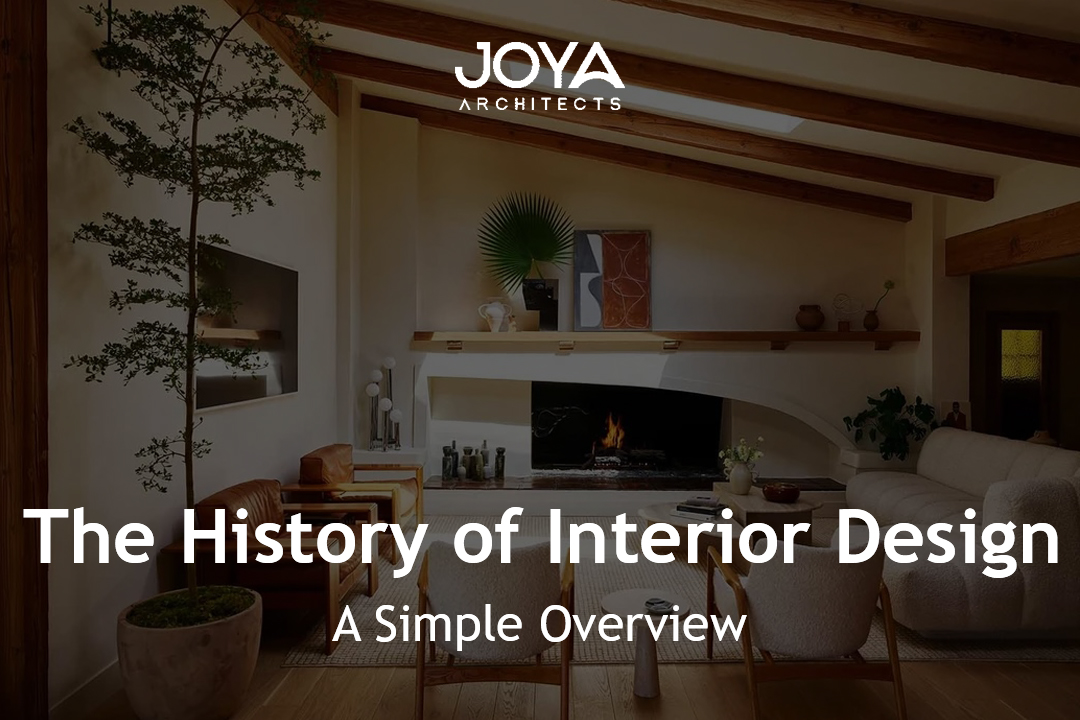
Interior design can feel like a very modern concept—a world of trends, showrooms, and TV makeovers. But the truth is, the desire to shape our indoor spaces is as old as humanity itself.
The history of interior design is not just a history of
styles. It’s the story of our own evolution. It’s about how we, as humans, have steadily transformed our shelters from basic caves for survival into complex homes that represent our identity, status, technology, and well-being.
At its core, interior design is the act of shaping our interior world to better suit our lives. That story, which spans millennia, gives context to every design decision we make today.
Here is a simple overview of how our interiors evolved.
Ancient Beginnings: Function, Status, and Afterlife
The earliest “interiors” were prehistoric caves, where paintings weren’t just decoration but held spiritual or ritualistic meaning. But the first true “designers” emerged with the great ancient civilizations.
- The Egyptians (c. 3100 BCE): The Egyptians were masters of status. For the pharaohs, their palaces—and more importantly, their tombs—were furnished with intricate pieces, murals, and sculptures. Their designs were highly symbolic, meant to reflect their divine status and provide for them in the afterlife.
- The Romans (c. 753 BCE – 476 CE): While the Greeks focused on the perfection of exterior architecture, the Romans were masters of interior comfort and luxury. They were engineers of comfort, pioneering technologies like the hypocaust—an early form of underfloor heating. Their homes featured vibrant mosaics, detailed murals (frescoes), and purpose-built furniture, all designed to showcase wealth and facilitate a life of leisure.
The Renaissance (c. 1400-1600): The Rebirth of Beauty
After the darker, more survival-focused Middle Ages, the Renaissance in Europe sparked a “rebirth” of art, culture, and humanism. Architects and artists—often the same person, like Michelangelo—began to think systematically about interior spaces again.
The focus shifted to light, proportion, and classical details. This was the era where design became a true profession, intricately linked with architecture. Beauty and human experience, not just function, became the primary goal.
Baroque & Rococo (c. 1600-1770): Opulence and Playfulness
- Baroque (c. 1600-1750): If you’ve ever seen the Palace of Versailles, you understand Baroque. This style was all about drama, grandeur, and power. Driven by the Catholic Church and absolute monarchs, interiors were overflowing with ornate gold, heavy, dark woods, and large-scale murals designed to inspire awe.
- Rococo (c. 1730-1770): Rococo was a reaction to the heavy self-importance of Baroque. It was lighter, more intimate, and more playful. This style moved into the aristocratic home, favoring pastel colors, asymmetrical curves (like seashells), and more delicate, human-scale furniture.
The Victorian Era (c. 1837-1901): The Industrial Revolution
This era is one of the most important turning points in design history. Why?
The Industrial Revolution.
For the first time, furniture and decorative items could be mass-produced. This meant that interior design was no longer just for the super-wealthy. The emerging middle class could now afford to decorate their homes.
The Victorian style is defined by this new accessibility. The philosophy was “more is more.” Rooms were filled with dark, ornate furniture, heavy drapes, and countless trinkets, all meant to display new-found wealth. This was also the era that sparked the first “anti-design” movement,
The Arts & Crafts (led by William Morris), which rebelled against the poor quality of mass production and championed a return to handmade craftsmanship.
The Birth of Modernism (c. 1920s-1960s): “Form Follows Function”
Modernism was not a single style; it was a revolution. It was a complete and total rejection of the Victorian clutter. Driven by a new machine age, designers believed a new, “honest” way of living was needed.
- The Bauhaus (1919-1933): This German art school changed the world. Its philosophy was to unite art and industrial manufacturing. They championed clean lines, simple geometric forms, and industrial materials like steel, glass, and concrete. The famous motto “Form follows function” emerged, arguing that an object’s design should be dictated by its purpose, not by useless ornamentation.
- Mid-Century Modern (c. 1940s-1960s): This is the style that truly brought modernism into the average home, especially after WWII. Designers like Charles and Ray Eames, Eero Saarinen, and Arne Jacobsen created iconic, functional furniture. This style is defined by organic shapes, open-plan living, and a deep connection to the outdoors with large windows—a direct ancestor of most modern homes today.
Today: The Contemporary Era
So, where are we now? The
Contemporary era isn’t one single style but a blend of many, defined by a few key values:
- Minimalism: The “less is more” philosophy, a descendant of modernism.
- Sustainability: A focus on eco-friendly, natural, and recycled materials.
- Biophilia: The belief that humans have an innate need to connect with nature, leading to more natural light, indoor plants, and organic materials.
- Technology: Smart homes, integrated lighting, and new high-performance materials.
Conclusion: Our Homes, Our Story
The history of interior design is a mirror of our own. It shows our evolution from seeking basic shelter to creating highly personal sanctuaries that speak to our status, our beliefs, and our well-being.
From a Roman mosaic to a sleek Mid-Century chair, every element in our homes is part of this long, fascinating story. The goal, which has remained unchanged for thousands of years, is to shape the spaces we live in to better shape our lives.
At JOYA Architects, we are students of this rich history—but we are designers of your future.
We understand the timeless principles of light, form, and function that have been perfected over centuries. We apply them to create private landed homes in Singapore that are not just reflections of a style, but are the perfect foundation for
your personal story.
Contact JOYA Architects today to start designing your timeless home. Chat on WhatsApp with +65 9192 0393.