An interior design process flow chart is the definitive roadmap that guides a project from a client’s initial thought to a fully realised, livable space. Embarking on an interior design project, especially for a private landed home in Singapore, can feel complex and overwhelming. With numerous decisions, timelines, and stakeholders to manage, the potential for chaos is high. That’s where a structured, repeatable system becomes invaluable. At JOYA Architects, we believe that a seamless process is the foundation of exceptional design.
This guide provides a clear, step-by-step breakdown of each phase, transforming a potentially stressful journey into a predictable, collaborative, and successful design workflow for both our team and our clients.
A well-defined process isn’t just administrative, it’s a strategic tool that ensures clarity, manages expectations, and ultimately, leads to a better-finished home. It translates creative vision into a tangible, actionable plan.
Think of an interior design process flow chart as a visual master plan. It outlines every critical stage, decision point, and deliverable in a logical sequence, from the first conversation to the final handover. It’s a shared map that ensures everyone involved—the architect, the interior designer, the client, and the builders—knows where they are, where they are going, and what is required to get there successfully. This structured approach is central to our ethos, creating a seamless transition between architecture and interiors.
For an integrated design practice like ours, a standardised workflow is non-negotiable. It is the bedrock of our service quality.
- Ensures Consistency and Quality: A documented process guarantees that every project, from a Good Class Bungalow to an inter-terrace home, receives the same high level of rigour and attention to detail. It creates a baseline for excellence.
- Improves Efficiency and Project Management: By defining tasks, deliverables, and timelines for each phase, the flow chart streamlines project management. It prevents bottlenecks, reduces rework, and ensures resources are allocated effectively.
- Sets Clear Expectations and Professional Boundaries: The chart clearly defines the scope of work and decision-making authority at each stage. This professional framework builds trust and fosters a respectful, collaborative relationship with the client.
For a homeowner, building or renovating a home is a significant emotional and financial investment. Our process is designed to provide complete peace of mind.
- Demystifies the Design Process: We break down a complex undertaking into manageable, understandable phases. This transparency reduces client anxiety and empowers them to engage confidently in the process.
- Clarifies Client Responsibilities and Decision Points: The flow chart highlights key moments where client input and approval are essential, such as signing off on the concept design or finalising material selections. This ensures clients feel involved and in control.
- Helps in Understanding Timelines and Budget Allocation: Clients can clearly see how the project will progress and how costs are associated with each phase, from initial design fees to final procurement and construction costs.
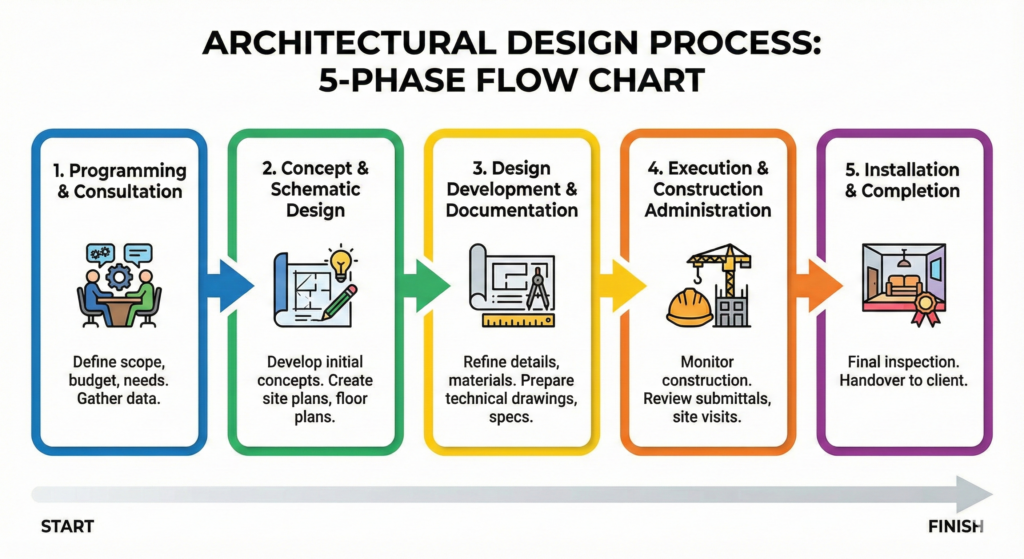
At JOYA Architects, our integrated interior design practice follows a proven 5-phase model. This systematic progression ensures every detail is considered, from the broadest architectural strokes to the finest interior finishes, resulting in a home that resonates as a unified whole.
This is the most critical discovery phase, where we lay the groundwork for the entire project. The goal is to deeply understand the “why” behind the “what.”
- Key Activities: We begin with a client discovery meeting and a thorough lifestyle analysis to understand your daily routines, family dynamics, and aspirations. We then define the project scope, establish a preliminary budget and timeline, and conduct a detailed site visit with measurements and photographic documentation.
- Key Deliverables: This phase concludes with a signed letter of agreement, a comprehensive project brief, a programming report detailing all requirements, and initial “bubble diagrams” that map out spatial relationships and flow.
- Designer’s Role vs. Client’s Role: Our role is to ask insightful, probing questions. The client’s role is to provide open, honest information about their needs, lifestyle, design desires, and budget realities.
- Tools of the Trade: Detailed questionnaires, laser measuring tape, a high-resolution camera, and collaborative note-taking apps like Notion or Evernote.
With the foundation set, this is where the creative vision begins to take shape. We translate the programming data into a tangible design direction.
- Key Activities: Our team brainstorms creative solutions tailored to your brief. We gather inspiration, develop mood boards to establish the aesthetic, and create initial space plans and furniture layouts (known as test fits) to explore possibilities.
- Key Deliverables: We present a written Concept Statement that articulates the core design idea, physical and digital mood boards visualising colour palettes, materials, and textures, and 2-3 schematic floor plan options for review.
- Designer’s Role vs. Client’s Role: We present compelling, well-reasoned creative concepts. The client’s role is to provide clear and decisive feedback on the overall direction that resonates most with them.
- Tools of the Trade: Pinterest for collaborative inspiration, architectural magazines, SketchUp for initial 3D massing, and Adobe Photoshop or Canva for creating polished mood boards.
This phase is about refinement and detail. We take the approved schematic concept and develop it into a fully specified, buildable design.
- Key Activities: We refine the approved floor plan and begin selecting all specific materials, finishes, and fixtures (FF&E). This includes sourcing furniture, bespoke joinery design, and lighting selection. We then create a comprehensive set of detailed technical drawings.
- Key Deliverables: The output is a robust set of documents including detailed floor plans, interior elevations, reflected ceiling plans, an FF&E specification schedule, photorealistic 3D renderings, and a refined, itemised cost estimate.
- Designer’s Role vs. Client’s Role: We meticulously specify every single item and produce the technical drawings required for construction. The client’s role is to provide final approval on all selections and the detailed budget.
- Tools of the Trade: Professional software is key here. We use AutoCAD and Revit for technical drawings, specialised FF&E software like Fohlio, and advanced 3D rendering engines such as V-Ray or Enscape.
This is where the design on paper becomes a physical reality. Our role shifts to project liaison and quality control, ensuring the design intent is executed flawlessly.
- Key Activities: We manage the procurement and ordering of all FF&E items. We coordinate closely with contractors, builders, and tradespeople through regular site visits, and we actively problem-solve any on-site challenges that arise.
- Key Deliverables: We issue purchase orders, manage a detailed project timeline (Gantt chart), provide regular site visit reports to the client, and respond to contractor RFIs (Requests for Information).
- Designer’s Role vs. Client’s Role: As the designer, we act as the client’s representative, ensuring quality and adherence to the plans. The client’s role is to stay informed through our updates but to channel all communication and direction to contractors through us to avoid confusion.
- Tools of the Trade: Project management software like Asana, robust communication tools, and punch list applications for quality control checks.
The final, exciting phase where the house truly becomes a home. It’s the culmination of months of careful planning and execution.
- Key Activities: We oversee the delivery and installation of all furniture. The final layer of styling and accessorising is meticulously executed. We then conduct a final, detailed walkthrough with the client to present the completed space.
- Key Deliverables: The primary deliverable is the completed, styled home. We also provide a “punch list” (or snag list) documenting any minor items needing rectification and a client handover package with all warranties and care instructions for finishes and appliances.
- Designer’s Role vs. Client’s Role: We execute the final vision, ensuring every piece is perfectly placed. The client’s role is to perform the final review, provide the punch list feedback, and formally sign off on the project completion.
- Tools of the Trade: A detailed installation checklist, a professional styling kit, and a high-end camera for capturing portfolio-worthy photographs of the finished project.
A truly exceptional client experience extends beyond the five main design phases. At JOYA Architects, we place immense emphasis on professional onboarding and thoughtful offboarding to build lasting relationships.
The foundation of trust is laid before Phase 1 even begins. From the moment a potential client reaches out, our process is designed to be clear, professional, and reassuring. This starts with the initial inquiry call, where we listen carefully to understand the preliminary needs. Following this, we send a detailed welcome packet that introduces our firm, our philosophy, and our process in greater detail. This packet sets the stage for the paid initial consultation, which is not just a meeting but a structured, value-added working session. This rigorous pre-project phase ensures that by the time we formally engage, both parties have a crystal-clear understanding of the goals and how we will achieve them together, establishing a tone of professionalism and partnership from day one.
Our relationship doesn’t end when you receive the keys. A successful project handover is just as structured as its beginning. The process involves sending the final, transparent invoice and a complete handover package with all necessary documentation. We then formally request a testimonial or review to gather valuable feedback on our process. Most importantly, we schedule a post-occupancy evaluation 3-6 months after project completion. This allows us to visit the home once our clients have truly lived in it, ensuring everything is performing as designed and addressing any latent issues. This final step underscores our long-term commitment to our clients’ satisfaction and the enduring quality of our work.
A structured interior design process flow chart is the essential backbone of any successful project. It is far more than a checklist, it is a strategic framework that provides clarity, drives efficiency, and ensures peace of mind for both the design team and the client. By breaking down a monumental task into five manageable phases—from foundation to final reveal—this workflow acts as a reliable roadmap, expertly navigating the journey of transforming a client’s unique vision into a beautiful, functional, and enduring reality. It is the discipline behind the design that allows creativity to flourish within a predictable and professional structure.
Ready to transform your space with a process you can trust? The first step to a beautifully realised home is a clear plan. Let’s discuss how our proven design workflow can bring your vision to life. For a complimentary initial discussion, WhatsApp us at +6591920393 today.